


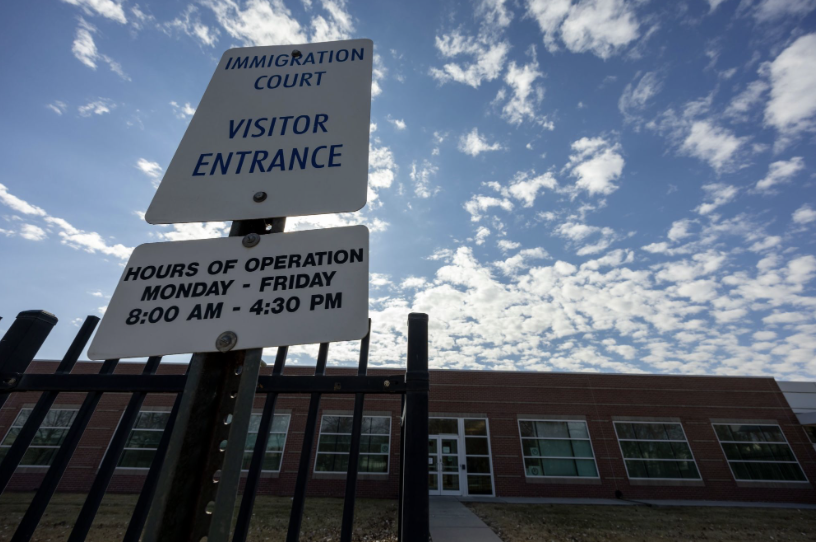
Chaos and confusion
Omaha's Immigration Court is backlogged, overwhelmed with language barriers and policy changes.
Jordy guzzled Monster energy drinks and chewed gum in an attempt to stay awake on his drive from California into the nation’s heartland on a chilly February day.
He sometimes tried to nap during the 22-hour road trip.
Jordy and a buddy embarked on the cross-country trip against the advice of his friends. It wasn’t a trip for fun. Instead, the journey would take him right into Omaha’s Immigration Court.
“I was very afraid to go, but if you’re doing everything right, I should go,” he said to Nebraska News Service through a Spanish interpreter after his Feb. 12 hearing.
Jordy and his friend took six-hour shifts driving along Interstate 80 in a rented Toyota RAV4. He drove past North Platte, the small Nebraska community where he used to live, before arriving at a budget motel in Council Bluffs, Iowa, around 2 a.m. It would be just enough time for him to get a nap in a bed before he would appear in front of Immigration Judge Matthew Morrissey.
Jordy arrived 90 minutes before his name was called.
And before it could begin, the judge mumbled that there was something off about the address on his file. He asked if Jordy lived at an address in Sacramento. Jordy confirmed that was, in fact, true.
“I’m impressed you showed up,” said Morrissey, a longtime immigration judge in Omaha who would hear 75 cases that single day.
Morrissey advised Jordy that whomever was helping him could have filed paperwork to move his case to a closer court, saving him from a 3,168-mile, round-trip drive.
After a bit of back-and-forth with an in-person Spanish interpreter, it remained unclear whether anyone represented Jordy.
“Make sure whoever is helping you knows what they’re doing,” Morrissey advised. “You did the right thing coming here.”
Morrissey moved his case to the Sacramento Immigration Court, a 15-minute drive from Jordy’s home.
“I got happy when he told me that I don’t have to drive back again to Nebraska,” Jordy said in Spanish to Nebraska News Service after the hearing.
A week in court
Jordy’s case was one of the 316 heard in Omaha Immigration Court from Feb. 9-13. Over that week, three University of Nebraska-Lincoln journalism students observed 140 hearings, during which they documented chaos and confusion in a court hit with multiple policy changes and executive orders from Washington, D.C.
“You did the right thing coming here.”
– Matthew Morrissey, Omaha Immigration Court judge
Omaha’s court, like the 73 immigration courts around the country, has been backlogged for years and has faced more challenges since President Donald Trump made illegal immigration a pillar of his second term.
The students found:
- The federal Board of Immigration Appeals sent more than 80 cases back to one judge, saying she had erred in earlier rulings.
- While Spanish-speaking immigrants had interpreters available, judges sometimes had difficulty connecting with interpreters of other languages via video chat or over the phone, making the proceedings frustrating for nearly everyone involved and prompting one judge to quip, “I can’t do this anymore.”
- Respondents, the name given to the people who are subject to removal proceedings in immigration court, didn’t appear for their hearings in about 25% of cases. When that happened, judges ordered them deported.
- During master calendar hearings, which are either first appearances of non-detained respondents or fairly routine check-ins, judges spent an average of just over four minutes per case and set next hearing dates well into 2029.
- One judge remarked he would set hearings for 2030 if he could.
- Respondents represented themselves during about half the proceedings.
Immigration courts operate differently from the better-known criminal and civil courts seen on TV. They fall under the executive branch – not the judicial branch – and judges are appointed by the U.S. Attorney General and are not elected, according to the Brennan Center for Justice at New York University Law. The second Trump administration has fired more than 100 immigration judges in its first year, according to the American Immigration Council.
Judges determine whether a non-U.S. citizen can remain in the country or be deported (or removed) to their home country. Judges can also grant them asylum, a legal protection for those who fear persecution in their home country based on race, religion, nationality, political opinion or social group membership if they return, according to the U.S. Citizenship and Immigration Services.
Respondents, much like U.S. citizens, have the constitutional right to due process under the Fifth Amendment. They are given notice to appear in court, read their charges and have an opportunity to present evidence to make their case.
They also have a right to a lawyer, but unlike in criminal court, the government doesn’t have to provide one if a respondent can’t afford one.
The national backlog of immigration cases has swollen in the last 10 years, often leaving immigrants and their families waiting in limbo for years to find out if they can remain in the United States. For households with mixed legal status, it means waiting to find out if their families can stay together or be torn apart, according to the Center for Migration Studies of New York.
The stressed system has faced more challenges over the past year since Trump returned to the White House. The number of people detained in eight Nebraska county jails or in the recently opened ICE detention facility in McCook, Nebraska, has increased from 30 in 2022 to more than 300, according to ICE data compiled by the Deportation Data Project at the University of California, Berkeley Law School. A respondent’s ability to post bond has tightened as lawyers and judges have struggled to keep pace with near-constant policy changes over the past year.
Burke Brown, a Lincoln, Nebraska-based immigration attorney, said immigration court has been a “whirlwind” since Trump returned to office.
“They’re going after absolutely anybody they could find, and they’re focusing on taking away people’s day in court,” said Brown, 32, who first started practicing immigration law in 2018 at UNL’s Immigration Clinic as a law student.
What they saw
Back in Omaha’s court in February, the students observed primarily what are called non-detained master calendar hearings, akin to arraignments and pretrial check-ins. Judges spent an average of just over four minutes per case reading why the government wanted to deport an immigrant. The judge also determined whether respondents had attorneys, understood their rights or knew why they were in court.
Nestor, a Nicaraguan man, stood in the back row of Immigration Judge Alexandra Larsen’s courtroom on Feb. 10 in a blue suit, holding a folder stuffed with documents. Through a Spanish interpreter, he said he had an attorney, but she wasn’t in court.
Larsen clicked through her computer to find that Deanna Marie Piña was his attorney on file. The judge thought the lawyer might appear remotely. She checked the WebEx virtual lobby to find it empty.
Nestor’s face flushed. Larsen let him leave the courtroom to find Piña.
“They’re going after absolutely anybody they could find, and they’re focusing on taking away people’s day in court."
– Burke Brown, immigration attorney
He stepped back inside minutes later. His attorney no longer worked at that law firm, he said. No one else had taken his case, he told the judge.
Piña, who declined comment when contacted by Nebraska News Service, became an attorney for the State of Nebraska in October 2024, according to her LinkedIn account.
Larsen found that Piña never filed a motion to withdraw and, with Nestor’s permission, the judge removed the lawyer from his case. Larsen set his next hearing for Oct. 19, 2027, and told him to find a new lawyer.
Sent somewhere new
Nestor not only has to find a new attorney, but also must fight a request to deport him to a country he’s not from.
The Department of Homeland Security, the agency in charge of ICE, filed a motion to cancel Nestor’s asylum application so the Nicaraguan national could be sent to Guatemala. It’s a trend Nebraska News Service observed in dozens of cases. DHS wasn’t just asking to send respondents back to their home country, but to a third country.
These claims are called motions to pretermite. DHS is using agreements the U.S. has with other countries to allow the government to deport people to those countries, even if they aren’t from there, known as Asylum Cooperative Agreements.
In immigration courts across the country, DHS attorneys, who act as prosecutors in removal proceedings, filed more than 17,000 motions to pretermit in January 2026 alone, compared to 60 motions filed in January 2025, according to the Center for Gender & Refugee Studies at the University of California College of the Law, San Francisco.
The U.S. has reached third-country deportation agreements with at least 27 nations, according to the Third Country Deportation Watch.
Such was the case for Sanaria, a Nicaraguan woman, in Omaha’s immigration court on Feb. 10. The government wanted to send her to Guatemala.
“I know that probably sounds confusing because you’re from Nicaragua,” Larsen told her through a Spanish interpreter.
Upon hearing this, Sanaria asked if she could return to Nicaragua on her own, a process known as voluntary departure.
Omaha’s judges originally denied these third-country removal requests, but were overruled by the Board of Immigration Appeals in October 2025.
“You guys are killing me."
– Abby Meyer, Omaha Immigration Court judge
The board sent dozens of cases to Omaha’s immigration judges, ruling that their earlier rulings were flawed. Simply stating that respondents feared deportation to a third country was not sufficient grounds for denial. Judges must now rehear each case.
“I got, like, what, 81 reprimands that I was doing this wrong,” Larsen said in open court about the third-country removal requests.
Omaha’s two other judges faced similar remands. After she finished her docket just after 2 p.m. on Feb. 11, Immigration Judge Abby Meyer joked with the ICE attorneys that she had time to go through the “millions of motions.”
“You guys are killing me,” Meyer said.
Brown, the Lincoln-based immigration attorney, described third-party removal requests as a Trump administration tactic to burn the court’s backlog.
“They’re just saying ‘Hey, we’re going to make it so that you don’t actually get a day in court,’” Brown said.
The tactic is facing legal challenges in the U.S. District Court for the District of Columbia in an ongoing lawsuit dating to 2020. Additionally, the Seattle Times reported on March 16 that ICE attorneys have been ordered not to file motions to pretermit anymore, but it’s unclear why.
Clogged courts, long wait times
Nationally, 3.3 million cases are backlogged, down from a peak of 3.7 million two years ago, according to the Transactional Records Access Clearinghouse, an immigration database maintained by Syracuse University and analyzed by Nebraska News Service.
On average, these cases have lagged on for just over two years.
Omaha’s court, which handles cases in Nebraska and Iowa, has around 42,000 cases pending as of February 2026, down from a peak in 2024, when 45,000 cases remained on the docket. It is the 23rd-most-backlogged court in the country out of 73 courts, according to TRAC data.
Respondents in removal proceedings in Omaha wait longer than the national average – or nearly three years – the second-longest wait time behind the El Paso Service Processing Center Immigration Court, which is about a mile from the U.S.-Mexico border.
Omaha’s immigration judges noted the jammed court during several open-court proceedings observed by the student journalists.
One Honduran national has been in removal proceedings since 2019, when she was a minor, a case that will stretch more than a decade before a judge decides whether she can stay. Her father has since left the country. Her next hearing is set for Sept. 28, 2029.
In another case, a mother, through her attorney, requested that Morrissey combine her case with that of her minor son, who was set to appear before Larsen in a few months.
“She’ll gladly get rid of a case,” Morrissey chuckled.
He called moving the case “a drop in the bucket.”
Kathryn Mattingly, a spokesperson for the Executive Office for Immigration Review, the office that oversees immigration courts, denied Nebraska News Service’s request to interview Omaha’s immigration judges.
Language issues
The backlog wasn’t the only source of frustration. For non-Spanish-speaking respondents, obtaining an interpreter could be difficult.
Spanish was the most common language among those in removal proceedings, appearing in 57% of cases observed. A majority of those cases had an in-person interpreter appear in court.
Creole, spoken in the Caribbean, was the next most common language, used in 3.5% of cases, according to Nebraska News Service data.
Loud piano music filled Morrissey’s courtroom on Feb. 12 as he waited on hold for a Creole interpreter.
Morrissey leaned back in his chair and took a sip from his cup as Willy, a Haitian man, waited to have his case heard.
Six minutes later, the judge leaned forward to hang up.
“I can’t take this anymore,” Morrissey said.
Morrissey called a different interpretation service, only to be put on hold again.
“I’m sorry, sir. I appreciate your patience,” he told Willy.
About 10 minutes later, Morrissey got a Creole interpreter on the phone to read Willy his rights.
It wouldn’t be the last time Morrissey had issues with getting a Creole interpreter that day.
Making their case
Immigration courts are considered open to the public; however, court records are not publicly accessible and asylum cases are not generally open to the public unless the lawyer and respondent agree.
Nebraska News Service was allowed to observe three asylum cases on Feb. 9.
In one such case, Cristian and Yahir looked at each other and around Meyer’s courtroom as their parents left them on the wooden bench at the front of the gallery. Their parents sat at a table in front of them.
Meyer asked if their mom, Guadalupe, would like to take the two young kids into the hallway so they didn’t have to hear the details of their father’s testimony on why he feared returning to Mexico.
Guadalupe promptly took her children outside.
“If you want to check on your family at any time, let me know,” Meyer told the dad, Jose.
Jose testified that he was working on a farm in Guerrero, Mexico, in February 2019 when drug traffickers, known as narcos, came and told him and the 20-some other workers to leave the field.
“I was working, and they threatened me and others,” Jose testified through an in-person Spanish interpreter.
Jose described it as a warning before things “got ugly.” He left. A gun battle followed.
He testified that days after the shooting, he took his family across the border into the U.S., as he feared the narcos would come back.
While in the U.S., he filed for asylum, fearing persecution in Mexico. Jose and his wife, in their seven years in the U.S., had two kids, who are U.S. citizens.
The DHS attorney called their asylum claim “fundamentally flawed.”
Asylum seekers must prove they’d face persecution, severe harm tied to their race, religion, nationality, political opinion or membership in a social group if they return to their home country, according to the American Immigration Council.
Meyer ruled that the general fear of narcos alone was not enough to keep Jose and his family in the United States.
“The court can understand why the respondent is fearful, but it does not meet the definition of persecution,” Meyer said.
Meyer granted the family of four voluntary departure to Mexico. They’ll have to pay a $2,000 bond, or $500 each, before returning to the homeland they now fear.
“Wish you and your family well in the future,” Meyer said.
It was unclear what will happen to the family’s U.S. born children.
The outcome was similar in the other two cases Nebraska News Service observed. Meyer ordered all three families removed from the U.S.
The Omaha immigration court has a 92% asylum denial rate, which is higher than the national rate of 85.5%, according to TRAC data.
Removal orders
In about a quarter of cases, respondents didn’t show up for proceedings, which was met with an immediate deportation order.
Omaha’s judges ordered respondents to leave the U.S. or granted them voluntary departure in about a third of cases observed by Nebraska News Service.
In one case, a man asked to go home. But, he couldn’t say where home was.
The man, Ahang, appeared via video from the ICE Detention Center in McCook, Nebraska. He was one of 19 detained cases Nebraska News Service observed. Detained hearings are those in which a respondent is held either in a federal ICE detention facility or a county jail that contracts with the federal government to keep some respondents awaiting rulings on their immigration status.
It was Ahang’s third time in court.
Meyer flipped through his file, the soft shuffle of paper cutting through the video static.
“…You are currently without an attorney,” Meyer said. “Do you understand that you have the right to representation, at no expense to the government?”
A Nepali interpreter followed.
Ahang nodded, then hesitated, as if unsure whether the nod carried through the screen.
“Yes,” he said through the Nepali interpreter. “I understand.”
Meyer: “Would you like time to find an attorney?”
Ahang leaned closer to the camera.
“I don’t have one,” he said through the Nepali interpreter. “I don’t know how to get one.”
Meyer waited a moment, then asked again.
“Would you like time to try to find one?”
Ahang shook his head slightly.
“No,” he said through the interpreter. “I just want to go back to where I came from.”
The interpreter echoed him.
“Let’s go over the charges,” she said.
She read from the government filings: Bhutanese citizen. Nepalese national. Entered the United States as a refugee in 2010. Resettled in New Jersey as a child. Lawful permanent resident. Convicted April 9, 2024, for possession of methamphetamine.
Ahang listened, eyes fixed somewhere just below the camera.
Then the judge looked up.
“Where are you from?”
The question hung a moment longer than the others.
Ahang blinked. His mouth opened, then closed. He shifted in his seat, glancing off-screen, as if the answer might be somewhere just outside the frame.
“I want to go back to where I came from,” he said through the Nepali interpreter.
Meyer tilted her head slightly.
“And where is that?”
Ahang shook his head.
“I don’t know,” he said through the interpreter. “I don’t remember. I was a kid.”
“I want to go back to where I came from,” he said again.
Meyer glanced back down at the file.
“Government records indicate Nepal or Bhutan as potential countries of removal,” she said.
Ahang leaned forward again, closer to the screen.
“Can I go to China?” he asked through the interpreter, the words coming out quickly, almost before the interpreter could catch up.
There was a flicker in the connection. For a second, his face froze mid-expression, eyes searching, mouth slightly open, before the image reset.
No one answered.
Ruth Bailey and Izabell Escobar contributed to this report.
Note: To protect the safety, privacy and legal standing of individuals in this report, Nebraska News Service is withholding the full names of immigrants, asylum seekers or their families.
Note: After Nebraska New Service’s observations, the Justice Department hired 42 immigration judges, including two for Omaha’s court, to help reduce the backlog. Juan Román and Eric Stransky, like the rest of Omaha’s bench, have backgrounds as ICE prosecutors.
The Trump administration is clearing the backlog with what it has been calling “deportation judges” in hiring materials.
A DOJ spokesperson said in an email to Nebraska News Service that the department was “restoring integrity” to the immigration system after what it characterized as years of lax enforcement under the Biden administration.

A digital journalist from Omaha, Nebraska.
More from On The Docket

Immigrant youth risk losing special protection status
Story by Izabell Escobar
Chaos and confusion inside Omaha’s Immigration Court
Story by Justin Diep

Fighting for immigrants amid policy shifts
Story by Grace Lewis

Immigration judges face firings and pressure
Story by Molly A. Wallace
Interpreters can shape asylum hearings
Story by Wesley J. Pérez Vidal & Ben Butler & Olivia Boyer Photos by Cassie Roshu
Bonds without bounds
Story by Mia Osmonbekov