


A guide to the legal rhetoric, proceedings and recent trends in Chicago's immigration courts
Navigating immigration court is a complicated process; it’s easy for people going through court, also known as respondents, to fall through the cracks.
Note: This guide is NOT legal advice and has not been prepared by an attorney.
Two weeks before her hearing, a woman from Mexico found out she still had an active case in immigration court and had to appear before a judge. Her lawyer had disappeared, without filing much evidence in her case. Within a week, she found a new lawyer, but the evidence they filed was too late. When the day came, she didn’t even know if she was supposed to bring her daughters into the hearing. She was ordered to be removed to Mexico.
Navigating immigration court is a complicated process; it’s easy for people going through court, also known as respondents, to fall through the cracks. This explainer provides an overview of the legal rhetoric and what happens in Chicago Immigration Court.
What is an immigration court?
Immigration court is a federal court where judges decide whether someone will be removed from the country. The Chicago Immigration Court has two locations in the Loop: 55 E. Monroe Street, which holds 13 courtrooms and a single courtroom at 536 S. Clark Street.
Chicago is just one of 73 immigration court locations in the United States. People living in Illinois, Wisconsin and some of Indiana have their cases heard at the Chicago location.
Immigration courts are run by the Executive Office for Immigration Review (EOIR), which is part of the federal Department of Justice. It is part of the executive branch rather than the judicial branch. This means that instead of being independent, like judges in other courts, immigration judges basically work for the government.
Immigration courts are focused on “adversarial removal,” which basically means deportation proceedings and defensive asylum claims, when a person is already facing deportation.
Separately, the United States Citizenship and Immigration Services is part of the Department of Homeland Security, which handles asylum claims filed without the immediate threat of deportation. Essentially, USCIS handles benefits the government can cooperate with you on, rather than fighting you in a legal battle.
This includes things like:
- Green cards and visas: often referred to as “proper documentation” in court.
- Juvenile/unaccompanied minor I-589 applications: applications for asylum by someone under the age of 18 or someone who was under the age of 18 alone when they entered the U.S.
- I-130 applications: petitions to prove someone is a family member of a citizen, so they can apply for a green card.
I-589 asylum applications for adults are also filed with USCIS. They will review your application and interview you before deciding if your case will be sent to removal proceedings in court.
Entering and residing in the United States
You can enter the U.S. in several ways:
- Visas: Individuals who intend to live in the U.S. permanently can apply for an immigrant visa, which is usually possible if they have a family member or employer sponsoring the application. A non-immigrant Visa is granted for temporary stays like tourism, business, or study.
- Green Card: A green card makes someone a lawful permanent resident. It allows someone to live and work in the U.S. and travel internationally. It is often obtained through family, employment, or special cases like refugee status.
- Parole: Most respondents in the Chicago immigration court were granted humanitarian or significant public benefit parole. That means they were allowed to enter the U.S. temporarily for urgent reasons or public benefit. When their parole expires, the government issues a Notice to Appear (NTA) in immigration court and deems them removable from the U.S.
- Crossing the border: Many respondents may have crossed the border illegally, without being processed by an immigration officer.
Filing for asylum
If an immigrant enters the country either through temporary parole or illegally and wants to seek asylum, they must do so within a year after entering. If you do not file for asylum within the one-year deadline, it will be much harder to win your case, unless you can show extraordinary circumstances that caused the delay.
Asylum is a legal protection for people in the U.S. or at a port of entry who fear persecution in their home country based on their race, religion, nationality, social group, or political opinion. You must prove that you are unable to return to your country of origin due to past persecution or a well-founded fear of future persecution. All asylum seekers in removal proceedings are going through a defensive process, meaning they must present their case before an immigration judge, where they must prove their case through testimony and evidence.
The application for asylum is called an I-589. It includes a detailed personal statement, supporting evidence such as medical records, police reports, reports about conditions in the home country and witness statements. In this application, you can also file to be considered for a withholding of removal under the Convention Against Torture Act (CAT), a treaty to protect people from torture and cruel, inhuman treatment or punishment.
Once an asylum application is filed, you cannot be deported while the case is pending. Applicants can apply for a work permit 150 days after filing the asylum application. The application must be pending for 180 days before you are eligible for the work permit; this is measured by what is called an asylum clock.
What actually happens in court?
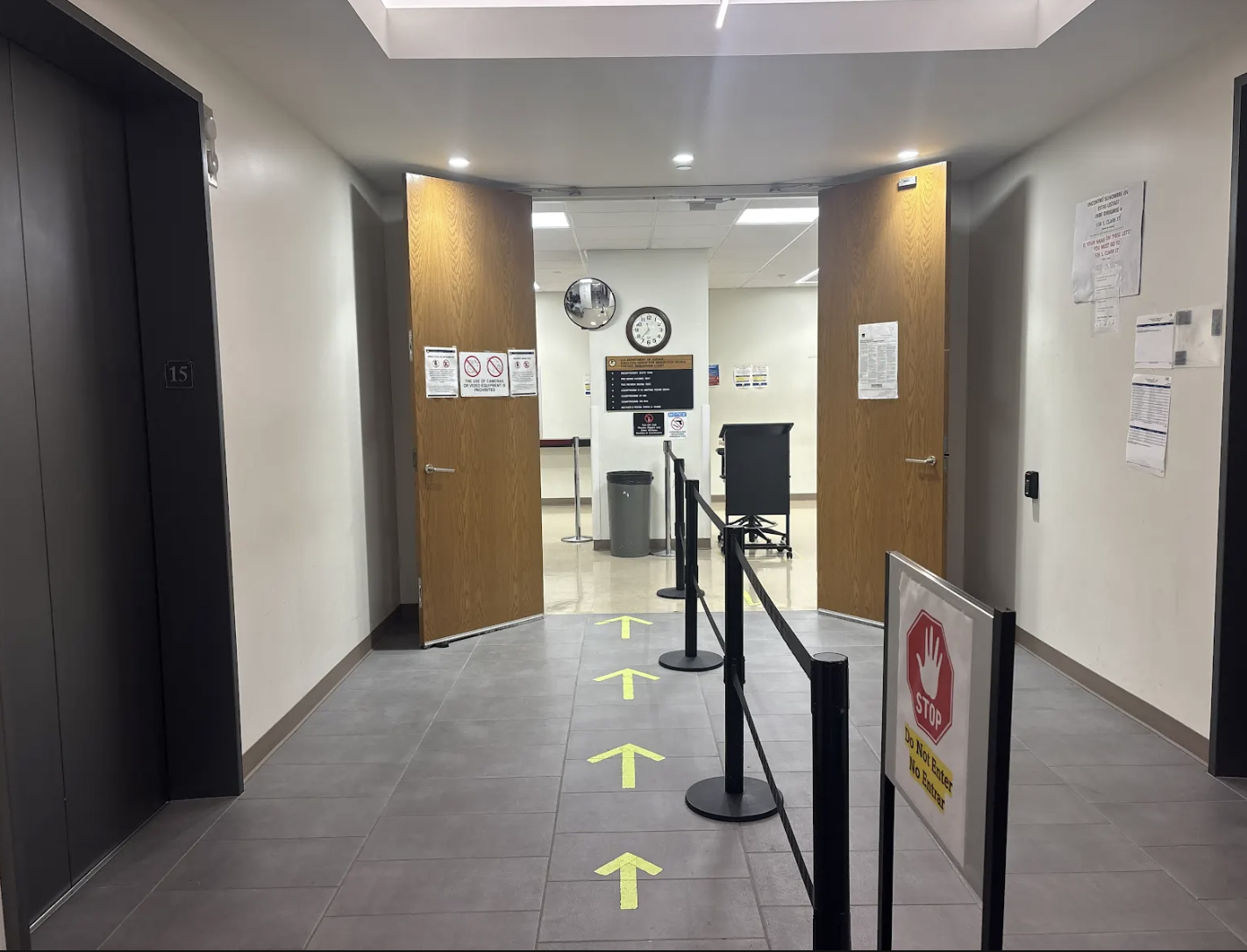
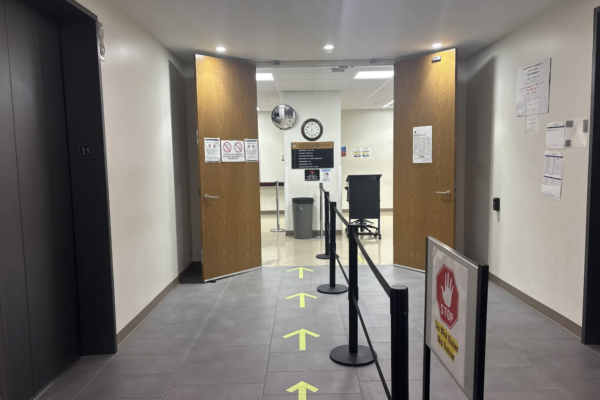
When you step out of the elevator, you are directed through a security line and then you must go to the docket board to find your case. In Chicago’s 55 E. Monroe location, typically more than 50 respondents, attorneys and observers sit in burgundy plastic chairs behind the board, anxiously awaiting their court date. There are a number of waiting spaces and small rooms where you can discuss details of your case with family members or your lawyer.
On the wall, there are 13 clipboards with court dockets. The number on the clipboard corresponds to the courtroom number, and the court docket lists all the cases the judge will hear in a day. Each respondent will see their name listed, with the time their case is set to start and end, their nationality, courtroom, preferred language and attorney if they have one. Each respondent is also given an Alien Registration Number (AR#) and a hearing type (H/C). The hearing type will often be either an ARMV, meaning they have attended court before, or an IMRV, which is an initial removal proceeding.
On the Notice to Appear (NTA), you will be given a date to attend an initial master hearing. This is a short, often procedural hearing. The judge will review charges and schedule a future court date. If the case is relatively new, often the judge will grant a continuance so the respondent can have time to find an attorney. Eventually, the judge will schedule an individual merits hearing. A merits hearing is like a “mini-trial” where evidence is presented, witnesses testify, and the final decision on removal is made.
If you are ordered removed, you are able to appeal to the Board of Immigration Appeals (BIA). The BIA is the highest court to interpret and apply immigration laws.
The Department of Homeland Security can also reserve the right to appeal, even if asylum is granted. This means that even if you win your case, the government can appeal it so that a different court and judge review the decision.
If you are ordered removed from the country, it’s difficult to win appeal cases. During the Trump administration, the board’s denial rates have increased.
“They have stacked the pool of immigration judges and the BIA members with [Trump] loyalists and fired everyone who is independent or even slightly pro-immigrant,” said former immigration lawyer Dan Kowalski. “It really is a kangaroo court at this point.”
Finding an attorney
You do have the right to be represented by an attorney, but the government does not provide you with an attorney. You can hire one to represent you in court, or you can represent yourself, which is called pro se.
When you attend your first hearing in court, the judge will give you several documents. One will likely be a short list of attorneys in Chicago who provide pro bono – meaning free – or low-cost legal representation.
Several ethnic organizations offer free counseling. They are organizations like the Resurrection Project, which largely serves Latino clients. You can also ask advice from the small office operated by the National Immigration Justice Center which is located at the Immigration Court’s East Monroe St. location.
It can be difficult to find a pro bono attorney; there are other options, including paying over time. Chicago immigration attorney Michael Ibrahim advised against trying to find an attorney for just one of your hearings, as that prevents your lawyer from being able to build a strong case and represent you at the final hearing.
“They have stacked the pool of immigration judges and the BIA members with [Trump] loyalists and fired everyone who is independent or even slightly pro-immigrant. It really is a kangaroo court at this point.”
– Dan Kowalski, Former immigration lawyer
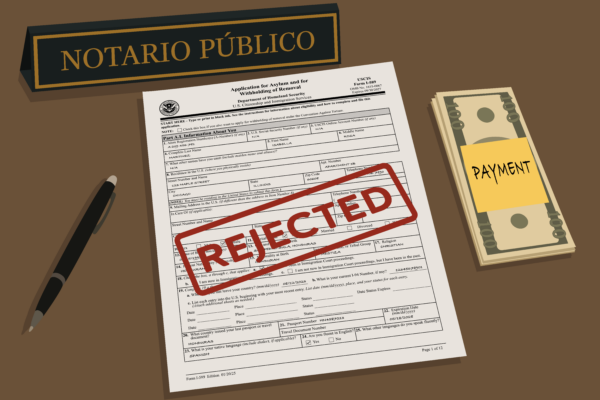
You may also be pointed towards a notary public to help you get some of your documents in order. In Spanish, a notario público is a trained legal professional. In the U.S., a notary public is not a lawyer; they witness signatures and verify identities. They cannot handle immigration cases. You should seek legal advice from a licensed attorney or accredited representative. An accredited representative is someone who is not an attorney but is approved by the Department of Justice to provide immigration legal services.
What’s happening in Chicago?
Tens of thousands of people go through immigration court each month. In Chicago, around 18% were granted asylum in March.
In March 2026, the Chicago Immigration Court saw 393 immigration cases. Of the cases heard in March, 70 asylum cases were granted, while the other 323 asylum cases were denied.
The rate at which asylum is granted differs for different nationalities. In 2026, respondents from Venezuela were most frequently seen in Chicago Immigration Court, followed by respondents from Mexico, Colombia, Russia and Nicaragua.
Since October 2000, people from Mexico were granted asylum in 26% of cases, according to data from the organization TRAC Immigration Reports, while people from China were granted asylum in 58% of cases.
Whether or not you have an attorney or a form of representation affects whether or not you will win your asylum claim. From October 2000 to March 2026, nationwide, in almost 80% of the cases where a removal order was issued, the respondent was not represented.
Who is hearing my case?
There are 21 active judges (see the full list below) in Chicago Immigration Court, according to the Department of Justice. Judge Craig Defoe oversees the court as the Assistant Chief Immigration Judge.
| Craig Defoe | Eva Saltzman |
| Michelle Venci | Gina Reynolds |
| Brendan Curran | Matthew Beese |
| Michael Klosowsky | Peter Kim |
| Ana Mencini | Dillon Ambrose |
| Patrick McKenna | Akash Vyas |
| Samia Naseem | Jacob Marshall |
| Marc Stahl | Shawn Abraham |
| Elizabeth Treacy | Jaime Poarch |
| Elizabeth Crites | Kenneth Flesch |
| Joshua Luskin |
Different judges have different demeanors and ways of approaching a decision. Judges have different rates of granting asylum, which can be affected by the types of cases they hear. Judge Craig Defoe has the highest rate of asylum denials in Chicago, while Judge Gina Reynolds has the lowest denial rate, according to TRAC Immigration Reports.
The judges are appointed by the federal government, and there is no chance for the public to have a say in who is hired. The judges are supervised by a chief immigration judge (Defoe) who has significant authority over them and has the ability to decide which judge gets which cases, as explained by the Brennan Center for Justice.
Judges can be removed from their roles at any time. The Chicago Tribune reported that nine Chicago immigration judges were terminated, retired or took buyouts during the current Trump administration. The following judges were appointed to the Chicago immigration court from late 2025 to early 2026:
| Matthew Beese | Akash Vyas |
| Peter Kim | Jacob Marshall |
| Dillon Ambrose |
What’s new?
The current Trump administration has introduced a wave of new immigration policies, from the early termination of asylum proceedings, also known as pretermission, and fast-tracking the cases of certain ethnic and immigrant groups, to drastically cutting down the time respondents are given to prepare their defense.
This year, the government had frequently pretermitted cases under Asylum Cooperative Agreements, also known as “safe third country” agreements. This meant someone could be sent to a third country with an agreement to seek asylum there. The government has such agreements with countries including Guatemala, Honduras, El Salvador, Ecuador and Uganda. The DOJ has halted the practice for the time being.
Chicagoland immigration attorney Alen Takhsh said it feels like policies surrounding immigration change every morning.
For example, this spring, cases for people from Somalia that were scheduled years in the future were suddenly set for hearings. This has an effect when other cases are heard in the court as well.
Takhsh said in March 2026 that he had a client who had been prepping his case for the past three years. Takhsh worked with the client to compile hundreds of documents, several witnesses, and medical and police records. He had even practiced answering cross-examination questions the DHS attorney might ask. On the day of his individual hearing, the judge told Takhsh they would have to move the case back to 2029, three years away, so that they could hear a Somali case instead. Takhsh said this could be detrimental to his client’s argument, which was based on the current war in Russia.
“Who knows what could happen in three years,” he said.
Cases that are pending in immigration court are part of what is called “the backlog.” Nationwide, more than 3.2 million cases were in the immigration court backlog as of 2026. Out of this, more than 2.3 million people were awaiting asylum hearings, the highest the backlog has ever been. As of March 2026, in Illinois, there are 220,455 total cases in the backlog.
How does detention factor in?
People can end up in immigration detention if they were picked up at the border, or seized in their own communities during enforcement surges like Operation Midway Blitz. They can even be detained at their court hearings. As of April 4, 2026, more than 60,000 people nationwide were in immigration detention. TRAC Immigration reports that immigration detention is at an all-time high since mid 2025.
Takhsh had a Sudanese client who was detained by ICE just 12 days before his individual hearing. Takhsh said he had done everything right and had no criminal charges. They had spent over two years prepping one of the strongest cases he’d ever seen, but the immigrant was detained outside of O’Hare Airport while waiting for a rideshare customer, and moved to five different detention centers within less than two months. ICE did not appear to care that his case was set to be heard in just two weeks, said Takhsh.
Immigration court, with continually changing policies and language barriers, can be very difficult to navigate. Your odds will be better if you understand the system and seek representation.
“So much has changed and continues to change under the current Trump administration with respect to removal proceedings,” said immigration attorney Melissa Brennan. “There have been enormous efforts to limit people’s ability to actually be granted asylum.”

A digital journalist at Northwestern University.
More from On The Docket

Bonds without bounds
Story by Mia Osmonbekov
Notario fraud persists in Chicago as the Trump Administration toys with immigration courts
Story by Vani Subramony Graphics by Jesse Renee Kennedy
Immigration courts backlog has grown since 2012
Story by Duncan Green & Brenne Sheehan Photos by Ike Wood
Chaos and confusion inside Omaha’s Immigration Court
Story by Justin Diep

Closed door justice
Story by Suzgo Chitete
Trends, jargon inside Chicago immigration courts
Story by Clare Kirwan