


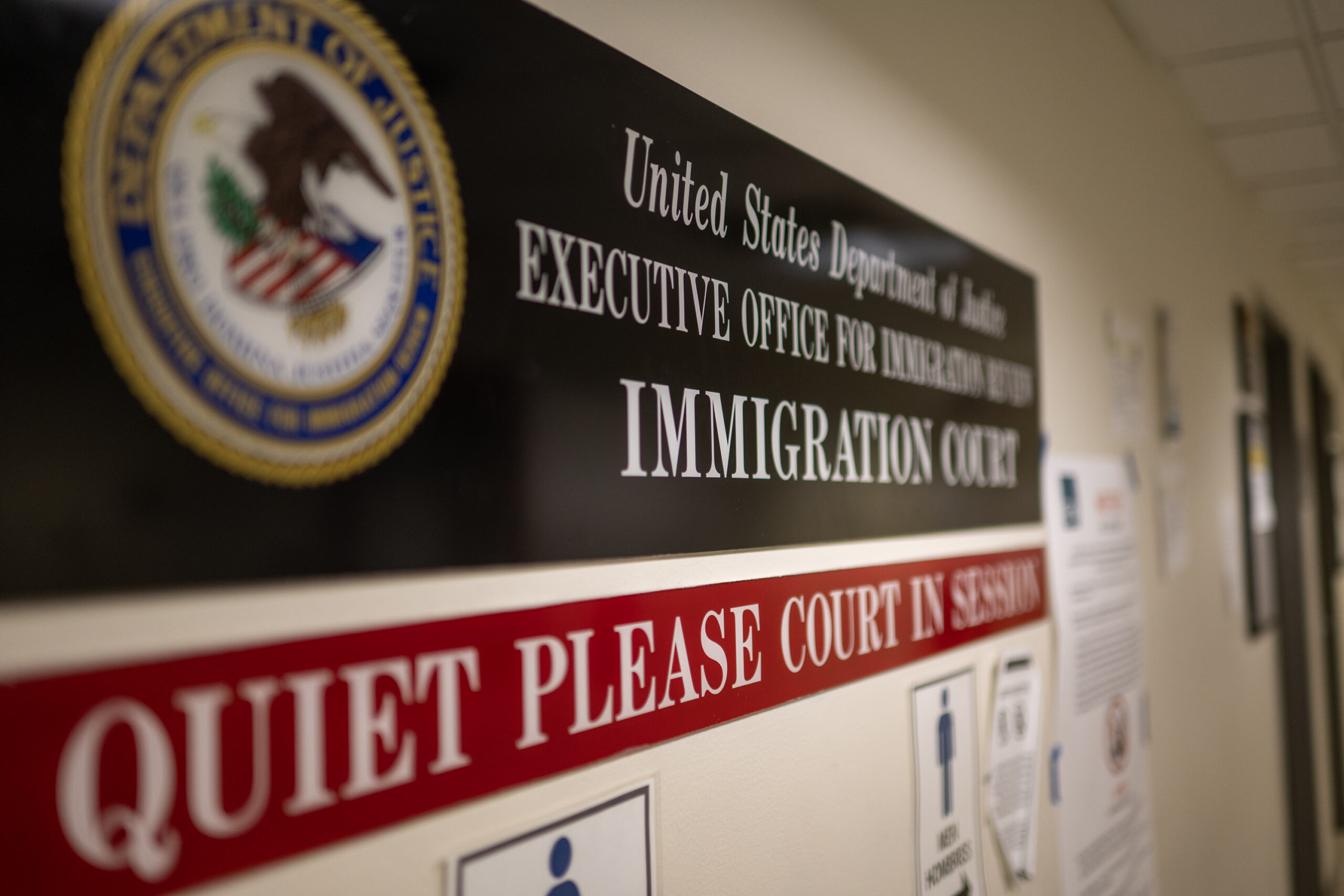
737 hearings across the country
More on what Lives in the Balance journalists saw and documented during a month of observations in 11 immigration courts.
A shorter 66-year-old man from Bangladesh made his way to the respondents side of the court room. He was the second person in the courtroom that morning. He gave a slight smile as he surveyed the room before he sat down for his bond hearing.
He said he had been detained during an interview for his naturalization application. His attorney’s face took up the majority of the huge flat screen TV — she was zooming in from her office. She said that the government had wrongly detained her client and as someone who has been in the country for more than 20 years with no criminal record, he posed no risk. The government’s lawyers argued that he was attempting to defraud the U.S. and he should be removed from the country.
Most of this man’s hearing consisted of the lawyers arguing a technicality [is this true? curious about how much time was spent on this]. In 2000, the man was 15 minutes late to a 9 a.m. hearing — thanks to a slow taxi, he said — and by the time he arrived everyone was gone. The government’s lawyers characterized this incident as him failing to show up to court, but in his mind, he had shown up to court. On his N-400 form, he said he’d never failed to appear at a removal hearing. The government said that he had “woefully misrepresented a terminal fact” on his form.
After a couple of minutes, the judge set the man’s bond at $1,500. He recommended that the man drive up to Buffalo from Schenectady the night before so as not to be late again.
The man nodded and gave a quick “yes, boss.”
This hearing was one of the longer ones in the Focal Point database of immigration hearings, and the outcome for this particular immigrant, who wanted to remain anonymous, was one of the better ones. He had a lawyer, he was able to understand the interaction in the courtroom without the use of an interpreter, and he’ll post bond, getting home to his wife where they can start the naturalization process over again.
He is one of the lucky ones.
This is just one of the more than 700 cases that were observed as part of the Focal Point Immigration Project. Focal Point is a nationwide project bringing together five universities in an effort to document and observe immigration court hearings across America for one month in early 2026.
Students from Arizona State University, Northwestern University, University of Florida, University of Nebraska-Lincoln, Syracuse University and University of Southern California, accompanied by faculty, were sent out into the field and observed immigration related hearings from Jan. 28 to Feb. 28.
Over that month period students and faculty visited 11 different courtrooms that dealt with a wide variety of hearings, both in-person and through Webex video calls. In total, the Focal Point Immigration Project was able to document 727 hearings, most of which were asylum or removal hearings.
More than half hailed from Latin America
Of the cases where the respondents nationality was clear, at least 60% hailed from countries within Latin America or the Caribbean. Almost one out of every three people were from Venezuela or Mexico.
At least 60% of the hearings observed took place with the immigrant physically in the courtroom. More than 20% of respondents appeared online through the Webex platform.
The majority of people —two out of three —attended their hearings under their own volition to avoid an in absentia order. Only about one out of every 10 people missed their hearings entirely.
Half of respondents that were observed had access to a lawyer, whether it was in-person or through Webex, though most lawyers appeared on video.
More than half got just five minutes
Most hearings were incredibly brief. The average time a judge considered a case was less than nine minutes. One hearing considering a Colombian immigrant in a Chicago court — the longest in the set —was three hours long. 35 hearings in the set, all in California, lasted just one minute. Data from the Transactional Records Access Clearinghouse (TRAC), which tracks the immigration court backlog in the U.S., shows that the wait time has lengthened to almost two years as of October of last year, and the wait has only grown.
What has been an ordeal of years for many was over in less than five minutes for more than half of the immigrants in court. For most, a new court date was set. Nearly 14% were ordered removed from the country. In less than 5% of cases, the person agreed to leave voluntarily rather than be removed. In one singular case in our set of more than 700, a Honduran immigrant in Chicago, who said he was attacked repeatedly by MS-13 gang members, was granted asylum with his wife and two children.
In cases where a new hearing was set, the dates were spread out dramatically. 150 cases were scheduled to be heard before May 1, 70 were scheduled between May and the end of the year. More than 220 cases were pushed to 2027 with at least two stretching all the way to December 2029.

A digital journalist from Dallas, Texas.

A digital journalist at Syracuse University.

A visual journalist from Syracuse, New York.
More from On The Docket
In Chicago’s immigration court: Cases of chaos, despair and hope
Story by Project Staff
Immigration courts backlog has grown since 2012
Story by Duncan Green & Brenne Sheehan Photos by Ike Wood
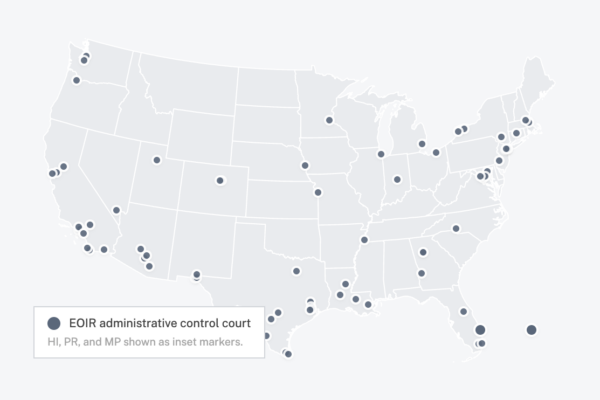
Immigration Court Guide
Story by Project Staff
Chicago’s immigration attorneys adjust to Trump’s policy changes
Story by Madison Roth
Chaos and confusion inside Omaha’s Immigration Court
Story by Justin Diep
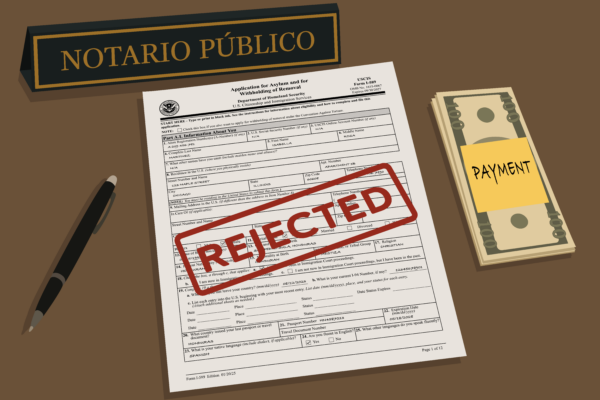
Notario fraud persists in Chicago as the Trump Administration toys with immigration courts
Story by Vani Subramony Graphics by Jesse Renee Kennedy