



"I'm an American"
Omaha lawyer fights for clients caught in immigration system overhaul.
Brian Blackford stands at his desk, reviewing cases and stealing quick bites of lunch between back-to-back legal consultations.
On the wall behind his dual computer monitors, a pair of blue eyes follow the Omaha-based immigration lawyer from a vintage movie poster:
BIG BROTHER IS WATCHING YOU, the caption reads.
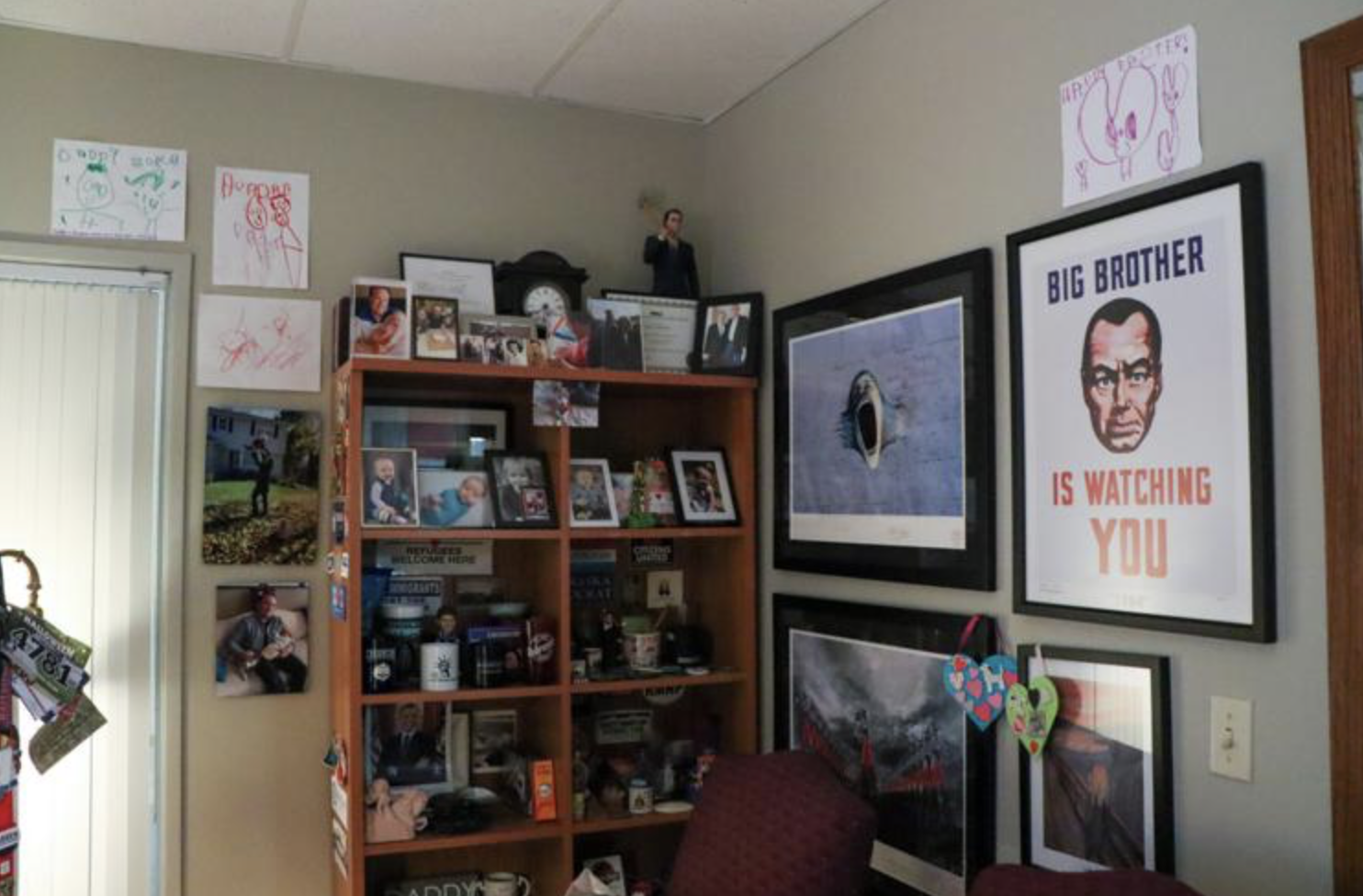
Photo by Nebraska News Service
In Brian Blackford's office a sign on the wall reads "Big Brother is watching you."
Blackford’s wife gave him the poster from George Orwell’s “1984” — a dystopian novel about an authoritarian regime published in 1949.
Blackford sees its eerie relevance now more than ever, he said.
For immigration attorneys like Blackford, practicing law has become an exercise in near-constant adaptation. Since President Donald Trump took office in January 2025, his administration has transformed the U.S. immigration landscape through aggressive enforcement sweeps, widespread deportations and increasingly restrictive pathways to citizenship.
As policies continue to change, immigrants increasingly turn to attorneys for clarity — but even attorneys don’t always have answers.
Nebraska News Service spent a week in November with Blackford to understand how immigration attorneys and their clients navigate a system in constant flux.
A week in the life
Blackford, 42, spends hours each week reading new Board of Immigration Appeals decisions, scanning listservs, cross-referencing court rulings and trying to discern what policies still stand and what new ones might mean to his current and former clients.
The new administration’s near-constant changing of longstanding precedent is reshaping the way Blackford practices law, he said. He’s cut back on the number of new clients he agrees to represent, focusing on quality over quantity.
In mid-November, Blackford Law had 1,067 open cases. Blackford is one of 111 immigration attorneys associated with the American Immigration Lawyers Association in Nebraska.
Omaha’s immigration court, which covers cases for people in Nebraska and Iowa, has a backlogof more than 43,000 pending cases, and as of 2023, had the second longest wait times in the nation, according to the latest data from Transactional Records Access Clearinghouse (TRAC), an immigration court and detention research center at Syracuse University.
“Immigration judges consider all evidence and arguments presented by both parties and decide each case in a manner that is timely, impartial, and consistent with applicable law and consistent with due process,” said Kathryn Mattingly, press secretary for the Executive Office of Immigration Review, which operates the nation’s 70 or so immigration courts.
Blackford stopped seeing new clients except during two tightly scheduled consultation days per week — Tuesdays and Thursdays from 9 a.m. to 4 p.m., booked out three months in advance.
Mondays, Wednesdays and Fridays are dedicated to working on existing cases: conducting follow-up meetings, preparing motions and petitions, helping clients prepare for interviews, and attending U.S. Citizenship and Immigration Services interviews and court hearings.
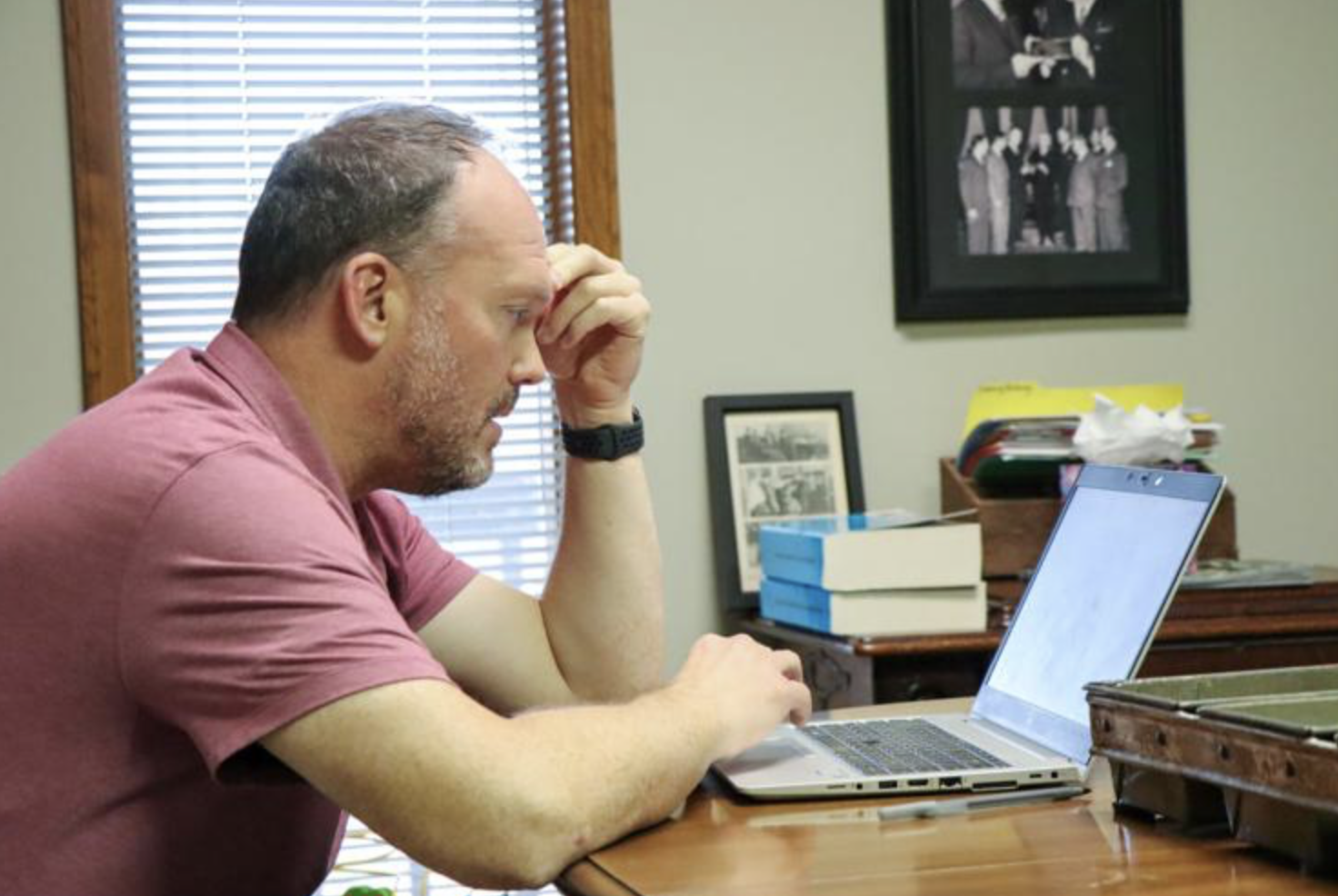
Photo by Nebraska News Service
Brian Blackford looks over documents on his computer.
After he and his wife put their daughters, ages 10 and 12, to bed, he continues work until he falls asleep at about 11:30 p.m. While he works to dedicate weekends to his family, he said there are many weekends he now spends more time at the office than at home.
Blackford opened the private practice, Blackford Law, in October 2014. After six years practicing immigration law following his 2008 graduation from Creighton University School of Law, he said a private practice seemed like the logical next step. Running their own business would also allow his wife more flexibility to raise their young family, he said.
She works handles asylum cases and U visas, which provide temporary protection to immigrant victims of certain crimes, he said.
Blackford attributes the business’s success to a passion for the work that causes them to work long hours and continue learning — a necessity now more than ever.
“You don’t know in any given day who’s going to call you and say they’ve been arrested."
– Brian Blackford, immigration attorney
Blackford’s time is consumed with keeping up to date on rapidly changing laws. In a typical week, Blackford might receive panicked calls from clients with questions about news reports of changes to immigration policies, or learn that a case strategy he’s relied on for years is no longer viable. He scrolls through his email on his phone before appointments and between meetings, flagging emails from other attorneys reporting policy and enforcement changes.
He’s also taking fewer clients to make sure he has the time, finances and staff support available in case something happens to his clients to make their cases more complex.
“You don’t know in any given day who’s going to call you and say they’ve been arrested,” he said.
That caution proved necessary.
After the Nov. 26 shooting of two National Guard members in Washington, D.C., allegedly by an Afghan national, the administration announced on Dec. 2 several new policy changes aimed at further restricting legal immigration.
Even before the Dec. 2 changes, calls from clients with questions had increased because things are changing every day, Blackford Law paralegal Quetzalli Pliego said.
Pliego often interpreted for Spanish-speaking clients during Blackford’s consultations throughout the week. She said watching her parents struggle through the immigration system shaped her commitment to this work. The firm employs two attorneys, two paralegals and two legal assistants. All, but the Blackfords, are bilingual.
Blackford and his staff spend most of the week communicating with clients in some form or another, and the office phone rings consistently throughout the day.
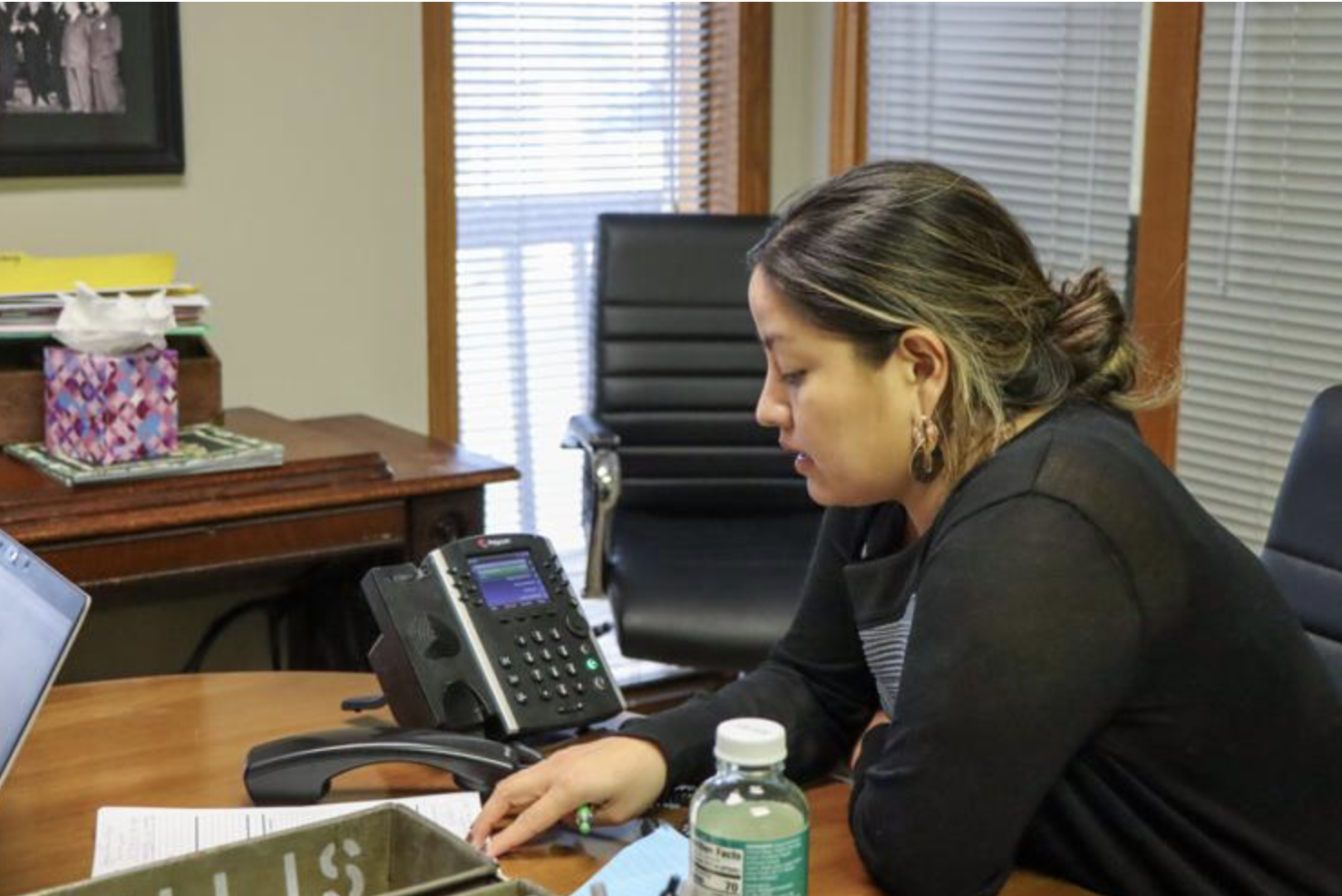
Photo by Nebraska News Service
Brian Blackford's paralegal works on a client billing worksheet.
Diana Alvarado, one of Blackford Law’s legal assistants, answers calls from a large U-shaped desk in the middle of the main office area, speaking to callers sometimes in English, but more often in Spanish. Her soft voice and the faint clicking of her computer mouse are barely audible over the sound of a bubbling brook from a white noise machine that sits outside the conference room where Blackford meets with clients so others in the office can’t hear their conversations.
Clients come to Blackford Law with concerns that form a portrait of a community on edge:
What are my options?
What would happen if ICE arrests my son?
I’m so scared to go back to Mexico.
Blackford wishes he had better answers:
I’ll be there from start to finish guiding you through the process.
You’ve got to be really, really careful right now.
I don’t know — and nobody really does these days.
‘What’s true today may not be true tomorrow’
Between consultations, Blackford sorts through his email inbox, often overflowing with email chains where immigration attorneys across the country share updates on policy and legal interpretations, asking and answering each other’s questions.
He said it feels like every Friday brings a new precedent-setting Board of Immigration Appeals decision — a frequency unusual compared to previous administrations. Even more unusual, he noted, is that in the dozens of precedent-setting decisions so far this year, not one has favored the immigrant.
“What’s true today may not be true tomorrow. So we have to pivot our strategies.”
– Brian Blackford, immigration attorney
In September, the Board of Immigration Appeals issued a decision effectively prohibiting bond for detained immigrants who did not arrive with a visa.
“It just upended 50 years of precedent,” Blackford said.
Federal judges have pushed back against the interpretation, he said, but challenging it requires filing habeas corpus petitions, which is high-stakes, resource-intensive litigation. Habeas corpus is a legal procedure that allows an imprisoned person to challenge the legality of their detention by demanding the government prove to a valid court that the imprisonment is lawful.
Blackford used to take these habeas corpus cases with the help of large firms. Now he believes a political “chilling effect” and pressure from the government prevents big firms from assisting. He said the lawyers he would have reached for help before this administration took office would not help him with the same cases today due to political pressure.
Blackford said he and his team navigate the ever-changing landscape by taking it one case at a time, maintaining open and honest communication with clients and getting creative.
“What’s true today may not be true tomorrow,” Blackford said. “So we have to pivot our strategies.”
That ability to pivot was tested severely weeks later after the National Guard shooting prompted the Trump administration to announce a full-scale reexamination of the immigration system.
In a reaction Blackford describes as “alarming,” the administration implemented three sweeping changes in a policy memo dated Dec. 2:
- A re-review of all immigration benefits granted under the Biden administration to immigrants from those same 19 countries who entered on or after Jan. 20, 2021.
- A hold on all pending applications for immigrants from 19 “high-risk” countries.
- A pause on all asylum proceedings — Blackford said this pause does not take away the ability to use an asylum claim as a defense for deportation.
These changes didn’t just freeze new cases; they reopened old wounds. Clients who thought they were safe — who had been granted status years prior — were suddenly back in the crosshairs.
Blackford said these changes create problems for at least 50 of his clients, most of whom are from Somalia and other countries on the high-risk list. But he said he doesn’t know yet how many clients received benefits during the Biden administration who are now subject to re-review.
‘I’m an American’
Two days after the memo dropped, Blackford said he had to prepare a Somali client for possible disappointment. The Somali man came to the U.S. with his family as a refugee when he was 16 months old, Blackford said. He and his family are all residents of the U.S., some of them citizens, and had been Blackford’s clients for many years. Blackford said he and his client had finally gotten all the paperwork together and submitted for his citizenship application, and his citizenship interview was scheduled for the following week.
“If this had been scheduled even a week ago or two weeks ago, he would have been probably fine to become a citizen,” Blackford said.
He said he had to tell his client he would likely still have the interview, but there was no way to know when his case would be adjudicated.
“He was kind of broken up over that, understandably so, just because he’s been here so long,” Blackford said. “That’s why he was just kind of in tears, saying, ‘I’m an American. I don’t know anything else. I only know this country. I came, you know, as just a baby. I don’t, you know, I have no ties, no recollection, no memories, in Somalia. My whole family is here.’”
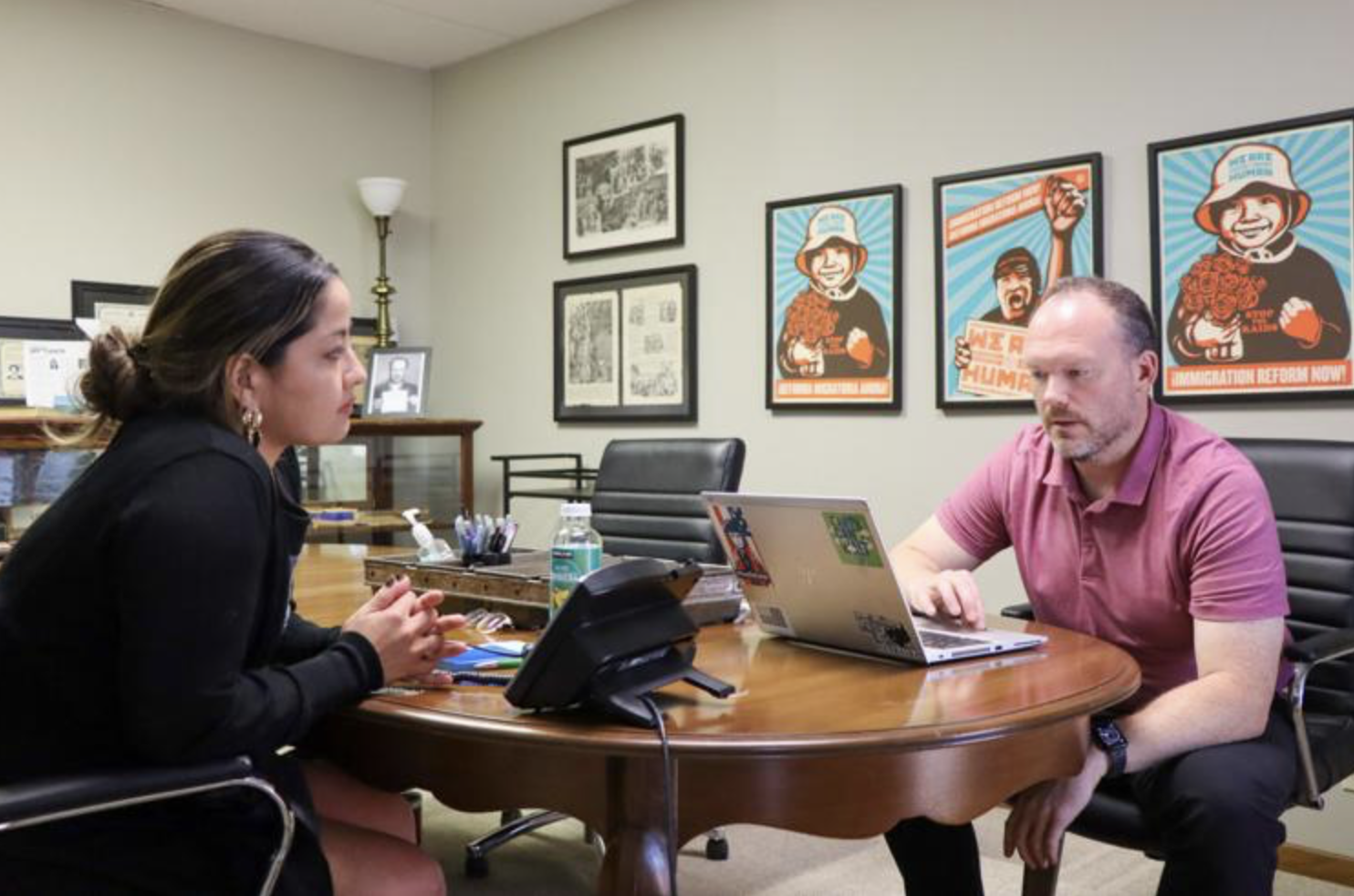
Photo by Nebraska News Service
Brian Blackford conducts and over the phone consultation with his paralegal across the table.
One warm November afternoon, a couple carrying a baby girl in a Mickey Mouse sweater arrived at his firm seeking help for their adult son, a Deferred Action Childhood Arrival recipient who was arrested on a domestic violence charge. They told Blackford their son was actually the victim and showed photos of injuries they said his girlfriend inflicted on him.
The baby girl babbled nonsense in the man’s lap and played with the sunglasses on his head. The couple explained to Blackford they brought their son to the United States from Mexico when he was 6 months old. It wasn’t until he was in high school and asked his mother for his Social Security number to work that he found out he wasn’t born in the U.S., she said.
Now ICE wanted U.S. Citizenship and Immigration Services to revoke his DACA status, a designation that protects eligible immigrants who came to the U.S. as children from deportation, based on the charge — placing him in deportation proceedings, even if the criminal case was later dismissed.
Blackford said in an interview this was the first time he’d seen the government try to take away DACA for a pending criminal charge like this.
“I don’t agree with this at all, but they do have the power to use their discretion to say he’s a danger to society based on this charge,” Blackford told the couple in the consultation.
The couple’s best chance, he told them, was to compile enough evidence of their son’s character and community ties to persuade the government not to revoke his status.
“I will do everything I can, but it’s going to be tough,” Blackford said. “That’s the reality.”
In the meantime, he advised something counterintuitive:
“I know this is hard to understand and accept, but we want him to stay in jail — in criminal custody,” Blackford said.
In criminal custody, he remains under the jurisdiction of the criminal justice system, which gives the family more time to build their case and potentially resolve the criminal charges favorably, he explained.
If the case is dismissed, and DACA is terminated, Blackford said, he will go into ICE custody, and deportation proceedings will begin.
Pliego, who had been interpreting for the couple, stepped out of the room for a moment.
“The thing is,” the mother said quietly to Blackford in English, “[my son] don’t have family over there.”
Emotional whiplash
Other cases cut deeper.
Blackford tries not to raise his clients’ hopes unless he’s confident he can deliver results. When he thinks the odds are against them, he’s honest about it. But, he is still willing to fight.
False hope is unavoidable when due to clerical errors or when the law shifts beneath long-settled lives.
A Sudanese refugee from what is now South Sudan had lived in the U.S. for 27 years. In 2006, he was convicted of “lascivious acts against a minor,” Blackford said. He said his client claims he didn’t know the child was underage. At the time, the Sudanese man couldn’t be deported because civil war had killed about 2 million people in the region. Since South Sudan gained independence in 2011, violence has killed an estimated 400,000 more, with ongoing conflict continuing to make the region one of the world’s most dangerous.
Since his criminal conviction, Blackford said the client seemed rehabilitated. For 17 years, he checked in with ICE annually, earned multiple academic degrees and stayed out of legal trouble. He married a U.S. citizen, who is now pregnant with their sixth child and medically unable to work. Between their children, her children from a previous relationship, and a grandchild, the couple cares for nine children.
At his most recent check-in on Oct. 1, the man was arrested.
On Nov. 5, Homeland Security Secretary Kristi Noem announced Temporary Protected Status for people from South Sudan would terminate on Jan. 5, 2026. New State Department reports downgraded the danger of returning to South Sudan — a determination Blackford said was manipulated and politically motivated.
He filed a motion asking the court to waive the client’s decades-old crime so he could apply for residency based on family hardship. When the online master calendar showed a hearing consistent with approval and a reopening of the case, Blackford called the family with what he thought was good news.
But no official notice arrived. When Blackford called the court, a clerk apologized and said she had clicked the wrong button.
The motion had been denied.
“I know that’s a horrible roller coaster of emotions to go through,” Blackford told the family.
He urged them to focus on next steps.
“They give us 30 days to appeal, but they don’t always honor that,” he said.

Photo by Nebraska News Service
The outside of the Blackford Law building.
Advocating for individuals against a system that seems rigged against them affects all aspects of Blackford’s life, he said, but he can’t imagine doing anything else.
Blackford said he always knew he wanted to be a lawyer and recalled watching old courtroom dramas with his grandmother as a small child. But he didn’t choose immigration law as his focus area until he clerked for an immigration attorney during his second year of law school. He said it was the perfect fit. He’d always loved politics, history and learning about other cultures, and he liked that he could see the tangible effects of his work when he helped immigrant families.
What they do vs. what they tell you
One couple sat across from Blackford on a Tuesday seeking answers about family-based petitions for residency.
The husband, born in 1990 in Mexico, married a U.S. citizen in June and hoped the marriage could open a path to residency. But when he mentioned an attempted border crossing years earlier, Blackford paused. Whether the encounter had been logged as a deportation would determine the man’s future.
The Mexican man said the border patrol agents told him he would receive a warning, not a formal deportation order, before he was sent back.
“Sometimes what they tell you and what they do are two different things,” Blackford said to the man.
To find out, the man would need fingerprints taken through the Nebraska State Patrol so Blackford could access his immigration records through the Freedom of Information Act, which grants the public rights to access records from government agencies.
At the mention of the Nebraska State Patrol, the couple reached for each other. The man’s wife held their joined hands in her lap as the meeting continued.
Blackford understood why, he said after the consultation. Since Nebraska Gov. Jim Pillen announced the agency would cooperate with ICE enforcement efforts, clients had grown nervous about interacting with the law enforcement agency.
Blackford reassured them he hadn’t seen problems arise from this particular process. But, he added, he couldn’t make them any guarantees.
If the Freedom of Information Act request revealed the man had been ordered deported, he would be barred from both residency and citizenship, Blackford warned.
“It’s a risk you have to take if you want to pursue this case,” he said.
The ruling group
Blackford said he doesn’t take cases in jurisdictions where he does not know the judges. Unlike other areas of law, licensed attorneys can practice immigration law anywhere in the U.S., but Blackford says understanding a judge’s individual quirks is essential when the stakes can be life and death.
"When looking at asylum cases, it is important to note that each asylum case is unique, with its own set of facts and circumstances."
– Kathryn Mattingly, Executive Office for Immigration Review spokeswoman
In Omaha, the stakes are particularly high for asylum cases.
Asylum is a legal protection for immigrants already in the U.S. fleeing persecution based on race, religion, nationality, membership in a particular social group or political opinion in their home countries.
In Omaha, judges collectively denied nearly 95% of asylum cases in fiscal year 2025, while the national average denial rate was almost 73%, according to TRAC data.
Mattingly, the Executive Office for Immigration Review spokeswoman, said in an email to the Nebraska News Service that immigration judges are independent adjudicators and decide all matters before them on a case-by-case basis.
“When looking at asylum cases, it is important to note that each asylum case is unique, with its own set of facts and circumstances,” Mattingly said.
She also said the immigration judges assigned to the Omaha Immigration Court routinely hear cases via video teleconference to detained hearing locations and assist with detained caseloads throughout the country.
“Immigration courts in detained facilities, or immigration courts that hear cases in which the respondent is detained or incarcerated, typically have lower asylum grant rates because detained aliens with criminal convictions are not eligible for many forms of relief from removal,” Mattingly said.
Since the second Trump administration, Blackford said he has noticed the three Omaha judges denying asylum cases based on “credibility.” This can mean anything from typos on a psychiatric evaluation to minute details in court not matching an application filed years prior.
Blackford argues this standard ignores the reality of trauma. Studies show that PTSD fundamentally altershow the brain stores memories, often making chronological recall fragmented.
“The other big issue is our court system — it’s not independent,” Blackford said.
The U.S. president appoints the attorney general, who appoints immigration judges. This fall, some judges who don’t rule in line with the administration’s platform risked being terminated.
According to the American Immigration Council, more than 100 permanent immigration judges were fired in the first seven months of the second Trump administration, bringing the total number of immigration judges down from a high of 735 in 2024 to about 600. Layoffs continued into December.
To address the shortage of immigration judges in a court system facing a backlog of more than 3.4 million cases, Secretary of Defense Pete Hegseth authorized up to 600 military lawyers to serve as temporary immigration judges. Nothing had changed in Omaha’s immigration court as of November.
But Blackford said he thinks the immigration judge’s background plays a significant role in their ruling. He attributes Omaha’s high asylum denial rate partially to the fact that all three Omaha judges are former ICE attorneys.
With the courts backlogged and the law narrowing, Blackford says there are fewer options for his clients — a reality few understand until they are sitting in his office.
One way for Blackford’s clients to gain a lawful status is through family-based petitions. This is easiest if they are married to a U.S. citizen or permanent resident, if they have a U.S. citizen child over the age of 21 or if they have a child or spouse who is a member of the U.S. military. These priority relationships can lead to a petition process that typically takes about five to six years.
No matter the circumstances, if the client’s last entry into the U.S. was unlawful, they will have to leave the country to adjust their status, usually by conducting their citizenship interview overseas in their country of origin.
A U.S. citizen can petition for other family members, such as siblings, but the process can take 30 to 40 years, Blackford said. He noted that this year, one of his clients finally received approval for a sibling petition filed in the late 1990s.
“There aren’t a lot of paths available,” he said. “Even if there is a path available, it can be a decades-long wait.”
‘To that one, I am’
Layered on top of the legal chaos are seemingly targeted fee increases that immigrants now face, Blackford said.
He said asylum applicants now pay initial and annual filing fees, people in removal proceedings face nearly $3,000 in green card fees and immigration court appeals for removal cases jumped from $110 to $1,010.
“I think they’re punishing people with removal proceedings and asylum applicants,” Blackford said.
According to the House Judiciary Committee, the fee increases, which were included in the sweeping reform measures passed in July known as the “One Big Beautiful Bill Act,” were intended to ensure the immigration court system is financially self-sustaining and to fund expansion of immigration enforcement and deportation efforts.
“It’s a continued attack on asylum to try to deter people from filing,” Blackford said.
When the work feels hopeless, when it feels as if he can’t make a difference, Blackford said he turns to a favorite parable:
On a beach littered with thousands of starfish, a boy stands, throwing starfish into the ocean one by one.
A man walks by and asks the boy what he’s doing.
“Throwing them back into the ocean,” the boy says.
“Why?” the man asks. “You can’t save them all. There are thousands of starfish here, you’re not making any difference.”
The boy throws another starfish back into the sea.
“To that one I am,” he says.
Note: This story was previously published by the Nebraska News Service as part of of a class at the College of Journalism and Mass Communications devoted reporting on the issue of immigration from various voices and communities.
Correction: This article was amended to reflect that Brian Blackford started his law firm in 2014 and is its sole partner. An earlier version indicated he and his former wife started the business together.

A digital journalist at the University of Nebraska-Lincoln.
More from On The Docket
What we observed in U.S. immigration courts
Story by Griffin W. Fellows & Brenne Sheehan Photos by Ike Wood

Fighting for immigrants amid policy shifts
Story by Grace Lewis
At NYC immigration courts, families brace for the worst
Photos by Ike Wood

Bonds without bounds
Story by Mia Osmonbekov
Behind the Docket
Story by Project Staff

Closed door justice
Story by Suzgo Chitete