



The longshot: How European hockey prospects are fighting for their spot in the NHL
European hockey players dream of making it to the NHL, but the journey to first playing in the American Hockey League isn’t easy.
Wojciech Stachowiak knew his time in Germany was likely coming to an end.
After double-digit goal and assist totals for the third straight year, the top-line winger’s agent said that NHL teams might start calling to offer a contract. But Stachowiak didn’t want to be bothered with those talks during the 2025 International Ice Hockey Federation World Championships. Team Germany and the quarterfinals had his full attention.
Stachowiak was wrapping up his sixth full season playing professionally for ERC Ingolstadt, a team in the Deutsche Eishockey Liga, Germany’s highest ice hockey division. But like many European players, Stachowiak’s goals reach beyond his home country. The dream is to play on the biggest stage, in North America in the NHL.
That dream became reality around midnight. Team Germany had lost to Denmark, but Stachowiak’s agent called with the news the player had been waiting for: a deal to sign with the Tampa Bay Lightning and start his journey in North America.
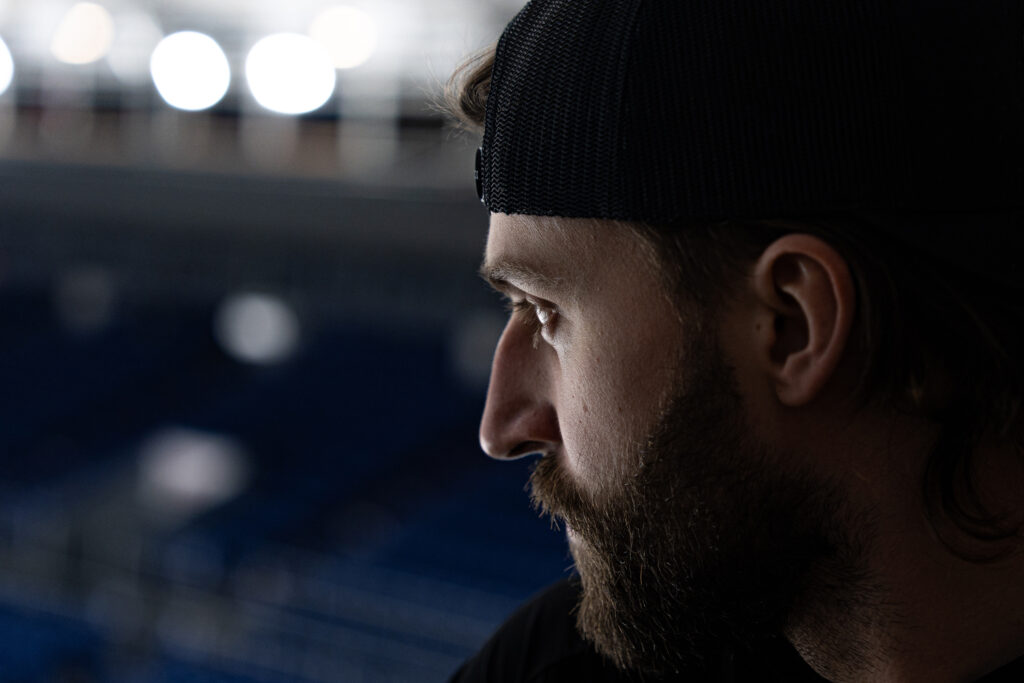
Photo by Ike Wood
Coming to Cuse
Next stop, the NHL
Wojciech Stachowiak reflects on his journey from Poland to playing for the Syracuse Crunch. Stachowiak moved to Germany alone at age 11 to pursue hockey before an emotional late-night call from his agent finally brought him to the United States.
Now Playing
Next stop, the NHL
Produced by Will Broad and Josh Solomon
But Stachowiak wouldn’t be moving to Florida. First he had to make a stop in Syracuse, New York, to play for the Lightning’s American Hockey League affiliate team, the Crunch. His agent described it as “one of the best places to play in the AHL.”
“I knew where Tampa was,” the 26-year-old said. “I had no idea where Syracuse was.”
Stachowiak’s parents had traveled with him to the International Ice Hockey Federation World Championships in Sweden.
“My parents were already asleep, and I woke them up,” Stachowiak said. ”My dad took sleeping pills just to fall asleep easier. I know he doesn’t remember the conversation we had, which was funny because he called me the next day and asked, ‘Did that really happen?’”
The NHL is currently made up of 69% foreign-born or immigrant athletes, according to George Mason University’s Institute for Immigration Research. Since the 1980s, more European players like Stachowiak have left stable professional careers behind to chase something uncertain in North America. For these players, the AHL is the first step: a proving ground where teenage prospects and veteran longshots coexist in the same locker room. They’re chasing a hockey “American Dream,” an opportunity they say is worth the uncertainty of short and cheaper contracts, constant traveling during the season, roster turnarounds and not having the chance to travel home for months at a time.
A European hockey dream
The National Hockey League is known as the best league in the world of hockey, and each NHL team has a “minor league” team in the American Hockey League that funnels players to the top. The Tampa Bay Lightning’s AHL affiliate team is the Syracuse Crunch. All players in both leagues’ contracts, bonuses and payments come through the NHL franchise.
The AHL players are a call away from playing in the NHL. If the Tampa Bay Lightning want a Syracuse Crunch veteran for the weekend, or if a young star is breaking out, the Lightning can elevate their contract to a standard NHL contract.
Leagues in European countries like Finland, Sweden, Germany, Switzerland and Czechia all provide stability, but for these players, being known as a top player in the world means sacrifice.
“Playing in the NHL is now a European dream,” said Bruce Berglund, a historian and professor at Charles University in Prague who wrote “The Fastest Game in the World: Hockey and the Globalization of Sports.” “And so for players who are in the Czech Republic, Sweden, Finland, Slovakia, the first goal or the top goal for a young hockey player and for their families is to play in the NHL. Their mentality is if they don’t make it to the NHL, then the secondary aim is to play in their domestic league.”
Canadian players take up a large sum of AHL rosters – approximately 550 Canadians, just over 40% of the AHL total, according to hockey statistics website QuantHockey. Teams across the league also feature European skaters from Sweden, Finland, the Czech Republic, Germany, Slovakia, Switzerland and more. European players make up about 5-10% of the AHL, according to QuantHockey. The reasons why and when to come to the United States and play in the AHL differ for each player. For some, it’s their third stop to the AHL after playing overseas in foreign hockey leagues for years, or it’s a 21-year-old’s first stop after being drafted by an NHL team.
The players understand that the NHL excels at constant access to coaches, scouts and general managers. Someone is always watching, whether it’s a Tuesday night game in Rochester or a Friday night game at Madison Square Garden.
“Even though NHL teams have scouts throughout Europe, the AHL is an essential part of the system because of the proximity to the NHL parent club,” Berglund said. “There’s so much movement in an NHL roster over the course of a season, whether it’s replacing injured players or trying different combinations.”
All roads lead to the AHL
Utica Comets center Matyas Melovsky grew up in Uničov, Czechia, a town with a population of just over 11,000 people.
“At 13, I started to play for another team … there weren’t enough guys to even have a team,” Melovsky said. “I had to move to a bigger city and play there. I never really thought about hockey as my job. I just enjoyed the sport, enjoyed being with my friends.”
But after traveling to Canada at age 18 and spending three years in Quebec with the Baie-Comeau Drakkar of the Quebec Maritimes Junior Hockey League, Melovsky knew that he wanted to play in the NHL, and going back home became harder to justify.
“From day one, I was like, OK, I want to stay in North America,” he said. “I want to stay because I feel like if I want to go back to Europe, it’s way harder to come back.”
Getting homesick is nothing new. Players like Melovsky spend long days at the rink and often come home to tiny apartments with no roommates. In these spots, the players are left with two decisions: go back home and return to their top league, or grind it out, hoping that the AHL is temporary.
“It’s understood that this is a necessary step,” Berglund said. “The NHL teams need their stock of potential, you know, potential guys who are going to be on the parent team. They need them close by. To have them in Sweden or Prague just doesn’t work, logistically.”
John Barr, a writer for the Seattle Kraken-focused outlet Sound of Hockey, said that one of the organization’s top prospects, Oscar Mølgaard, comes from Denmark. The player developed in Sweden when he was 18 and 19 years old before heading to North America, where he began playing in the AHL for the Coachella Valley Firebirds.
Although this is the player’s first professional season, he has already appeared in three NHL games, which Barr said puts him ahead of schedule in his development. Just 2.2% percent of the 2025 NHL opening day rosters included teenage players.
“The NHL is looked at as a premium league to play in throughout the world, and that showcases itself in the international players that tend to play in the NHL,” Barr said. “The best international players and the European players that are playing in North America, they’re usually at the top end of the lineup.”
European players also help the NHL reach an audience around the world.
“You don’t want it to turn into a sport of just Americans and Canadians. You want an international flair,” Barr said.
Gabriel Szturc, a forward for the Syracuse Crunch who is also from Czechia, spent time in Canada working for his shot in America.
“So after my draft when I was not drafted, I went here for a development camp and then rookie camp to Tampa. I came to Syracuse for a week and then I went back to Canada,” Szturc said.
After that Western Hockey League season, the forward returned to Syracuse. Szturc signed his contract with the Lightning organization in 2024.
“I signed with Tampa Bay and that was an unreal feeling,” Szturc said “I was very grateful.”
Leaving home
The exposure to NHL scouts and fans across the U.S. comes with a price. The AHL begins on long bus rides, in smaller arenas and in cities many European players have never heard of. Playing in the NHL means leaving family behind, but the players said they try to stay in touch.
“I try to call my parents as much as I can because … they want me to,” Melovsky said, chuckling. “So like once a week, twice a week, I try to call them so they don’t miss me too much.”
Szturc has been away from home in Czechia for more than five years. The attacker spent a season in Canada before playing in Syracuse the past three years. But he knows even if his parents aren’t physically there, they’re still rooting for him.
“They watch every game in the season,” he said. “So even though it’s not the best time for them, or they have to wake up at like 2 a.m. just to watch the game, they still do. They support me and I really appreciate it.”
An AHL team’s locker room can be full of different personalities and mentalities, which defines the players’ experience in the league. At one end of the spectrum, teenagers and prospects in their early 20s have to work their way up through the AHL. These players are known as “long-term investments” for their respective teams, and their progress is monitored closely by coaches or scouts.
Melovsky said the dynamic of an AHL locker room shocked him.
“Honestly, it’s pretty cool. Like it’s my first year pro and I was always around guys my age. Now I’m also with guys much older than me, but I’m surprised how everyone talks to everyone and it just blends really well,” he said. “Maybe I thought a little bit it will be like the younger guys will only create a small group and talk together and the older guys will talk together. But no, I feel like everyone’s talking together. It doesn’t matter if someone is 33 or 21. We’re all one team.”
Why do they stay?
Once the players are in the AHL, the likelihood of them making it to the NHL full time skyrockets. And even if it doesn’t happen immediately, consistency can always lead to the call. Two seasons ago, the AHL reported that 83% of NHL opening day rosters featured former AHL prospects.
“I would say, you know … the odds are pretty good,” Berglund said. “And if you’re going to get signed to a club and get to the AHL, I would say that, yeah, the likelihood is much better for a European player.”
Players said the adjustment period can be uncomfortable off the ice.
“Here is different for sure. It’s new compared to back home,” Szturc said. “The culture – you gotta get used to the new grocery stores and stuff like that. The language is the biggest part. Like a new language, everywhere everyone speaks English.”
“The schedule is tough,” Lundmark added. “Sometimes we can have, like, three games in four days, which is tough for the body, but like for the mental as well. Or even like three games in three days sometimes, which is hard.”
For Stachowiak, being in the AHL means adapting to what comes next. One minute you’re playing in the Olympics on Team Germany, the next you’re back in Syracuse, New York.
“I like to keep it simple in terms of my goals. My goal for this year is just step by step, get called up to Tampa,” Stachowiak said. “We’ll see what happens after. There’s a lot of variables in terms of contracts and opportunities. I might get a different opportunity if I play a game in the NHL this year, or different when I don’t.”
Stachowiak found that different opportunity quickly upon returning from the Winter Olympics in Italy: He was traded from the Tampa Bay Lightning organization to the Detroit Red Wings, and then assigned to their AHL affiliate, the Grand Rapids Griffins.
A digital journalist from McLean, Virginia.
A digital journalist from Montclair, New Jersey.

A visual journalist from Syracuse, New York.

A digital journalist from New York.
More from Coming to Cuse Podcast
View All Stories
Syracuse’s Italian Americans keep culture alive through charity
Story by Sofia Kissel Photos by Rebecca Beckas

How Syracuse’s immigrants navigate a changing system
Story by Sara Oppenheimer & Evan Edmiston Photos by Christine Kao

European hockey prospects fight for their spot in the NHL
Story by Will Broad & Josh Solomon Photos by Ike Wood
International students come to US to chase their dreams
Story by Trinity Corbett & Kyra Wood & James Mullarkey & Max Olson
How international students navigate collegiate soccer
Story by Rohan Borges & Felipe Ferraz de Souza Miranda Photos by Ella Chan

Making time for traditions
Story by Kira Desai & Olivia Boyer & Maya Aguirre