


“Not a real Haitian”
Schneider Joachim is sometimes shunned by other Haitian immigrants for not speaking Creole well. Now, he leans into his heritage by starting a Creole food truck in Syracuse.
At a Walmart a couple minutes outside of Syracuse, Schneider Joachim wore a hoodie printed with the Haitian flag and “1804,” the year Haiti won its independence from France.
After a successful slave-led revolution, Haiti declared its independence from France. Haiti had become the first independent Black nation and only nation to conduct a successful slave revolt. France forced Haiti to pay for this recognition — a debt that, although paid off, still has lasting effects on Haiti, making it one of the poorest countries in the world today.
Some shoppers approached him speaking Creole, assuming the flag meant fluency. It is the unofficial test of Haitian identity. He understood bits and pieces. As they kept talking, he broke the news.
“I can understand, but I can’t speak.”
His honesty, repaid with an insult.
“You’re not a real Haitian.”
For Joachim, who was born in Haiti and came to America from Port au Prince at 5 years old, the words landed hard. Those people did not know his story.
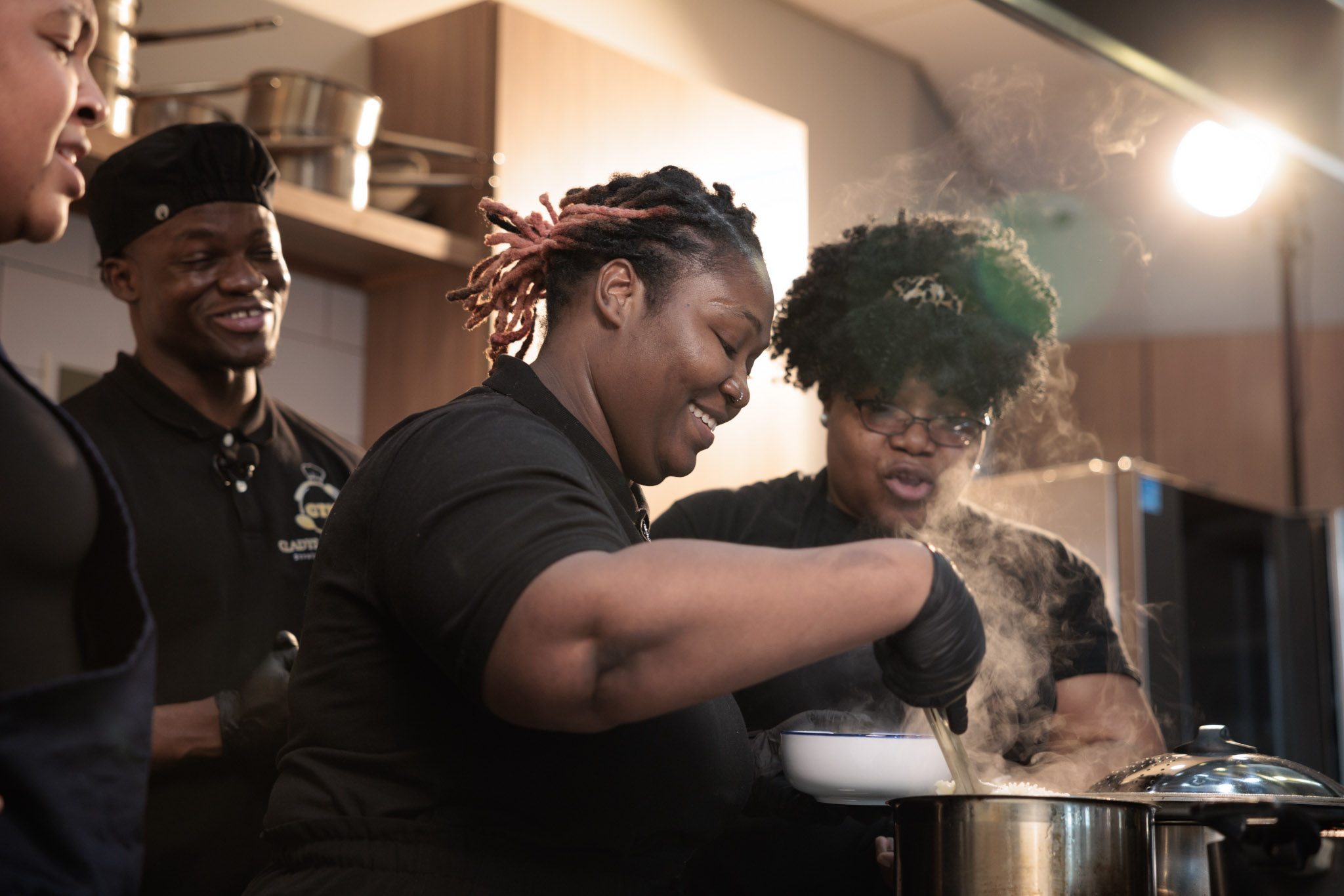
They did not know that Joachim owned and operated a Haitian catering business with his mother. It started as friends and family telling his mother she should cook professionally and eventually grew into GladysTastyMealsLLC, named after his grandmother. Joachiam, who is now a student at Syracuse University’s School of Information Studies majoring in applied data analytics, quickly realized that Syracuse lacked Haitian food. When he joined student organizations at the university and his mother would cater, he realized people were hungry for the cuisine.
Joachim recently won a business competition at the university’s Blackstone Launchpad for his Haitian food business. The two are working toward opening a food truck, bringing the food his grandmother taught his mother to cook to people who have never tasted it.
“I get it, but propagating that kind of rhetoric, you don’t know me or my story,” Joachim said. “Moments like that I despise a lot because not only are you enforcing such a negative mindset to people in your community, you’re coming in already not trying to be understanding of my situation growing up.”
A love of cooking
Joachim’s mother, Sherly Joseph, was 5 when she could fully cook her own dish, growing up in the family restaurant business.
She was expected to come home from school, wash her hands and get to work. Every day the routine was the same. Come home, put on your apron, wash your hands and get to work.
It was not just her. Every child in the family received the same initiation. While other children played with dolls, Joseph’s mother, Joachim’s grandmother, gave her daughters real kitchen sets. Real pots. Real tools. The dolls they did receive were not for playing either. They were for braiding hair, practicing the kind of skills that would be expected of them as they grew older.
Joseph describes the skills as a gift.
“I love cooking,” she said. “I think it’s because of that that I have that passion. When you come to cooking, I put all my heart on it, all my love.”
For her family, teaching a child to cook and clean was not a burden. It was preparation. It was their heritage.
“It’s a part of survival.”
When Joseph came to Syracuse at the age of 17, following her father who had immigrated in 1993, that tradition followed her. She cooked three times a day. She was up by four in the morning getting breakfast ready for her family, then lunch, then dinner. She spent her days at the grocery store and in the kitchen.
There was one exception: a cheat day, once a week, usually Friday or Saturday, when the kids could choose pizza or Applebee’s. They would eat so much junk food they ended up with stomach aches. It was the only day, so they went all out.
When Schneider was born, he was her shadow in the kitchen. Joseph called herself the “mama dog” and him the “baby dog” because he was always right behind her. He knew what vegetables she needed, how to cut them and how to wash them.
He knew what they were cooking on each day of the week. Around age 10, when he was responsible for taking care of his younger siblings and watching his mother work in the kitchen, he started cooking seriously.
He learned to make labyoui, a Haitian plantain porridge that requires boiling, cutting and blending.
“The least you can do is make sure your home is clean,” Joachim said. “Make sure, if there’s nothing crazy, you can make them breakfast, make them coffee, stuff like that.”
His younger siblings, all born in America, never learned any of it. Joseph never pushed it on them the way she had with Schneider.
“My siblings were born here and my mom didn’t reinforce any of that,” Joachim said. “The western lifestyle got to her.”
Change in culture
Joseph was teaching her youngest child and only girl to cook. She put a knife in her hand when her mother-in-law walked in and started screaming. Joseph froze.
“’Okay, what?’” Joseph said. “’Am I doing something wrong?’”
What if the police come? What if someone calls? In Haiti, when you cut a finger you simply place salt and lemon juice in warm water and a few days later it heals. In America, it meant something else. It often led to questioning whether a mother was capable of ensuring her child’s safety.
“‘What do you mean, what if police come? Police can’t just show up here without you calling?’” Joseph said. “But that never stopped me anyway.”
This made Joseph question the things she wanted to teach her kids. She knew that back home this would never be a problem. But in America, others outside her family and culture were watching. It made it difficult to pass on what she knew. Her mother-in-law’s warning was always the same: what if the police come.
Joseph replaced the knife with a plastic toy kitchen set for her daughter.
Research calls this phenomenon generational acculturation, the process of immigrant families adapting to the cultural norms of a new country. It describes the gradual process by which immigrant families adopt those norms, often without realizing it is happening. It starts as a plastic kitchen set instead of a real one, french to english, or the belt that she always kept in a bag to discipline her kids that eventually stayed home.
Carrie Smith, a professor of social work at Syracuse University, said that one of the main challenges immigrant families face is having their cultural practices misread by outsiders.
“People react to something they do not understand the intent involved in the practice,” Smith said. “They respond with a cultural view or a cultural bias that doesn’t give room sometimes even for the family to fully explain what it is that’s going on.”
Smith said there is a long history of differential treatment of children of color in the child welfare system. This history trickles down to immigrant parents, especially those of color.
“When something is done within one context it might be viewed as normalized in this culture,” Smith said. “But when it is done outside of that, it’s viewed as more harsh or negative.”
Loss of language
The language was the next thing that was lost.
When Schneider and his two younger siblings started school, they switched between French, Creole and English mid-sentence. The school placed them in language support classes. Joseph made a decision. She stopped speaking Creole at home.
“That was the only thing we changed in our culture for them to be able to be comfortable,” Joseph said. “And that’s something I regret at the same time but there’s no going back.”
It was hard trying to communicate with his grandmother, Joachim said. She never learned English. His siblings speak almost no Creole. The love was there but the communication was not.
The experience of Joachim is not isolated, according to a study published in PubMed Central, second generation Haitian Americans must navigate three cultures simultaneously: American culture, Black American culture and Haitian culture. Researchers say this cross-cultural dynamic creates something called acculturative stress, the tension that comes from trying to integrate into a new culture while maintaining your original one.
Joachim said he understood why his parents made the choice but has never stopped feeling the weight of it.
“When I first came to this country, I was so fluent,” Joachim said. “But over the years they just didn’t speak it in the household because they wanted us to be Americanized. I can’t speak my language to save my life and that’s actually kind of embarrassing.”
Cooking together
The irony is that the independence Joseph was instilling into her children through cooking is something American parents are now paying to replicate. Montessori schools introduce children as young as 18 months to cooking and call it child development.
According to the Montessori Academy, cooking is part of what the curriculum calls practical life activities. These activities are designed to build independence, concentration and responsibility in young children. They can include peeling and cutting a banana.
Joseph already knew this without the research or the tuition. She knew it from experience. She had learned to cook, and so had her children and all her siblings. That was proof enough that these skills are essential at a young age.
When Joachim was growing up in Syracuse there was nowhere in the city to get Haitian food. If he wanted something from his culture he either had to learn to make it himself or ask his mother. This became the motivating factor for his business GladysTastyMeals.
Joseph’s daughter now lives alone in New York City, where she cooks for herself.
One day Joseph received a call. Her daughter told her that when she was younger she had tried to ignore all the skills her mother wanted to teach her. Now as an adult she understood.
“I never thought that my princess would come to me and say thank you for trying to teach her how to cook and clean and to be able to stand on her feet when she’s alone,” Joseph said.
They hugged. Then they cooked together.
Schneider still wears the hoodie. The cooking survived even when the language did not. He cannot speak to his grandmother in her language but he can make her food.
A digital journalist from Compton, California.
More from Journeys
Immigrants and ethnic eats fuel Salt City in Syracuse
Story by Jai’La Du Rousseau

SU student’s nonprofit delivers food to Kenya
Story by Jai’La Du Rousseau
“Not a real Haitian”
Story by Jai’La Du Rousseau
LA street vendors risk deportation to work
Story by Lizbeth Solorzano
Syracuse’s Italian Americans keep culture alive through charity
Story by Sofia Kissel Photos by Rebecca Beckas

Suddenly uprooted
Story by Delia Rose Sauer & Vera Lucia Pappaterra