


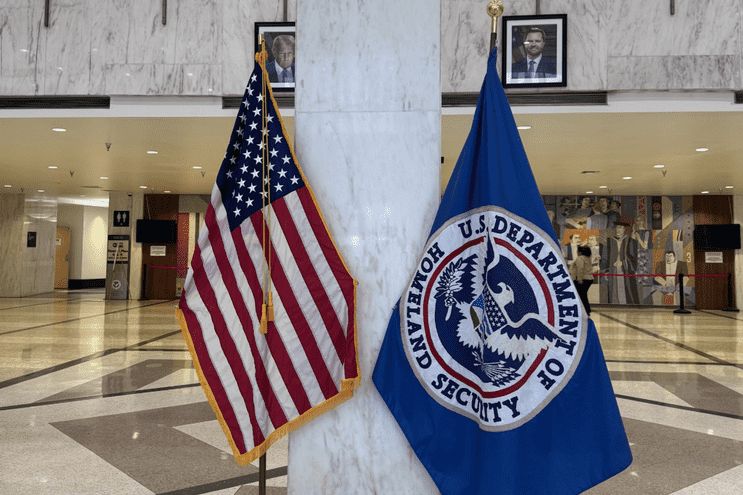
Upheaval in the immigration courts
How firings and other dramatic changes are affecting the immigration court system – and due process.
One afternoon last November, former San Francisco immigration judge Jeremiah Johnson was talking with his supervising judge when a colleague walked by with bad news: two of their fellow judges had been suddenly fired. He remembers going over to console them.
“I went around that afternoon, you know, in the half hour or so saying goodbye to them…giving them resources and, you know, ‘here’s what you need to do,’ and just being there for people fired,” Johnson recalls.
Then he went back to his chambers: “I logged on, and I saw that I, too, had been fired as well.”
It was “a bit surreal,” as Johnson remembers it. “You know, you’re expecting it. But when it comes, you’re trying to make sense of it. To this day, it still doesn’t make sense.”
Johnson became one of more than 100 immigration judges fired by the Trump administration since last year. He’d been on the immigration bench since 2017, appointed during the previous Trump administration. Like other recently fired judges, he was not given a reason.
”The law says you cannot fire government employees in my position without cause,” Johnson said. “And yet no cause was given.”
Johnson finds it especially frustrating that this would happen in “a court system designed to adjudicate the most important cases, perhaps,” he said. “These are cases of life and death, of people fleeing from persecution.”
Sudden purges
As the Trump administration pursues its deportation agenda, the firing and replacement of immigration judges around the country is leaving the immigration courts’ future in limbo, as well as that of millions of people with pending immigration cases.
By early this year, the Executive Office for Immigration Review, as the courts are known, had lost roughly one-quarter of its judges around the country.
There were reports of sudden purges in cities like San Francisco and New York, courts where asylum grants outpaced denials, and of firings around the country.
Judges report being fired without explanation, leaving them in the dark for what’s next in their careers as they are taken off the bench. Some have sued. While not given cause, some of the fired judges had lower asylum denial rates than the national average, and an NPR analysis also found that some had previous legal backgrounds in immigrant defense.
The Trump administration has made efforts to replace the fired judges with new and temporary immigration judges, most with military backgrounds, in an effort to move with the president’s goal of fast-tracking asylum cases and quickly dismissing them. The administration has also used advertising recruitment calling for so-called “deportation judges.”
The intent of the administration is clear, say some long involved in the immigration court process.
“I would say that there’s almost no due process left in immigration court,” said Nick Frenzen, clinical professor of law and co-director of the USC Gould School of Law Immigration Clinic.
Judge Dana Lee Marks, a retired immigration judge who served for 35 years in the San Francisco court, points out that the EOIR is part of the executive branch – and that the recent firings and restructuring under the Trump administration are a direct result of this.
“It really has come to a head under the Trump administration because of the fact that they are exploiting the weaknesses of having the court be an executive branch agency rather than a judicially independent group,” said Judge Marks.
No judicial independence
The Executive Office for Immigration Review is part of the U.S. Department of Justice. Immigration judges are appointed by the Attorney General, who answers to the president.
Because the immigration courts are part of the executive branch within the Department of Justice, Frenzen said, “they are not independent to the extent that any court is independent anymore.”
The immigration courts operating as part of the executive branch also means that the immigration court system is readily influenced by political pressure.
Frenzen said that as judges see their fellow colleagues get fired because they are ruling against the government and in favor of the non-citizen in a immigration proceeding, they feel political pressure as to how to rule.
“That has an impact on remaining judges who want to keep their jobs, because they see the writing on the wall,” Frenzen said.
Some have faced direct consequences: In April two immigration judges, Roopal Patel and Nina Froes, were fired after respectively dismissing deportation cases against Rümeysa Öztürk and Mohsen Mahdawi, two pro-Palestinian students arrested for deportation last year as part of President Trump’s campaign against the Gaza protest movement.
Immigration court data compiled by the Transactional Records Access Clearinghouse, or TRAC, at Syracuse University illustrates the shift in court outcomes. Between August 2024 and August 2025, the rate of asylum grants fell by half. These rates have continued to drop. Out of 2,275 immigrants granted some kind of immigration relief by judges in March 2026, only 700 won asylum. By contrast, there were 2,753 asylum grants in March 2025.
Out of 36,040 bond hearings held so far this fiscal year through March, only 9,930 people were granted bond, which allows immigrants to stay out of detention as their cases are heard.
The Trump administration has also made it more difficult for immigrants to obtain due process and relief from the Board of Immigration Appeals, to which cases from the immigration courts are appealed. The administration has reduced the number of judges on the board by almost half, removing those appointed by former president Joe Biden while keeping Trump appointees.
Judge Marks said this will affect how appeal cases are processed.
“The Board of Immigration Appeals is so politically oriented and has such a heavy burden of the Attorney General breathing down their necks and looking over their shoulders,” Marks said. “They’re going to uphold denials much more often than they are going to uphold immigration judges granting the case.”
More no-shows, in absentia orders as a big-city court closes
As Trump’s immigration crackdown continues, there has also been a growing number of no-shows in immigration court, people not appearing, which typically results in removal orders in absentia. In some cases, people don’t realize that the immigration court has changed their hearing schedule to a different date.
Frenzen, the USC immigration legal expert, said that often there are language barriers to blame, as people may not understand the court proceedings.
“It’s not an unusual event for people to not understand that they had…an initial court hearing and that they were required to go, ” Frenzen said, “not because they’re trying to abscond or violate the law, but just because they don’t understand these five or six pages of English documents that they’ve been handed after they’ve been released from detention.”
Courts having to move cases as judges are fired has also contributed. In March, immigration judges in the beleaguered San Francisco court ordered 800 in absentia deportations in just one week. KQED reported that rapid changes in the court, which lost most of its judges and recently closed its main location, had led to court hearings being suddenly rescheduled, with some hearings moved up by two years.

Photo by Dreamyshade / Wikimedia Commons
The exterior of 100 Montgomery Street in San Francisco, which housed the city’s main immigration court until it closed in early May.
According to Judge Marks, if it appears that notice of a hearing has been mailed to someone, unless there is reason to believe the address is not valid, “the judge has to go ahead anyway, and hold the hearing in their absence, which means that they can’t defend themselves, and the government is always going to win, and they’re ordered deported,” she said.
Marks worries about more people losing their right to due process in the Bay Area. With the closure of the main San Francisco court at 100 Montgomery Street, cases are being rescheduled and moved to Concord, Calif., some 30 miles away.
“In absentia hearings take place when someone is not in court at the right time in the right place,” Marks said. “So how many more in absentia hearings are going to take place?”
Only two courtrooms in San Francisco are expected to remain open as satellites in a different building under jurisdiction of the Concord court.
Marks points out that people who rely on public transportation must take a train to Concord. She says the closure of the court deprives people of access, and that it’s unfair to the population it serves.
“It’s so blatant. It’s transparent, in my mind,” she said. “So the excuse for closing the San Francisco immigration court is that the lease was up. But what about the public that they serve? Find another building in the San Francisco area, right?”
A continuing backlog of cases
At the end of March 2026 there were 3,288,186 immigration cases pending. This backlog is slightly smaller than it was in late 2024, but the arrests of immigrants continue, and the upheaval in the courts doesn’t help, said Frenzen.
“There have been more judges fired or resigned, [and] replaced, so that just makes the backlog worse,” Frenzen said.
The Trump administration has taken steps to expedite removal cases for immigrants, also making it tougher for them to obtain due process. The expansion of detention centers, where people are held as their removal cases are expedited, has made it difficult for immigrants to challenge their deportation case, especially without an attorney.
For many immigrants, acquiring legal representation is already tough since the cost represents an economic hardship, and they don’t receive any representation at government expense.
‘No cause was given’
Jeremiah Johnson, who remains executive vice president for the National Association of Immigration Judges, the judges’ union, remembers how things began to shift in the San Francisco courthouse last year. During the first Trump administration, he’d typically heard three cases a day.
“You can imagine, if you have a hearing for your life that you fear harm, you know, you would want this trial that lasts longer than three hours, right?” he said.
This time around, the caseload doubled as policies shifted.
“Now, I was doing six,” Johnson said. “So the pressure came from moving faster, more work. I never was given direct pressure as far as told how to rule.”
He and other judges were also hit with motions to re-calendar cases that had been administratively closed.
“They wanted to schedule all those cases, and so you had thousands of motions that you had to hear, to get them back on,” he said.
He added: “Why would I be given this additional work, if they were going to fire you?’”
Now, with most of his colleagues dismissed and the immigration court he worked in closed, Johnson says the closure is going to be felt in the Bay Area as immigrants see longer delays and less due process.
“People are going to wait. People are going to be in legal limbo, not able to resolve their case one way or the other,” Johnson said . “That doesn’t align with the mission of EOIR. The Executive Office for Immigration Review that says they should fairly adjudicate things expeditiously. This is not expeditious.”
Both Johnson and Marks point out a need for the immigration courts to function independently of the executive branch.
“You have to totally take the immigration court out of a political branch of government and make it an independent judicial function, because that is what the law, currently even, asks judges to do,” Marks said.
A House bill introduced in March by Bay Area Democratic Rep. Zoe Lofgren seeks to turn the immigration courts into an Article 1 court, something the judges’ union has long advocated for.
“Immigration judges are supposed to be neutral adjudicators,” Marks said. “We are supposed to figure out what the facts are in a given case, and then apply the law that governs to those facts, to decide if somebody has met their standard or not. And how can you do that in this setting with the political interference?”
Marks answered her own question: “You can’t.”

A digital journalist from Seattle, Washington.
More from On The Docket

What is a habeas corpus petition?
Story by Laura Robertson & Mikayla Melo

Immigrant youth risk losing special protection status
Story by Izabell Escobar
Notario fraud persists in Chicago as the Trump Administration toys with immigration courts
Story by Vani Subramony Graphics by Jesse Renee Kennedy

Closed door justice
Story by Suzgo Chitete
Interpreters can shape asylum hearings
Story by Wesley J. Pérez Vidal & Ben Butler & Olivia Boyer Photos by Cassie Roshu
Chaos and confusion inside Omaha’s Immigration Court
Story by Justin Diep