


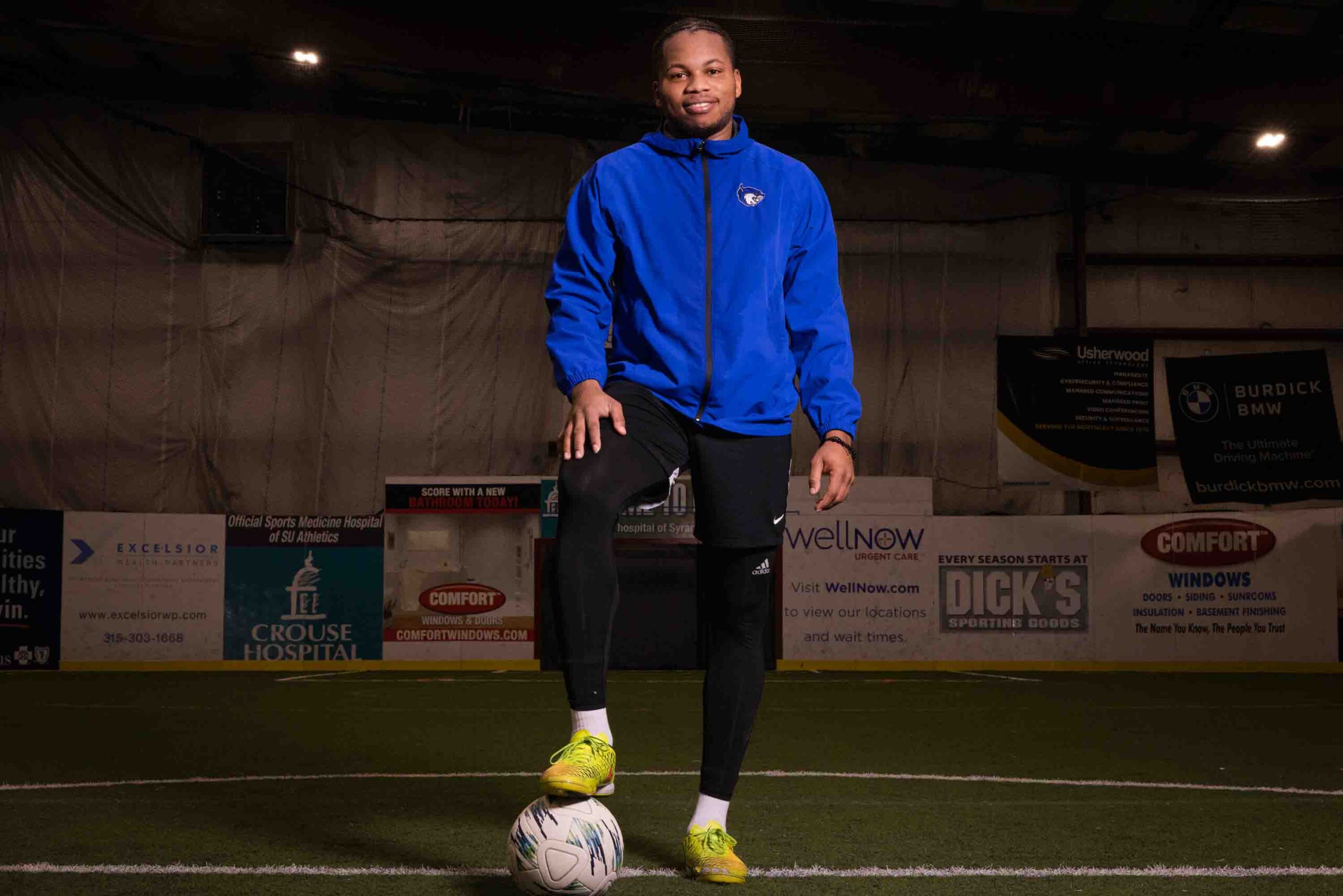
More than minutes: How international students navigate competitive collegiate soccer
For international soccer players at Bryant & Stratton College, every minute on the field comes with financial, emotional and professional stakes.
The office at the Massasoit Community College soccer facility was quiet when Jhonny Zamor sat down across from his head coach. He had lied to get out of training that day, half-convinced that his time playing in Massachusetts as a Massasoit Warrior was over. For the international student from Haiti, the weight of working part-time, grinding through classes and competing for minutes on the pitch stopped feeling like a sacrifice and more like a sign. Perhaps it was time to put soccer on hold to reconsider his options.
Zamor’s coach wasn’t angry with him for skipping practice. Instead, there was an offer on the table: Bryant & Stratton College’s Syracuse campus offered him a full scholarship to play as a defender for their national championship-winning soccer program.
“That was a life-saving opportunity,” he said. “I said, ‘Thanks God, I’ve been waiting for that.’”
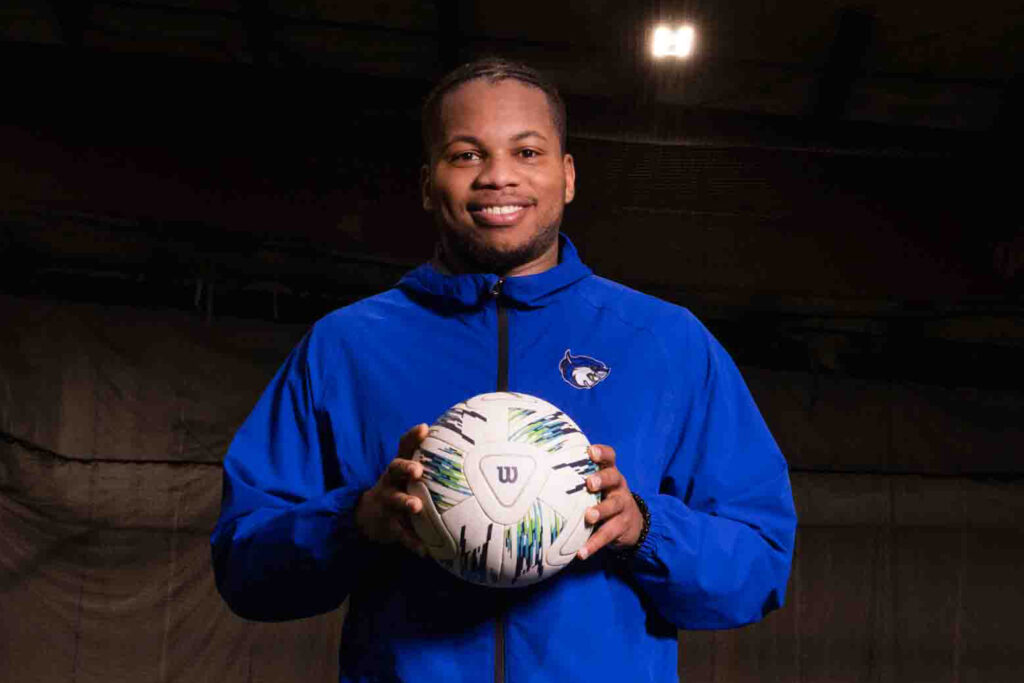
Photo by Ella Chan
Coming to Cuse
Far from home, closer to a goal
Jhonny Zamor traveled from his small hometown of Petit-Goâve, Haiti, to Bryant & Stratton College's Syracuse campus. In this episode, Jhonny talks about his lifelong dream of a professional soccer career.
Now Playing
Far from home, closer to a goal
Produced by Rohan Borges
Across the United States, college soccer has become a major entry point for international players seeking professional playing careers. But making it to a professional team in the U.S. starts with intense competition, limited playing time and challenges many players don’t fully anticipate before they arrive.
“When you first come here, everyone around you is basically the same as you,” said Tyrese Osayande, a forward from Coventry, England. “Everyone has the same goal: Everyone wants to go pro. That can be very challenging, mentally.”
More athletes means more competition
From 2017 to 2022, the percentage of international athletes on men’s NCAA soccer rosters jumped from less than a third to nearly two out of five players. Of the 28 athletes that made up an average 2022 NCAA soccer roster, around 11 were likely to be from overseas compared to fewer than nine in 2017. Across all NCAA college sports, the number of international athletes playing in the U.S. increased by more than 16% in the same time frame — a gain of more than 4,000 athletes.
With more players from overseas steadily making the journey to compete at a high collegiate level in the U.S., even the multiple divisions of the NCAA don’t have the roster space to accommodate them. Some players must accept scholarships from teams in the National Junior College Athletic Association for two-year junior college programs or United States Collegiate Athletic Association Division I & II schools, which include community colleges. At colleges like Bryant & Stratton, a USCAA institution, players seek to establish their names in order to move up to the NCAA or even gain professional consideration.
“There are players that I’m probably better than playing in a higher league. However, there are players in lower leagues who are probably better than me,” said Tyric Mcallister, a 26-year-old forward from Guyana. “From my perspective, it’s about connection, but it’s also about your ability.”
In the USCAA Division I this season, at least 40% of the 585 student-athletes listed on official rosters were from outside the United States, and this figure jumps above 50% when excluding players without a listed nationality.
“Soccer is totally different than any other college sport,” said Bryant & Stratton Head Coach Ryan McGee, who played in the NJCAA before beginning his coaching career. “There are millions of these kids who want to come here on scholarships. Hundreds of thousands of them at a higher level than our high school players. It’s a massive industry… and sometimes the players don’t realize they’re part of that.”
At Bryant & Stratton, the soccer team included 14 different nationalities over the past three seasons. This season’s roster consists of 24 players, 22 of whom are from abroad. Players said adapting to this new and ever-evolving environment means not only adjusting to a new culture, but also learning to survive and grow under pressure.
“There’s always tension because everyone is on their own journey. People are going to feel a certain way about you because they think you’re not thinking about the team,” Osayande said. “But realistically it’s your journey and everyone has to move above everyone else to get somewhere.”
Although data from Divisions II and below are limited, just 0.8% of male NCAA Division I soccer players receive professional offers after college.
When playing takes a toll
The hard work players put in for the opportunity to join a USCAA Division I school like Bryant & Stratton is only the first step. Now playing at the collegiate level, student athletes are competing for limited playing time and relying on coaches and scouts for opportunities to advance their careers. Players must produce goals and assists during their time on the pitch. Without quality highlights or tangible evidence of a return on interest, their futures as athletes become uncertain.
“The school can only lose so much money. They have to draw the line somewhere,” McGee said. “Sometimes it breaks your heart. They have the best attitude, all they want to do is play for you … and you just can’t find a solution.”
Life off the pitch also isn’t easy: Living in the United States is expensive, and for many international players, visa restrictions mean they can’t work to support themselves.
“My scholarship only covers 60% of my tuition, so I need about $4,700 to pay the rest,” Mcallister said.
Players must also grapple with the unexpected: Mcallister described a leg injury he sustained last season as one of his darkest moments, forcing him to regain the coach’s trust and re-establish himself in the rotation.
“Picture yourself praying for an opportunity and you got it, and then someone just kills your spirit,” Mcallister said. “You’re not motivated anymore. You just want to not play anymore. That’s the feeling.”
Players said they continue to rely on something much more steadfast than the system itself: their community as a team.
“You all come from different countries, but we all speak one language, and that’s soccer,” Osayande said. “Everyone comes together to play the same game, and that’s how we communicate. Even if our backgrounds are different, the game gives you something shared right away.”
Building community off the pitch
For some players, becoming familiar with a new environment takes time. But the sting of being far from home and away from family always lingers.
“For international players, if you don’t have family around you, it can really affect you,” Osayande said, quietly. “I went through a tough period last year where I felt very alone. The support from my family back home gave me the motivation and discipline to keep going.”
International Student-Athletes
Map showing player origins and routes to Syracuse, New York
Where the Bobcats Come From
The 2025-26 Bryant & Stratton College men's soccer roster spans the U.S., Canada and four continents. These paths represent each player's journey to Syracuse.
Source: BSC-Syracuse Athletics 2025-26 men's soccer roster
At Bryant & Stratton, players said support also grows naturally within the locker room. Former team captain Jessie Kwasi, from Ghana, said brotherhood keeps them grounded.
“Most of the time, the relationship we build is mostly between the players,” he said. “We end up asking for more help from teammates than we do from the coach. The coach is there, and he helps when you reach out. But we spend most of our time together: living together, eating the same food, being in the same apartment.”
Over time, that togetherness evolves into its own lifeline. When recruits arrive, the older players ensure they feel like part of the family. Teammates bond over their shared struggles and stories of off-the-pitch success and perseverance, Kwasi said. The team leaders set a culture of diversity and inclusivity so that newcomers can fit in seamlessly.
“We have small traditions,” Kwasi said. “When we’re driving somewhere, we play music from Haiti, from Africa, from wherever someone is from. We just vibe and laugh.”
The players said that as teammates, they communicate through movement and instinct. The coaching staff watches it unfold each season.
“The glue of the team is just a very strong love for the game of soccer,” McGee said. “That’s what always pulls them together.”
By the end of practice, as the players pack up their bags with sweat-soaked training kits and ice-cold water bottles, laughter and joy engulf the pitch.
“A lot of us are making sacrifices just to be here,” Zamor said. “But every time we play together, it reminds me why I came.”
For some players, the grind pays off. After earning his degree, Zamor took on a role on Bryant & Stratton’s technical coaching staff. Kwasi signed with the Fourth Division National Premier Soccer League team, Virginia Dream Football Club, at the end of the season.
A digital journalist from West Orange, New Jersey.

A digital journalist from São Paulo, Brazil.

A photographer from Temple City, California.
More from Coming to Cuse Podcast
View All Stories
Making time for traditions
Story by Kira Desai & Olivia Boyer & Maya Aguirre
International students come to US to chase their dreams
Story by Trinity Corbett & Kyra Wood & James Mullarkey & Max Olson

European hockey prospects fight for their spot in the NHL
Story by Will Broad & Josh Solomon Photos by Ike Wood

Syracuse’s Italian Americans keep culture alive through charity
Story by Sofia Kissel Photos by Rebecca Beckas
How international students navigate collegiate soccer
Story by Rohan Borges & Felipe Ferraz de Souza Miranda Photos by Ella Chan

How Syracuse’s immigrants navigate a changing system
Story by Sara Oppenheimer & Evan Edmiston Photos by Christine Kao