


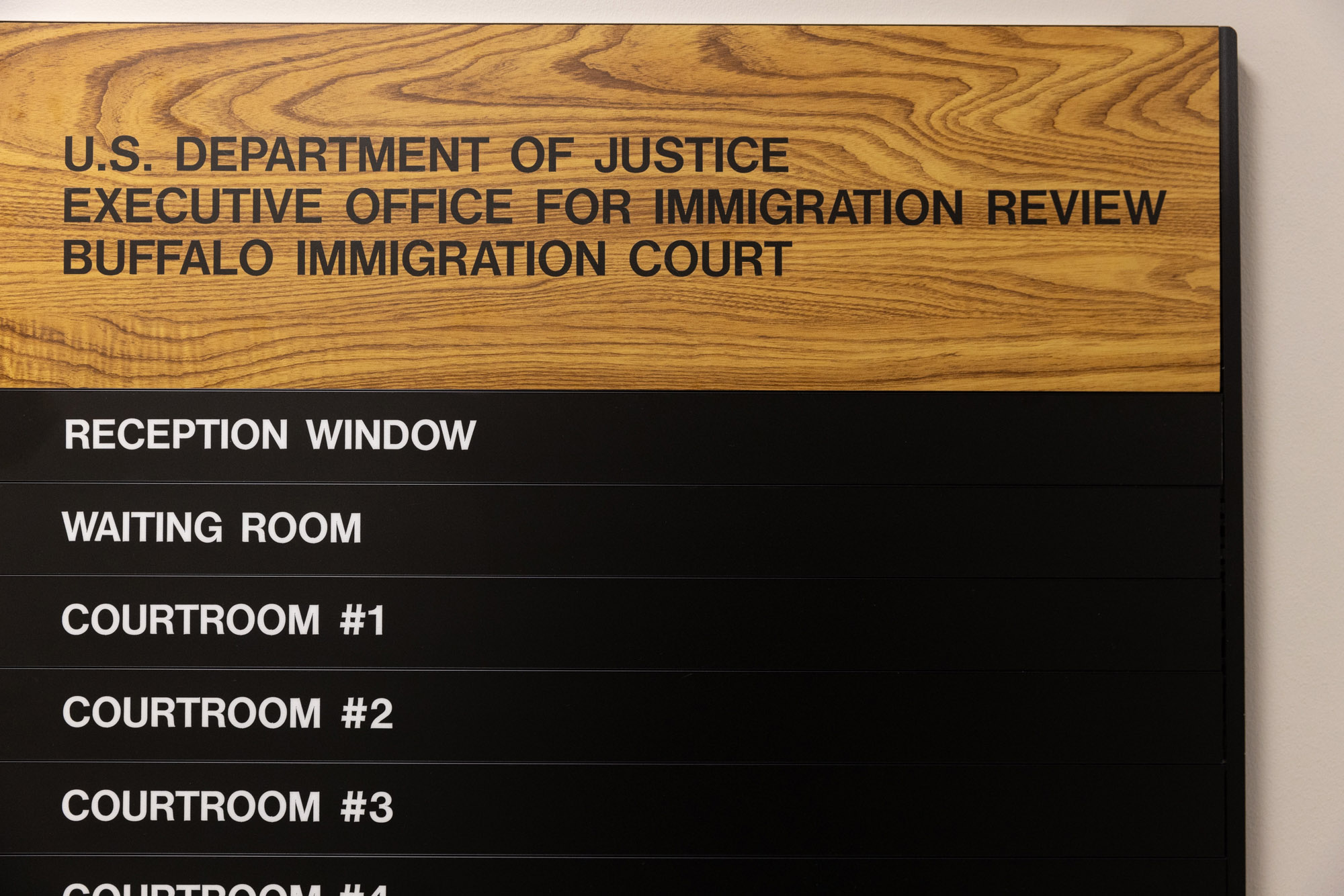
High-stakes translation in immigration court
In Buffalo Immigration Court, asylum seekers must explain fear, trauma and legal timelines through remote interpreters as federal spending on private language services grows.
A young father struggles to explain why he is afraid to return to his native country of Venezuela with his wife and child.
He does not have a lawyer to help tell his story.
The translation is halting. The interpreter works for SOS International LLC, an aerospace and defense contractor that also provides language services for immigration courts. He appears by video conference.
At one point, he throws up a hand, pleading “un momento” as he tries to keep up.
The Venezuelan man’s wife tries to help him explain. But she isn’t the one sworn to testify. Lohr silences her.
A few minutes later, her husband brings his finger to his lips as he senses his wife is about to speak again.
In Buffalo and other immigration courts across the country, the difference between staying in the United States or being ordered deported often depends on words spoken through an interpreter appearing by telephone or video conference. Syracuse University reporters observed interpreters being used in nearly 84% of the 66 proceedings they witnessed in Buffalo, Batavia and New York City.
Those interpreters must communicate the legalese of immigration court to the respondents, and then translate back to the government lawyers and immigration court judges the stories of asylum seekers that often include traumatic events, complicated timelines and layered family relationships.
In a Buffalo courtroom on Feb. 12, the digital dial tone of a remote translation service echoed through the room as Judge Lohr attempted to connect with a Haitian Creole interpreter for a Syracuse couple seeking asylum.
The court’s contracted interpretation service, Lionbridge, played an automated message four separate times asking the courtroom to continue holding for an interpreter.
When an interpreter finally joined the proceeding, another problem emerged: volume.
The Haitian husband, dressed in a white button-down shirt and black vest and carrying a suitcase filled with documents, and his wife, wearing a rose-gold coat and holding her own paperwork, spoke quietly into the courtroom microphone.
Erin Adams, the government attorney, stood, walked to the table where the couple sat to her left, and physically moved the microphone closer as Lohr instructed them to speak louder so the interpreter could hear them.
The hearing slowed as the court worked through translation, record keeping and filing instructions. Lohr informed the couple they would need to submit all supporting documents in English at least 30 days before their next appearance. Any translated materials would require certification from the person assisting with the translation.
The heavy reliance on remote interpretation reflects both the scale and logistical complexity of immigration court proceedings, where respondents speak dozens of languages and many courts operate with limited resources. The Newhouse School journalists heard 11 different languages spoken in the hearings they witnessed: Arabic, Bengali, Chinese, Creole, English, Lingala, Pashto, Punjabi, Russian, Spanish and Urdu. Along with Focal Point reporters from other universities, Lives in the Balance documented nearly 40 languages spoken in immigration court.
Immigration courts are administrative courts, not criminal ones, but the outcomes can permanently alter the course of a person’s life.
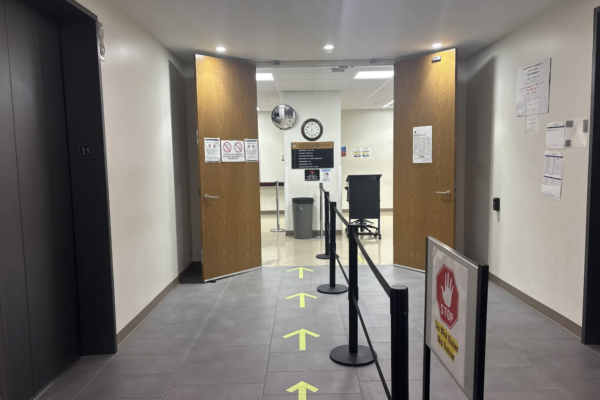
In the Buffalo court waiting area, a young girl sat on the floor coloring in a book from a small stack of children’s literature while guards directed respondents through a security checkpoint requiring belts to be removed and handheld metal detector scans across the front, back and bottoms of shoes.
“Okay, you can go,” one guard told a visitor after the final sweep.
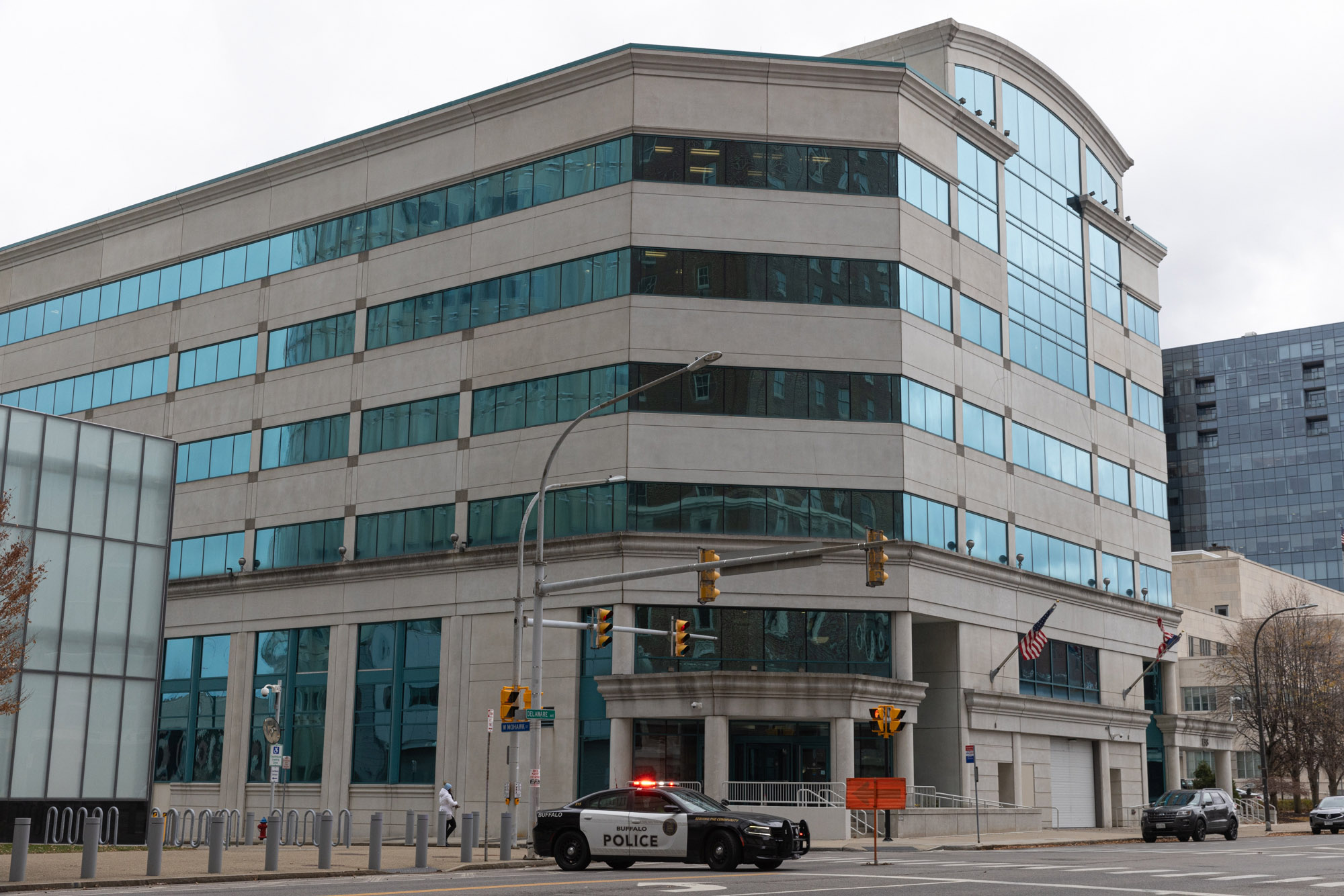
Photo by Cassie Roshu
The downtown Buffalo building where federal Immigration courts are located.
Inside the courtroom, nearly every interaction depended on interpretation.
Federal contract records show the government’s reliance on private immigration court interpretation has grown sharply over the past decade. Lionbridge received an annual contract for interpretation services worth about $14 million a year in 2016, according to The National Association of Judiciary Interpreters and Translators. The Justice Department’s Executive Office for Immigration Review signed a deal with SOS International, also known as SOSi, that set aside up to $400 million for translation and interpreting services, federal procurement data compiled by Federal Compass shows. SOSi won another contract, this time for $126 million, for services from September 2024 to January 2026, according to HigherGov, another federal contracting database.
The government moved to expand that work again after Trump returned to office. HigherGov records show the Executive Office for Immigration Review awarded SOSi a new court interpretation contract on Jan. 20, 2026, for up to $875 million. SOSi said in a statement the work includes in-person, telephone and video interpretation, written translation and transcription for immigration proceedings nationwide.
At the same time, the policies on language services inside immigration detention have shifted.
In 2023, the Executive Office for Immigration Review issued guidance directing immigration judges handling detained cases to familiarize themselves with language-access resources available in detention facilities, including translation services offered through facility libraries. That guidance, known as Director’s Memorandum 23-02, was rescinded at the beginning of 2025.
The memo rescinding the policy criticized the earlier guidance as “paternalistic and patronizing.”
Back in Judge Lohr’s courtroom, the Venezuelan couple’s case continued. A Spanish-speaking reporter from Syracuse University observing the hearing noted a discrepancy involving Anthony’s educational background. Anthony told the court he had completed “cuarto año,” a phrase commonly used to describe a high school-level education. The proceeding recorded it as “fourth grade.”
Despite these difficulties, the man’s story comes into focus. The police arrested him while he played bingo and tried to extort money from him, which he did not. The man tells Lohr they then planted drugs on him and imprisoned him until his family could come up with the money. When his family paid, he fled the country in fear of it all happening again.
“I believe you,” Lohr tells him, visibly moved, her voice soft and sympathetic. “I believe everything you said happened to you and I am very sorry that happened to you. And I understand why you are afraid to go back.”
Then she orders him removed from the United States and returned to Venezuela.
He’s free to appeal. But it is clear he does not have an asylum claim that is likely to succeed in the current environment.
A digital journalist from Puerto Rico.

A digital journalist at Syracuse University.
A digital journalist from Akron, Ohio.

A photojournalist from Oregon.
More from On The Docket
Chicago’s immigration attorneys adjust to Trump’s policy changes
Story by Madison Roth
Due process at risk in Trump’s immigration courts
Story by Bryan Nicolas-Nicolas
Immigration courts face pressure to move faster
Story by Tymber Klahr Photos by Ike Wood
Interpreters can shape asylum hearings
Story by Wesley J. Pérez Vidal & Ben Butler & Olivia Boyer Photos by Cassie Roshu
Trends, jargon inside Chicago immigration courts
Story by Clare Kirwan
Immigration Court Guide
Story by Project Staff