


Bond without bounds
The unchecked price of freedom from immigration detention.
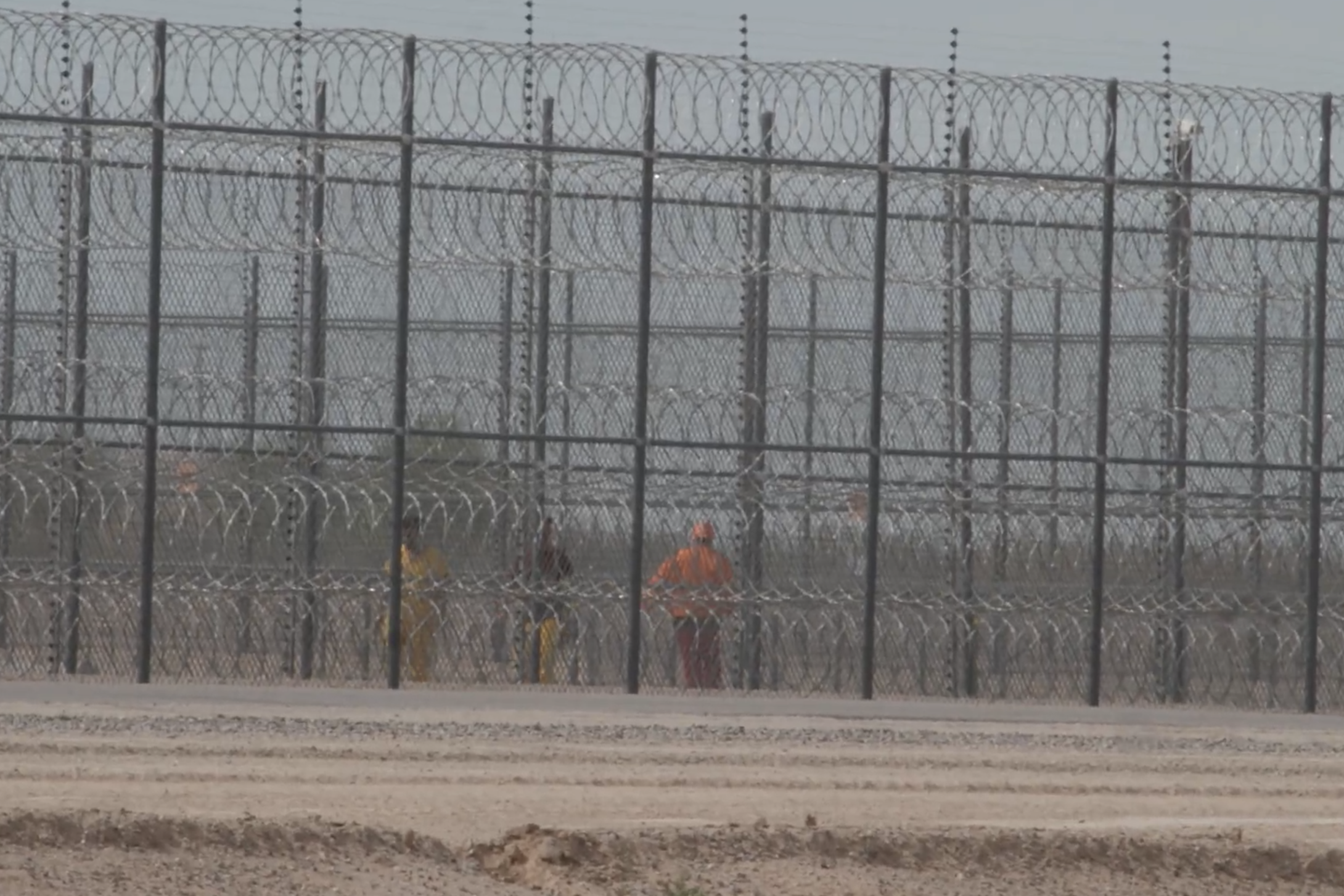
A middle-aged man detained by U.S. Immigration and Customs Enforcement, with no criminal record, a 15-year history with his local church, and a U.S. citizen wife and children, sat in an Eloy, Arizona, immigration court, after a judge declared him eligible for release. But his freedom came with a price tag: $12,000.
That amount, set by Immigration Judge Michael Schnitzer, is eight times higher than the federal minimum, another hurdle for immigrant families already struggling under the weight of a detention case. That is the financial reality for the three in four immigrants detained in Eloy whom ICE recognizes have “no criminal convictions,” according to the agency’s fiscal 2026 detention data. They might otherwise meet the requirements to be released on bond: reliable to appear for court dates and not a danger to the community.
While the U.S. Constitution protects criminal defendants from excessive bail, an analysis from the Howard Center for Investigative Journalism at Arizona State University found that no such protection exists in the federal immigration court system. In a loophole that stretches across the country, the price of liberty is left to the discretion of judges who, without specific guidance from the U.S. Department of Justice, are not required to consider whether a family can afford to pay.
Using Arizona’s courts as a window into this national system, a data analysis of 10 active immigration judges presiding over bond cases reveals a broad lack of consistency. In 2025, one Eloy immigration judge set an immigration bond more than 30 times higher than another judge in the same building. Following a Department of Homeland Security memo to ICE officers in July 2025 and a landmark September 2025 court ruling that stripped bond eligibility for most people in the country unlawfully, the few who still qualify for a bond hearing find that a judge’s whim — and a family’s bank account — have become the ultimate arbiters of justice.
The Howard Center reviewed court data from January 2025 to February 2026 and found detainees in Arizona have had to pay bonds as high as $50,000. Arizona judges mostly set bond three to seven times the $1,500 minimum.
“It would be better if there were some type of guidance so that (immigration judges) can have more consistency in the way that they provide bonds,” said Adriel Orozco, a senior policy counsel at the American Immigration Council.
“Without taking into consideration the person’s income level, some of these bonds are effective denials,” Orozco said.
Without an official policy on how judges should determine bond amounts, judges do not have to consider the detainee’s income. As a result, a detainee with no criminal background might not be able to afford release.
According to the court data reviewed by the Howard Center, Judge Kathryn DeAngelis set bonds averaging $5,485. Judge John Cortes averaged $14,050 — more than double the amount set by some other Arizona immigration judges.
Kathryn Mattingly, press secretary for the Executive Office for Immigration Review, a division of the U.S. Department of Justice that hires and oversees immigration judges, told the Howard Center in an email that the office does not comment on judges’ decision-making.
More than four in five bond hearings in Arizona resulted in denials or withdrawals in 2025, a Howard Center analysis found. But the trend cannot be fully attributed to the Trump administration. Most immigration bond cases have ended in denial since 2000, but in 2021, under the Biden administration, data from EOIR show denials and withdrawals began to increase somewhat, when 84% of cases resulted in bond being denied or withdrawn. That is up from 76% the prior year.
Immigration judges are federal employees who can be fired by the Department of Justice without the protections of Supreme Court justices and federal circuit and district judges outlined in the Constitution. This makes them susceptible to political pressure, according to retired federal Judge Paul Grimm.
“The administration has significantly greater ability to put economic or other pressures on them to try to get them to rule on cases in a certain fashion that would not exist under the federal system,” Grimm said. “They try very hard to be fair and to follow the rules, but they don’t have protection of life tenure.”
Immigration judges’ decisions can be reviewed by the Board of Immigration Appeals, the highest administrative body for interpreting immigration law that is also housed inside the Department of Justice.
On September 5, 2025, in the decision Matter of Yajure Hurtado, the Board of Immigration Appeals stripped judges of jurisdiction to hold bond hearings for immigrants who entered the country unlawfully, subjecting them to mandatory detention without bond. The court acknowledged that it overturned long-standing practice for immigration judges, but the decision mirrored a Department of Homeland Security memo sent to ICE employees two months earlier that instructed them to detain anyone crossing the border unlawfully without a bond hearing, according to screenshots of the directive published by the American Immigration Lawyers Association.
“The Board of Immigration Appeals functions effectively like the Supreme Court of the immigration system, so when the BIA issues a decision and they call it precedent, all the other immigration judges in the country have to apply it,” said Keith Hilzendeger, a federal public defender based in Arizona.
Hurtado made it impossible for most detainees to get bond hearings, forcing attorneys and immigrants to file a historic number of petitions in U.S. federal courts to maneuver around the BIA’s ruling and force a bond hearing. Before the Hurtado ruling, immigrants who entered the country unlawfully were still generally eligible for bond, similar to most people accused of crimes in criminal courts.
But while the Constitution protects people in criminal cases from excessive bail and Arizona law guarantees bond hearings for people accused of crimes, those protections do not apply to immigration bond cases. This means, before trial, an accused robber or drug dealer has more rights than an immigrant with long-standing ties to the United States and no criminal background, according to Orozco.
“A person could have been here for 20 years, gotten a $40,000 bond, but there’s no constitutional protection against that,” Orozco said.
During the week of February 9, Howard Center reporters visited the Eloy and Florence immigration courts to observe bond hearings. At least 11 of the 28 bond hearings observed, or nearly 40%, ended in denial. Of the observed cases that resulted in bond being granted, the required payments ranged from $5,000 in Florence to $12,000 in Eloy. Federal data showed two instances, in 2025 and 2026, in which a judge in Eloy and a judge in Florence granted bonds that required the immigrant detainees to come up with $50,000, more than 30 times the amount judges are required to set.
“Immigration judges have a huge amount of discretion, especially in bond proceedings, to set bond amounts,” said Anita Gupta, a senior advisor for immigration programs for the advocacy group UnidosUS. “What we’ve seen is an increase in bond amounts over a period of time, even though the fact patterns aren’t changing.”
Judges generally want to set a bond amount that is sufficient for an immigrant to show up to court hearings “without being unreasonable or punitive,” according to Matthew O’Brien, a former assistant chief immigration judge and former ICE assistant chief counsel.
“If an Immigration Judge sets a bond so low that an alien is willing to sacrifice his or her cash, rather than appear in court, the purpose of the bond is defeated,” O’Brien said in a written statement.
Unlike in criminal court, the burden of proof in immigration proceedings is on detainees, rather than the government, to prove they are not flight risks and do not pose a danger to the community. This results in thousands of immigrants with no criminal backgrounds still being detained, reflecting the second Trump administration’s priority shift from detaining people perceived as a national security or public safety threats to detaining everyone, according to immigration attorney Danny Chrisney.
“[Immigrants are] being told, even though you did everything we asked you to do under the previous administration, our policies have changed, and now you’re subject to mandatory detention,” Chrisney said. “Everyone’s a priority regardless of family ties or lack of criminal history, which was a huge change because before it was like the lowest rung on the ladder.”
Proving a detainee is not a danger requires gathering documents that show positive qualities, such as significant ties to the community and employment history, to outweigh lack of legal status or criminal history, according to immigration attorney Maurice Goldman, who represented a detainee in one of the 27 bond hearings in the Eloy and Florence immigration courts observed by the Howard Center in early February.
“The burden is on us to prove that he’s not a flight risk, not a danger,” Goldman said.
To meet that burden, Goldman presented 351 pages of evidence in his Feb. 11 bond case before Judge William Mabry III, while the government’s attorney presented three pages. The documents showed his client was the primary caregiver of an autistic son and a daughter with mental health struggles. They showed he had worked as a welder for over a decade and had a pathway to citizenship once his oldest U.S. citizen son turned 21 and could petition for his father’s green card. Goldman’s client had a DUI 20 years ago, but he had paid the fine and taken the required alcohol course.
Even though his client overstayed his visa and therefore did not fall under Hurtado, the government’s attorney claimed Mabry did not have jurisdiction over the case and asked him to deny bond. Mabry granted a $10,000 bond, which is nearly seven times the federal minimum.
But not all detainees are lucky enough to have an attorney help them build a case. A Russian-speaking man in his early 20s — left behind in Eloy when his parents and younger brother were released in California — sat alone before Schnitzer on Feb. 10, with only a letter of support from his parents as evidence that he had sponsors in the United States. He spoke wistfully of the 12-year-old dog he had not seen in two years and mentioned his parents’ pending asylum case.
However, because bond hearings place the burden of proof on detainees and not the government, he was assumed to be a flight risk unless proved otherwise. Schnitzer denied bond, saying his hands were tied.
Bonds are paid to ICE at full value, with no options to pay a fraction of the amount upfront, as is the case with criminal bond cases in Arizona. Only legal residents of the United States and certified companies can make the bond payment, so detainees and family members without legal status cannot do it themselves. The money is only returned if the detainee does not violate bond terms for the duration of the court proceedings. ICE also interprets what counts as a “substantial violation” of the bond terms, including not showing up to court.
Crowdfunding or immigration bond services are often the only options for these families.
Sanctuary Bail Bonds is one of the few businesses in Arizona that pays criminal and immigration bonds, but it sees little demand from detainees’ families for its services because it is either too risky or unaffordable.
“When we receive an ICE-related call, we’re dealing with somebody who may not lawfully be here, and one of two things happens: They do have the cash, but they don’t want to put their name on paper or vice versa,” said Maximillian Master, an administrator at Sanctuary. “That’s the reason why there’s not much of a demand for it, because at the end of the day, because of the way that the system works, it’s almost like you put yourself at risk.”
That means if the bond was set at $10,000, Sanctuary would require the family to give it the full amount in cash or credit instead of collateral items. Since detainees’ family members can sometimes be undocumented too, they might not have access to credit cards and therefore cannot use the service.
German and Bea Quiroga are part of Pima Monthly Meeting, a Quaker group based in Tucson that helps pay for immigration bonds. The couple began this work in 2017 and have since posted bond for 32 detainees, amounting to $111,000 in payments.
“We are able to help a few people out, unfortunately not as many as we’d like,” German Quiroga said. “We do what we can when we can.”
Note: This story was produced by the Howard Center for Investigative Journalism, based at Arizona State University’s Walter Cronkite School of Journalism and Mass Communication. The Howard Center is an initiative of the Scripps Howard Foundation in honor of the late news industry executive and pioneer Roy W. Howard.
Contact us at howardcenter@asu.edu, visit us at https://howardcenter.asu.edu/ and follow us on X and Instagram @HowardCenterASU.

A digital journalist at Arizona State University.
More from On The Docket

Fighting for immigrants amid policy shifts
Story by Grace Lewis
What we observed in U.S. immigration courts
Story by Griffin W. Fellows & Brenne Sheehan Photos by Ike Wood
Chicago’s immigration attorneys adjust to Trump’s policy changes
Story by Madison Roth

Trends, jargon inside Chicago immigration courts
Story by Clare Kirwan
Bonds without bounds
Story by Mia Osmonbekov