


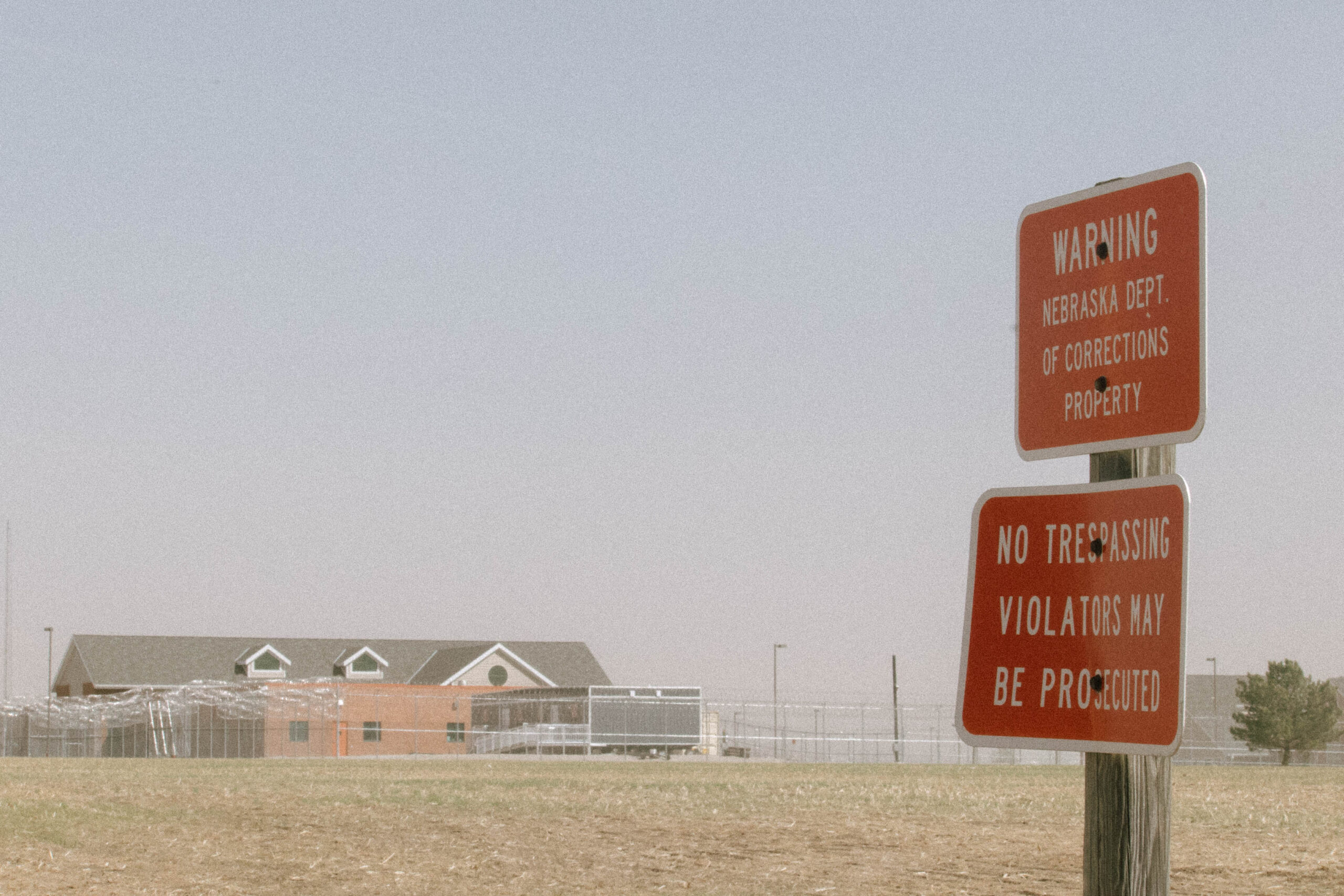
"It was done to us"
Eight months after an ICE detention facility opened in rural Nebraska, financial records and legal challenges raise questions if promised economic benefits have materialized.
While many residents fill church pews here on Sunday morning, Phil Lyons sits along the dusty shoulder of U.S. Highway 83 preaching a sermon of his own.
In a lawn chair on property just south of the so-called “Cornhusker Clink,” Lyons holds a poster condemning the use of the state’s former McCook Work Ethic Camp as an Immigration and Customs Enforcement detention facility.
Four large wooden signs staked into the ground that condemn Nebraska Gov. Jim Pillen and ICE serve as a visual backdrop to his dissent. Even when he leaves, the signs remain: A signal to passing drivers that he is not alone in his fight against the facility, which opened in November 2025 to house up to 300 detained immigrants awaiting their day in court.
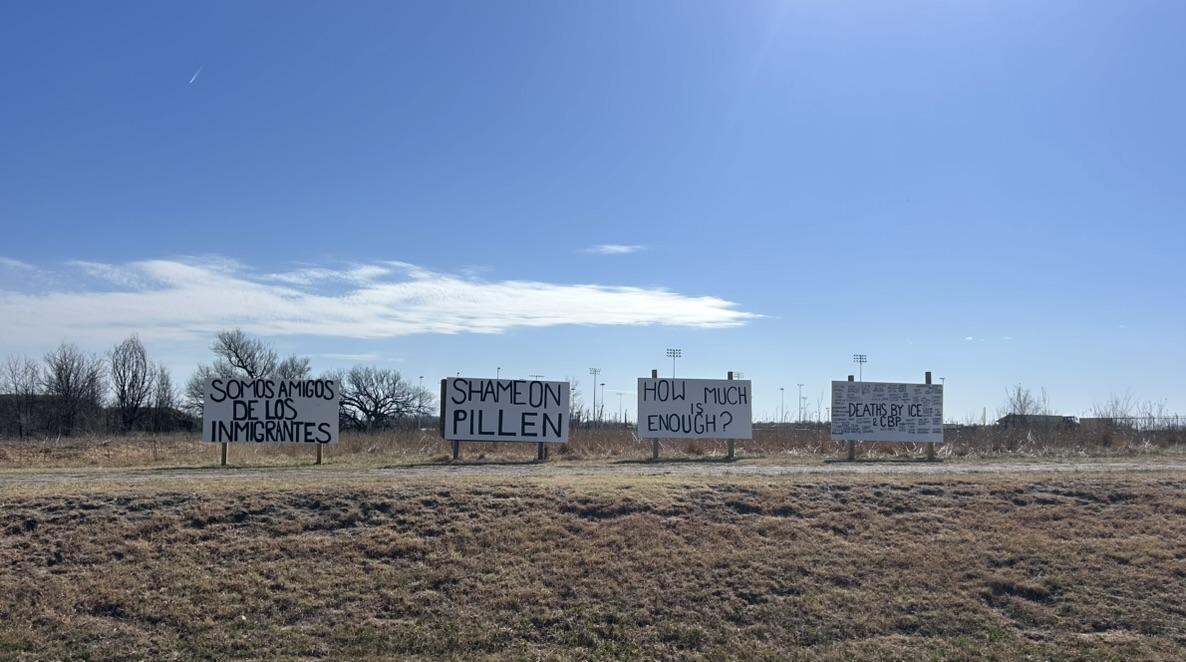
Photo by Ruth Bailey
Four wooden signs sit alongside Highway 83 on the plot of land next to the so-called “Cornhusker Clink."
Rain or shine, the 69-year-old lawyer returns to the roadside for at least 30 minutes every week.
Federal detention dollars, disputed figures
When Pillen stood before cameras in August 2025 at the McCook Ben Nelson Regional Airport, the Republican governor promised Nebraskans that the federal government would pay for the detention facility, the state would turn a profit and a rural town would keep its jobs.
But eight months later, ongoing legal challenges, confusing state financial records and divided local reactions raise questions about whether the facility is delivering the economic benefits and transparency Pillen promised — or if it is shifting financial and social costs onto a rural Nebraska community.
“It was done to us, rather than with us,” said Ronda Graff, a longtime McCook resident and one of 13 people who sued the state in hopes of stopping the ICE facility.
Inconsistencies across state accounting reports and the state treasurer’s office highlight the confusing nature of the McCook facility’s funding structure and raise broader questions about how federal immigration detention money is being tracked and managed by the state.
Despite millions of dollars flowing between Nebraska and the federal government, records reviewed by Nebraska News Service show differing figures across agencies, making it unclear how much funding remains available and where those funds are currently held.
The ICE contract with the state stipulates that Nebraska could see over $30 million in federal funds. Pillen said the state would make $14 million. For fiscal year 2025-2026, the state has appropriated over $19 million in federal money for the McCook facility.
Nebraska state treasurer expenditure and legislative records show state spending at the McCook facility has surged in the months since Pillen’s announcement. The Nebraska Department of Correctional Services has spent over 1.5 times as much at the site since July 2025 as it did during the previous fiscal year, including more than $1.8 million in state-funded renovations.
At the same time, the Nebraska Legislature on April 1 approved a reduction of $1.9 million in fiscal year 2025-2026 and $10.2 million in fiscal year 2026-2027 based on the agreement between the agency and the federal government to convert the state’s Work Ethic Camp into a federal ICE detention facility. Currently, the state has appropriated $10.9 million in general funds for the McCook facility.
Most of the payments drop into the state’s coffers each month based on the number of inmates housed in McCook.
Under the agreement with ICE, the Department of Homeland Security is expected to pay Nebraska approximately $2.46 million a month. So far, the state has received about $16.2 million of the nearly $19.5 million the state appropriated for the facility, according to state accounting reports.
However, the federal government has paid the state $9.25 million not $16.2 million, according to Keisha Patent, legislative fiscal analyst for the Nebraska Unicameral and based on state accounting reports.
As of May 12, the correctional department has spent a little over $5.2 million of the available funds, according to an email from Patent.
“This partnership with President Trump’s Administration to deliver on his promise to secure our country has been a success, and it will continue.”
– Nebraska Gov. Jim Pillen
The remaining $11 million is purportedly sitting in state reserves, but after dozens of unreturned calls and emails to the governor’s office, the Nebraska Department of Administrative Services and the Nebraska Department of Correctional Services, it is unknown exactly where that money is held.
While officials say the state is on track to generate revenue, it remains unclear whether the facility will ultimately deliver the level of profit Pillen projected, particularly as upfront costs and ongoing operational expenses continue to mount.
When asked about the financial guarantees Pillen made to Nebraskans, his office directed Nebraska News Service to the governor’s March 27 news release following the dismissal of the lawsuit against the governor attempting to stop the Work Ethic Camp from becoming an ICE detention facility.
“Nebraska has been and will continue to assist DHS and ICE in assuring that criminal illegal aliens are housed appropriately and securely,” the news release quotes Pillen. “This partnership with President Trump’s Administration to deliver on his promise to secure our country has been a success, and it will continue.”
From rehabilitation to maximum security
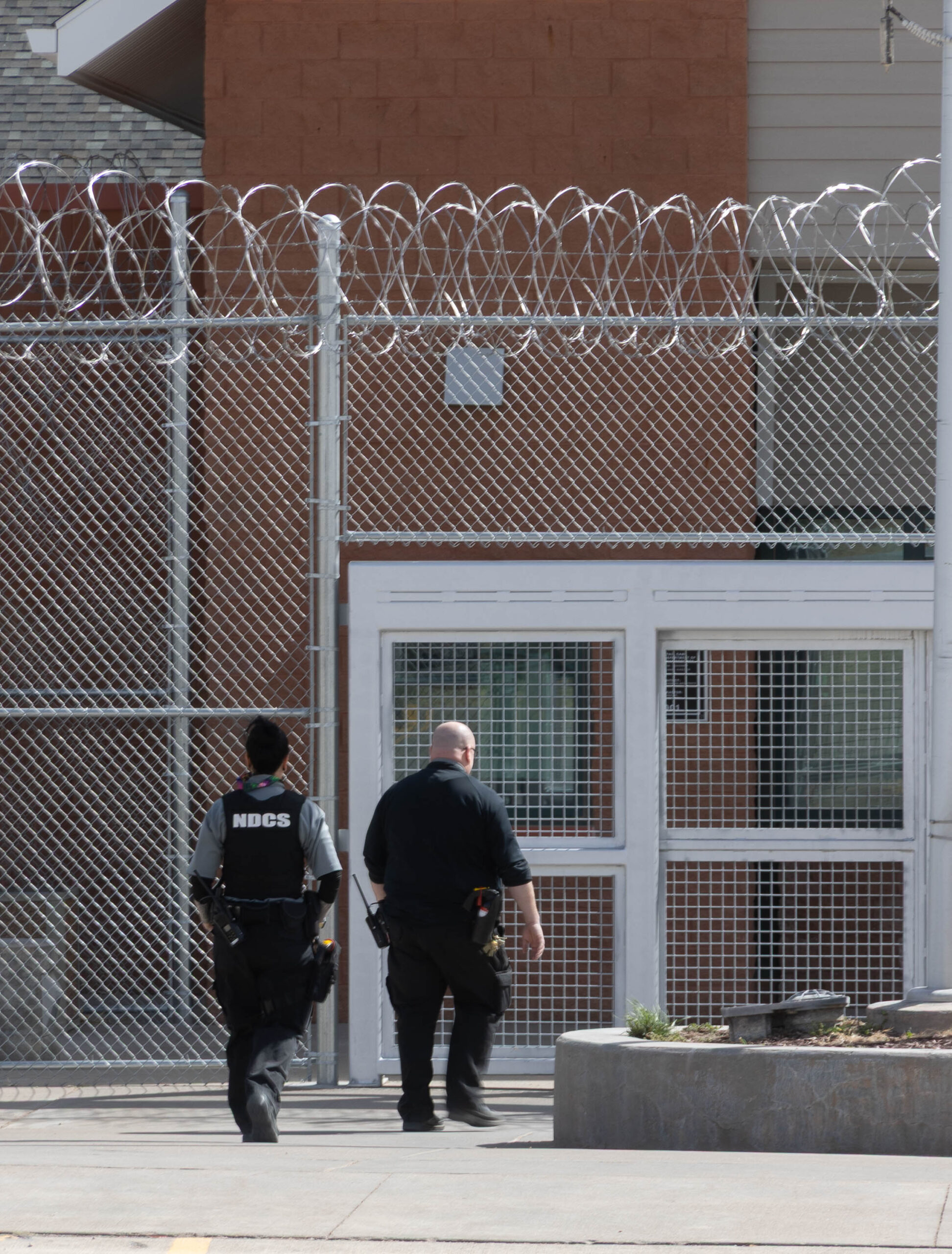
Photo by Julia Trost
Two McCook guards walk inside the facility.
Pillen’s August announcement came without advance notice to most McCook residents or to other state and local politicians, according to McCook public officials and residents.
The following month, Nebraska Department of Correctional Services Director Rob Jeffreys signed a two-year contract with ICE on Sept. 30, and renovations began at the state facility to increase capacity and enhance security. The corrections department signed five contracts with three organizations, one of which is contracting two out-of-state businesses, to contribute to the building updates.
State correctional services has spent approximately $2 million on renovations, according to expenditure data from the state treasurer’s office. The contract between the state’s corrections department and ICE stipulates a nearly $5.9 million one-time payment for renovations. It remains unclear if the state has spent the remaining $3.9 million and if so, on what upgrades or improvements.
According to corrections, renovations remain ongoing however it is uncertain if the state will broker more contracts or if that money is part of what the state has already received from the federal government. It is also unclear whether that one-time installment is part of the $16 million already allotted to the state.
Dayne Urbanovsky, director of strategic communications for state corrections, did not address specific questions about the McCook facility’s finances regarding renovations, although she answered other inquiries from Nebraska News Service.
Of the existing contracts, five organizations are outside Red Willow County, where McCook is located. Two contracts include agreements with out-of-state businesses.
The state has signed:
- A $105 contract with Red Willow Storage and Parking, which is next door to the detention facility in McCook.
- A $1.3 million contract with Outback Fence Co., based in Lincoln, to supply, deliver and install secondary fencing.
- A $716,636.82 contract with System Technology Services Inc., based in Lincoln, to supply and deliver door control upgrades and perimeter detection.
- A $322,000 contract with Davis Design, headquartered in Omaha, and LattaTech, located in Plano, Texas, to provide the necessary design upgrades to accommodate 300 detainees.
- A $72,000 contract to Davis Design to help design a perimeter fence by contracting with Benesch, an engineering and design firm headquartered in Chicago. Benesch has more than two dozen offices nationwide, including five Nebraska offices, none in McCook.
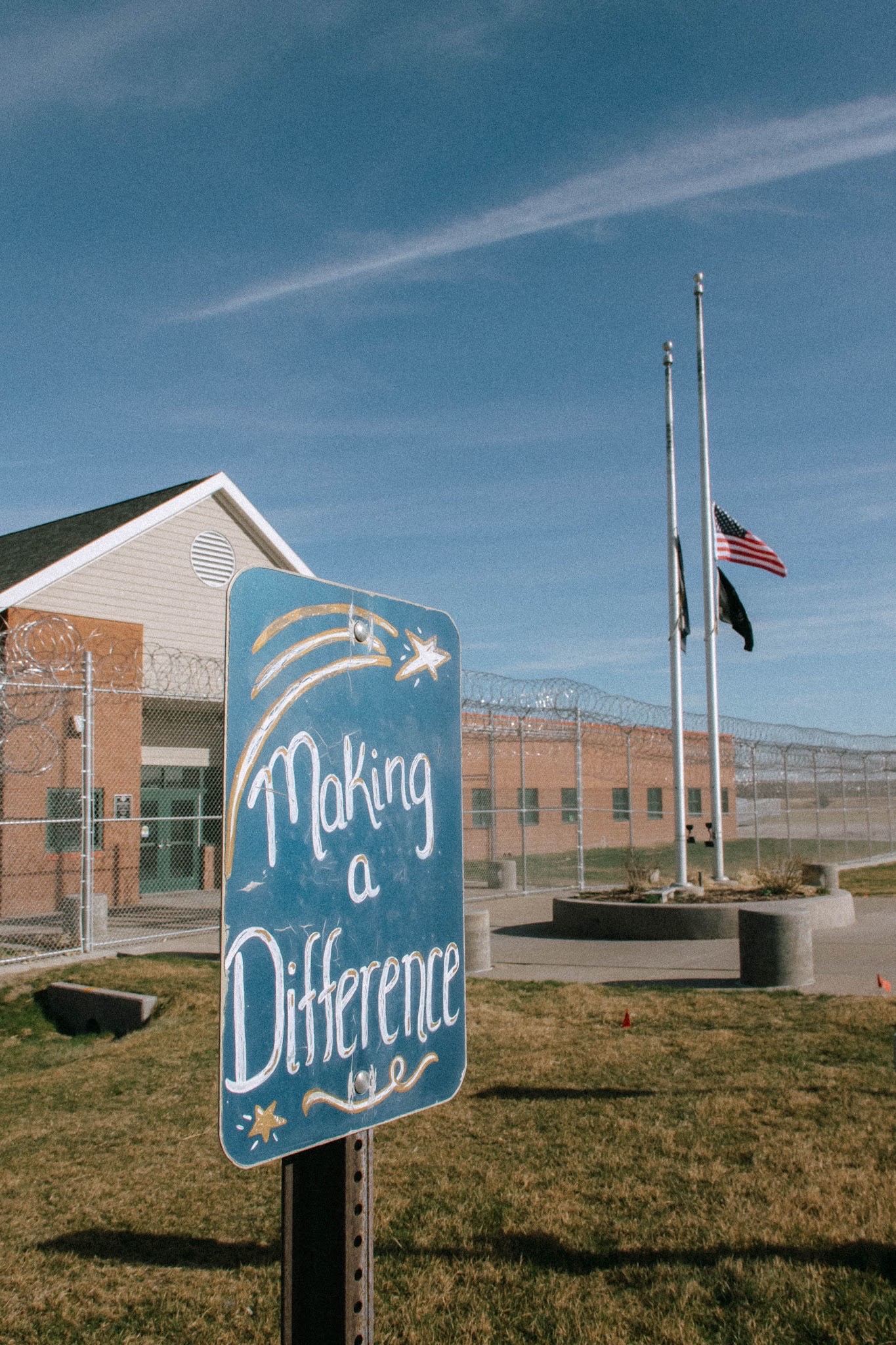
Photo by Julia Trost
A sign in the McCook ICE detention facility’s parking lot reads “Making a Difference.” The sign was installed before the Work Ethic Camp, the only rehabilitative prison in the Cornhusker State, transitioned.
The Work Ethic Camp was a minimum-security prison, aimed solely at rehabilitating prisoners before they left prison to re-enter society. As a state facility it housed about 186 male inmates, according to Nebraska correctional services reports.
Prisoners stayed at the facility for about six months, completing a number of programs before they were released. Most were transferred to Nebraska’s other prisons, while some were discharged or paroled directly from the McCook facility.
The Work Ethic Camp was the only state prison required to release an annual operational report.
As of Aug. 13, 2025, there were 98 positions at the facility with an average of eight to 10 job vacancies, according to Doug Koebernick, inspector general of Nebraska corrections.
The state added 83 jobs at the McCook facility, including 54 guards, Urbanovsky said in an email. It is unclear whether those jobs went to Nebraska residents or out-of-state employees.
McCook Mayor Linda Taylor said residents are satisfied with the transition.
“The employees are glad to have a job,” she said.
The Rev. Bernard Lorenz, a priest at St. Patrick’s Catholic Church in McCook who hosts occasional worship services at the detention center, said he thinks the interior of the converted facility is welcoming.
“I keep telling people, the thing I see is the detainees seem well fed, well cared for, very calm, very good, peaceful communication and relationship with guards,” he said.
Million dollar mystery
Under the contract, Nebraska operates the detention facility, providing staffing, security, food and medical care, while ICE reimburses the state through a daily rate per detainee and additional federal payments. The federal government promised McCook a monthly flat fee of approximately $2.46 million for operational costs, the $5 million one-time renovation payment and approximately $10,800 per month for transportation costs.
This includes paying the state about $269 per inmate per day, according to Urbanovsky. The contract is more precise, saying the federal government will pay the state $269.17 per inmate per day.
Once the facility reaches its maximum capacity of 300 detainees, the federal government will pay the same rate regardless of whether the facility dips below capacity, Urbanovsky said in an email.
Year two of the contract stipulates that DHS will pay Nebraska $277.24 per detainee each day.
As of March 10, 2026, the facility was a little over half full, according to the Deportation Data Project — a public data project maintained by the University of California, Berkeley, School of Law, that compiles and analyzes U.S. immigration enforcement records obtained through Freedom of Information Act requests. It peaked at 171 detainees on Feb. 9, 2026.
Totaling the amount of money outlined in the contract, Nebraska should receive around $35.4 million in federal money if the facility remained at capacity from the contract’s start date of Sept. 30, 2025 to the year one end date of Sept. 29, 2026.
However, because the facility is housing just over half its capacity, it is on track to make around $18 million after averaging the daily number of detainees.
Currently, the state has appropriated just over $19.5 million in federal funds for the McCook facility. It is unknown whether the state is expected to receive more than appropriated and why the state is expecting to see $19.5 million during fiscal year 2025-2026.
Urbanovsky did not clarify which figure is more accurate.
If Nebraska receives between $18 million and $35.4 million from the federal government, DHS payments to Nebraska would be less than those in some other states.
In Florida, the federal government pledged a $608 million FEMA grant for an ICE detention facility. In Indiana, at the so-called “Speedway Slammer,” DHS pays about $291 per detainee per day.
However, the per diem rate at McCook is over $92 more than what the state was paying to house inmates while it was the Work Ethic Camp.
‘Red Country’
For some McCook residents, the facility is an economic boost. For others, it’s a financial strain on the community, tainting both their workforce and the nation’s perception of the town.
Inside Lucy’s Bakery and Cafe in early spring, the hum of conversation mixed with the clatter of mugs and the smell of fresh donuts. Families shuffled in and out, babies fussed and a group of retired men lingered over coffee, swapping stories.
But beneath the easy familiarity and united love of warm pastries and strong coffee, the bakery’s patrons found themselves divided by political lines.
Randy Lashley, 70, sat at a four-person table with other local men and didn’t hesitate to share his view on immigration enforcement. He said he believes the ICE detention facility is a step toward a better future, reflecting strong leadership at the state level.

Photo by Julia Trost
Randy Lashly, longtime McCook resident, drinks coffee with friends at Lucy’s Bakery and Cafe.
“We finally have a governor with a backbone,” Lashley said.
Pillen understood what Nebraska needed — stronger enforcement and a willingness to follow through on difficult decisions, he said.
Many McCook residents share Lashley’s opinion.
McCook, founded in 1882, is home to about 7,500 residents and makes up nearly three quarters of Red Willow County’s total population. Seventy percent of its voters are registered Republican. And, in the 2024 presidential election, 63% of all county residents who went to the polls cast a ballot for Trump, according to Nebraska State Secretary voting data.
"It was shoved down our throats."
– McCook resident
It’s a city that makes up less than 1% of the state’s population; where most everybody knows each other. Residents can’t go grocery shopping, grab takeout, attend church or watch a Friday night game under the bright lights of the town’s only football stadium without bumping into someone they know, said Nate Schneider, McCook’s city manager.
McCook sits off the beaten path in southwest Nebraska, accessible by U.S. Highways 83 and 34, and has limited regional air service.
That isolation, a defining feature of the town, plays a role in the debate itself.
“You don’t accidentally end up here,” Graff said.
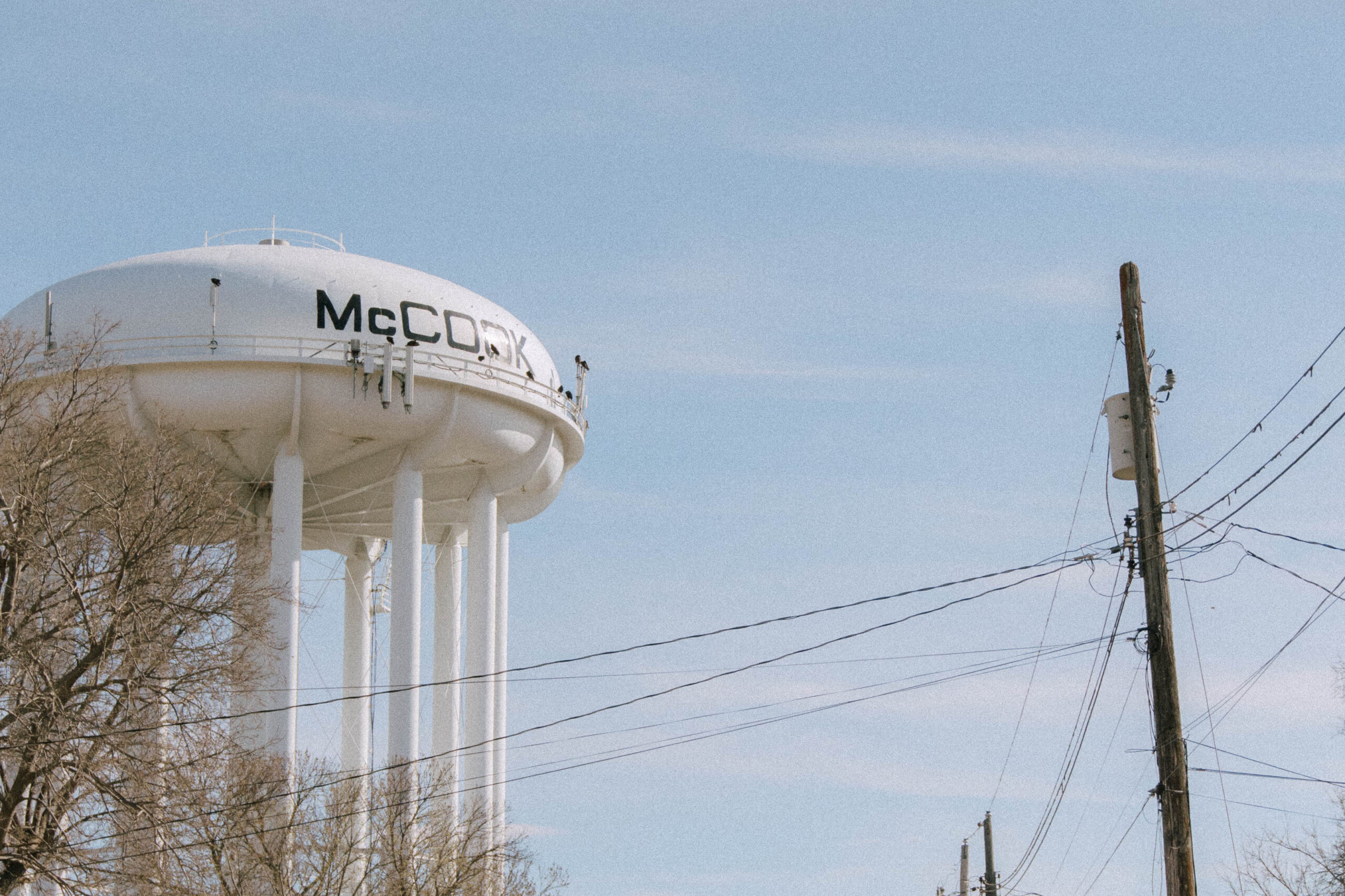
Photo by Julia Trost
McCook, a city of less than 7,500 with declining population levels, is home to the only state prison turned into an ICE detention facility in the state of Nebraska.
The detention center is a 4½-hour drive from Omaha’s Immigration Court. According to Schneider, detainees are flown into Omaha and bussed through North Platte to the detention center. McCook’s airport only has six-inch-thick concrete runways, which can’t support planes large enough to transport detainees in and out of the city, he said.
Detainees are moved into the detention center at night to protect the safety of those involved in the transportation process, said a person who works at the facility who asked not to be named to protect their job.
A number of Nebraskans praised Pillen and the facility, expressing gratitude toward the governor and president for detaining immigrants without legal status. Others support the existence of the ICE detention center but oppose how it came to be.
“It was shoved down our throats,” one resident said.
‘We really need to look at this’
There are others here who disagree with what has happened. Graff, former State Sen. DiAnna Schimek of Lincoln and 12 other McCook residents sued Pillen and Jeffreys in October 2025 to halt the opening of the detention facility. The plaintiffs, represented by Nick Grandgenett from Nebraska Appleseed, questioned the legal authority the governor claimed he had to repurpose the state prison.
Grandgenett argued that the state moved without proper authority and bypassed community input and clear legislative approval.
“It all happened so fast,” Graff said. “We had to…put the brakes on and say, ‘We really need to look at this.’”
Red Willow County Judge Patrick M. Heng denied the request for a temporary injunction, meaning the state could keep spending money and preparing the site for ICE detainees. In his opinion, Heng wrote that the Legislature’s statutory language was broad enough to allow the state’s action, even if this exact use had not been specifically stipulated.
Pillen responded that the decision affirmed “the state’s right to enter into the contract” and its authority to operate the facility.
Five months later, on March 27, Heng dismissed the case. In the written dismissal order, the Red Willow County court found that Pillen had authority to enter contracts with the federal government and delegate those duties, state corrections officials had authority to detain and house ICE detainees under the contract and Jeffreys had authority to house them at the Work Ethic Camp.
Nebraska Appleseed appealed in April. It is pending.
The plaintiffs and other opponents of the ICE detention facility said McCook has changed, not just politically, but socially and economically.

Photo by Julia Trost
Ronda Graff talks about her opposition to the McCook Work Ethic Camp’s transition into an ICE detention facility.
Graff pointed to the loss of the Work Ethic Camp’s former role, in which incarcerated people worked in the community and contributed to local projects. The city relied on its workers, Graff said.
“That was taken away overnight,” she said.
Schneider, the city manager, said former prisoners helped set up the city’s annual Christmas celebration. Prisoners also worked throughout the community, maintaining public property and helping move equipment for the town’s new YMCA, he said.
Prior to the COVID-19 pandemic, inmates took classes at the town’s community college, according to the 2022 Nebraska correctional department master plan final report.
Other residents described a more subtle shift of growing division in the town, quieter conversations and a heightened awareness of political identity in a place where it once stayed largely unspoken.
“It’s always been kind of a divided town,” said Lyons’ wife, Diane.
Graff said even joining the lawsuit came with hesitation in a town where speaking out against the popular belief can carry social and professional risks. Some residents quietly supported opposition efforts but are reluctant to speak publicly, fearing backlash in a community where reputations are closely tied to community perception.
It’s such a small town that losing customers is detrimental to many business owners, she said. Advocating for unpopular beliefs can result in less business and social stigma, she said.
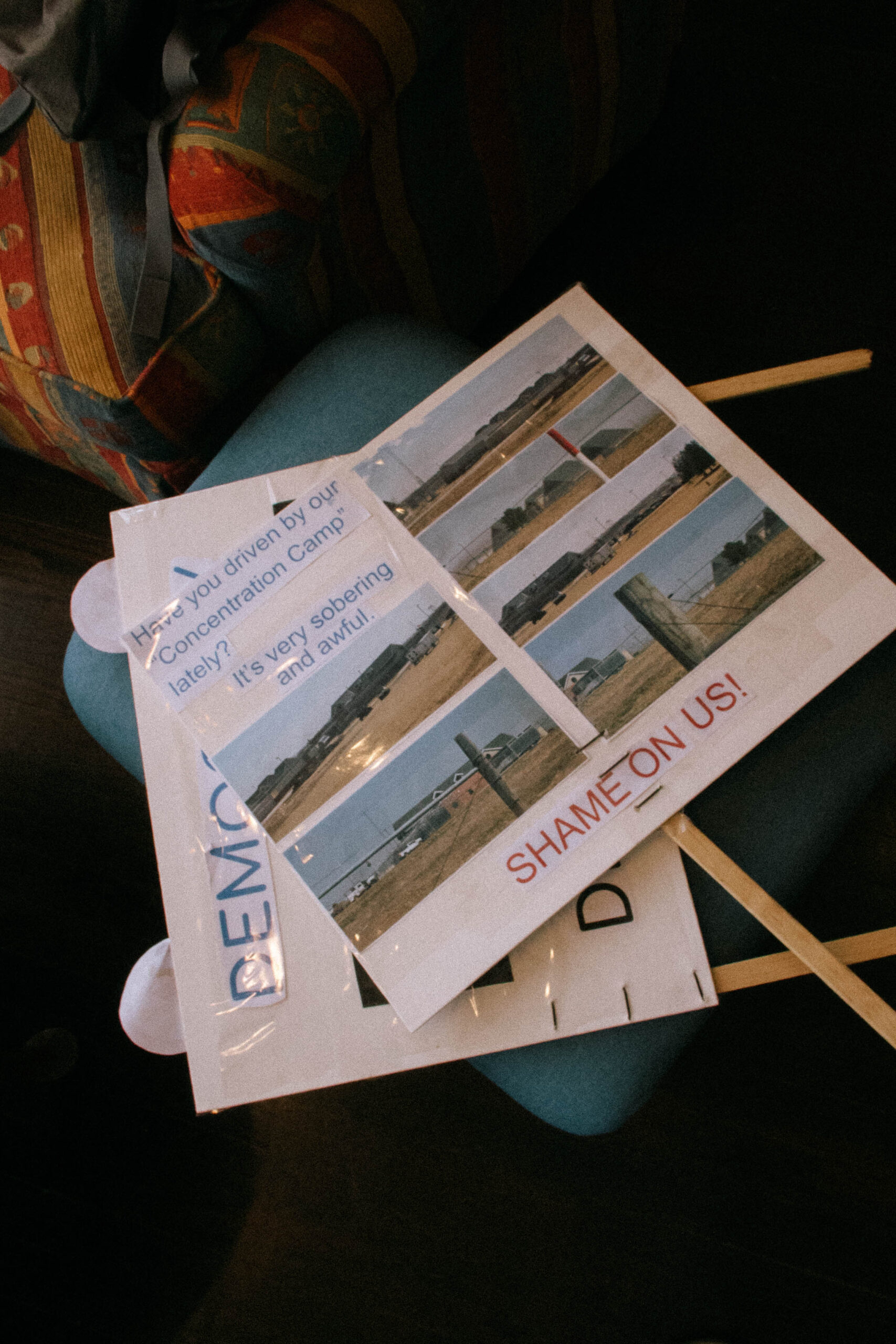
Photo by Julia Trost
Two signs to be used during a No Kings Day protest on March 28, 2026, condemn the usage of WEC as an ICE detention facility.
“You are in red country out here,” said Graff.
That tension between private concern and public silence runs throughout McCook, exacerbated by the uncertainty of the success of opposition measures.
Some residents said the problem was not just the facility itself, but how it was introduced.
“A lot of people were very upset because they didn’t know what was happening,” Diane Lyons said.
The Lyons couple began attending Tuesday night meetings hosted at Graff’s business, Pour Farm, an event space located next to the Fox Theater in downtown McCook. Diane Lyons said she met some people who had never been politically active before, but they felt it necessary to speak out against the ICE facility. In a county where Democrats are scarce, Diane said the number of people attending the rallies was surprising.
Still, her husband said, many residents seem politically disengaged.
“Most people,’’ he said, “don’t give a damn.”

A digital journalist at the University of Nebraska-Lincoln.

A photographer at the University of Nebraska-Lincoln.
More from Enforcement

ICE split her family apart
Story by Elany Romero Cruz & Megan Ebken Photos by Ella Chan
Financial questions linger over ‘Cornhusker Clink’
Story by Ruth Bailey Photos by Julia Trost

Protests, clashes and home raids in Minneapolis
Photos by Ike Wood

N.J. protests meet tear gas as hunger strike ensues
Photos by Ike Wood
Built in a flash: New satellite imagery shows rapid construction of “Alligator Alcatraz”
Story by Kairi Lowery
DHS after a turbulent and deadly year
Story by Gian Marco Velásquez Photos by Ike Wood