


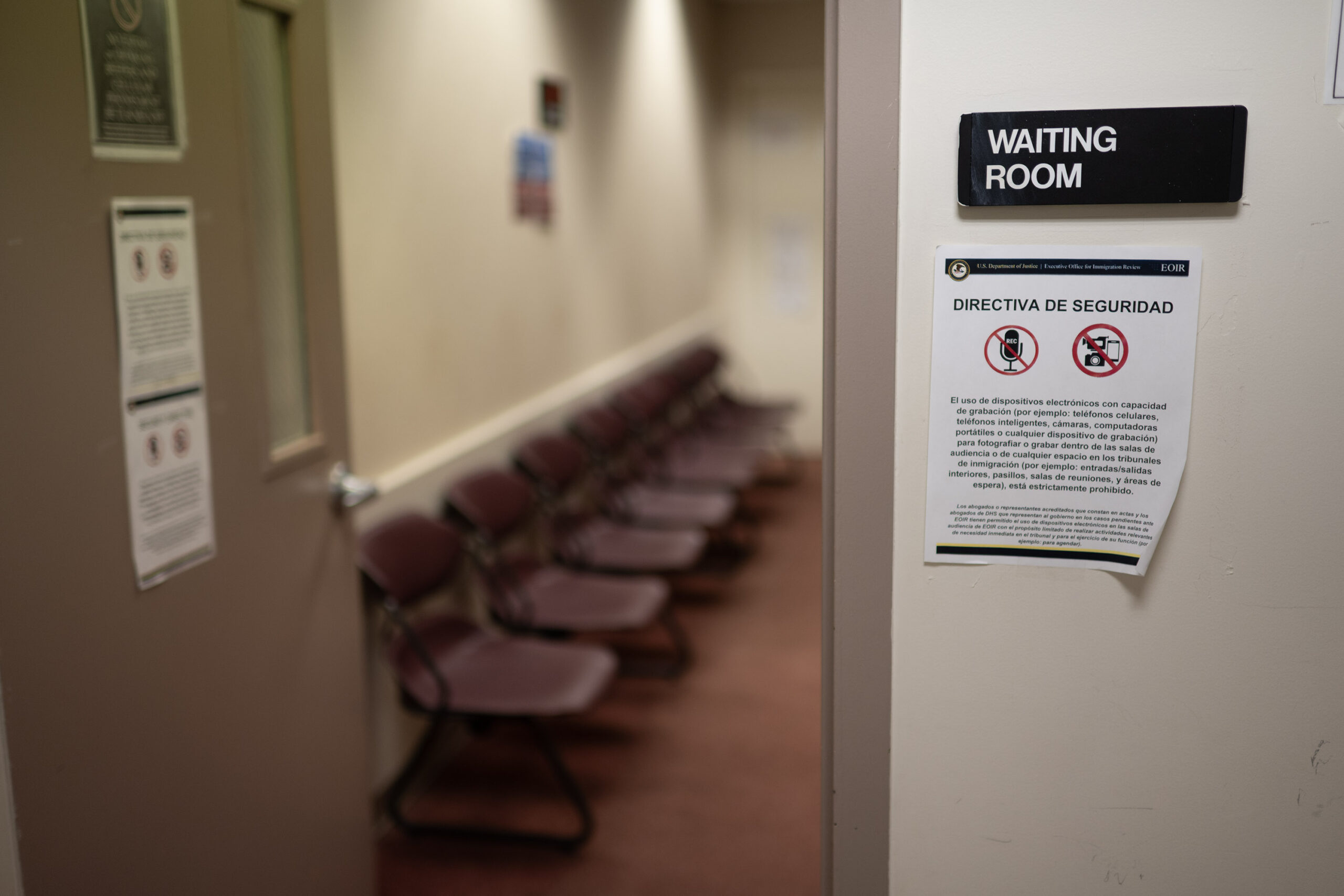
Immigration courts backlog
Immigration cases have swelled since 2012, creating a looming backlog. Though courts have moved faster the past two years, critics say the Trump admin’s “efficiency” comes at the expense of due process.
“In this system, the delay has become the relief.”
The couple entered a stuffy courtroom and waited quietly by the door. Quickly, the clerk on duty realized the couple didn’t know where they were meant to sit.
As he made his way over to them, he tried first in English, then broken Spanish, to explain they needed to move to a table at the front of the room.
The couple, from Haiti, spoke neither English nor Spanish. Judge Brandi Lohr tried to connect a virtual Haitian-Creole translator, and the couple sat in silence as the phone rang continuously. Lohr looked apologetically at them, who nodded their understanding to the judge.
Once the interpreter joined, Lohr launched into a volley of questions, confirming when the couple arrived, their residence in Northside Syracuse, and their employment status. Throughout the hearing, the wife answered questions, while her husband sat quietly.
“Your wife may speak on your behalf, but I need you to confirm that you’d like her to,” Lohr said to Darius, who chuckled and approved once the message was relayed.
After about 30 minutes, the court found the middle-aged couple hadn’t completed much of their paperwork, were missing documentation, and needed to hire an attorney. Instead of a decision, Lohr ordered further documentation sent to their Syracuse apartment, and scheduled them for another hearing in December.
More delays. More waiting. More uncertainty.
The couple, who preferred to remain anonymous out of fear of being targeted by immigration officials, are two of millions across the United States facing significant delays as they await final decisions from the Department of Justice.
As of March 2026, more than 3 million federal immigration court cases around the country have yet to be decided on, sitting in what the Transactional Records Access Clearinghouse (TRAC) calls a national “backlog.” While the total number of cases has decreased by a little more than 10% since 2024, the backlog sits over 10 times higher than what it was in 2012, according to data collected by TRAC, a nonpartisan group founded at Syracuse University that obtains data on federal agencies, including immigration-related data.
In a 2021 report by the U.S. Department of Citizen and Immigration Services under the Biden administration, the gradual increase in the backlog comes from a “prolonged” and “significant” increase in asylum and other immigration case filings.
Overbooked judges in New York
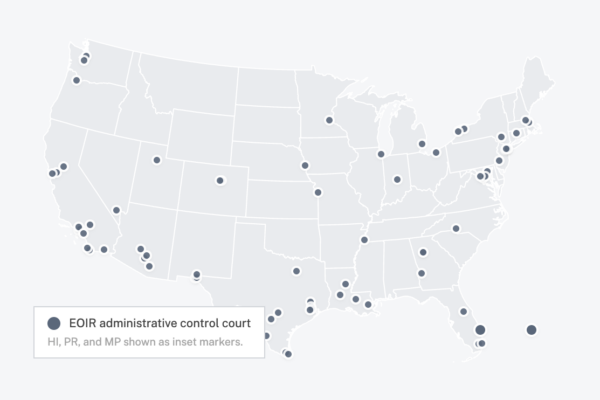
New York ranks fourth nationally in states with the most backlogged cases-percapita, trailing behind Florida, Texas and California. In 2025, federal immigration courts in New York City saw the highest level of backlogged cases — with just the city’s Federal Plaza court dealing with more than 22 times the number of cases at the three upstate courts combined.
As of 2026, Buffalo — whose court sees cases from ICE’s largest area of responsibility in upstate New York, including Syracuse — had a little more than 10,500 backlogged cases. Batavia, the court that sits outside of upstate’s largest ICE detention center, saw almost 350 backlogged cases.
The majority of migrants voluntarily attend court in Buffalo. But Batavia is described in court documents as a “detained court,” where undocumented immigrants are kept in a detention facility and brought to court by immigration agents. A vast majority of people with backlogged cases were never detained, according to TRAC data.
“We have this giant court system, in the end, only about 20% of the people in the system get to stay in the country, in other words, win relief,” said Lenni Benson, an immigration law professor at New York Law School, regarding immigration courts across the country. “In this system, the delay has become the relief.”
Of 33 states that reported detained cases, New York ranks 7th in detentions per capita for backlogged cases. Guam, the U.S. territory, has the highest reported detention rate at 27.5%.
Jose Perez, an immigration lawyer based in Syracuse, attributes the nationwide backlogging issue to overbooked judges. Generally, judges are expected to see around 20 cases daily, Perez said. But even with a full schedule, the system is overburdened by the millions of respondents awaiting their turn.
Merit hearings, which determine ultimate removal decisions, can eat up hours of a judge’s time. Perez said judges can usually only handle two or three a day.
“It’s impossible,” Perez said. “They schedule a (merit) hearing in a two hour slot, but an individual hearing may take four hours. Then they have to reschedule another case and another … so the three cases they were supposed to move forward, they didn’t, and the (rescheduled) cases cover a whole afternoon or whole morning block for the next time.”
The backlog under Trump’s second term
Backlogging has decreased slightly during President Trump’s second term, both nationwide and in New York state. The Trump administration has said it has made substantial efforts to process pending immigration cases. In September 2025, the Executive Office of Immigration Review touted resolving more than 722,000 cases during fiscal year 2025 — a number it said was its largest in the agency’s history.
The EOIR has revised “numerous” policies, including rescinding 20 that were “unfounded in law” or slowed pending cases down, and expanding the Dedicated Docket, a Biden-era process for detained families to receive hearings within 300 days and ambiguously “restoring adjudicator impartiality.”
“Reducing the immigration court backlog is one of the highest priorities for the agency,” EOIR Director Sirce Owen said in a September press release. “This Administration is committed to using all of its resources to continue to adjudicate immigration cases fairly, expeditiously, and uniformly.”
To Perez, the numbers reflect the president’s disinterest in due process. While the numbers suggest recent improvements in backlogging, Perez sees more chaos. In the past six months, the Trump administration has prioritized new methods of “expedited removal,” in many cases resulting in immigrants’ deportation without a hearing. Even if the Trump administration has “succeeded” in speeding up the process, Perez says it’s come at the price of immigrants’ rights.
With overburdened courts, the White House has enacted “archaic laws,” such as the 1798 Alien Enemies Act, to dodge due process, Politico reported. While no day in immigration court is easy, Perez has found the past year particularly challenging as some clients aren’t just delayed for extended periods, but sometimes denied their constitutional rights.
When speed is a priority, the people appearing in court suffer, said Benson. And it makes a judge’s jobs “almost impossible” too.
While it can appear that judges are contributing to the problem in delaying hearings by months and sometimes years, Benson believes they are doing the right thing; balancing an overburdened schedule while doing their best to guarantee a fair trial. If anything, forcing cases through just to check them off the list is more damaging.
“If you ever read a well-prepared asylum application, it should take you two hours just to read it,” Benson said. “And you say, ‘Well, Your Honor, we’re going to have an expert witness, the respondents (are)going to testify. We need more than two hours for justice.’ The administration says, ‘No, you’re going to have to do it in two hours.’”
The president has made it clear since the early days of his second term that due process for immigrants is not a priority. Since early in his tenure, the Trump administration has moved to cut protections from deportation, cut grants aimed at assisting minors in finding attorneys, and firing unfavorable immigration judges, NPR reported in April. For attorneys like Perez, these arguably unconstitutional acts have made daily work all the more difficult — for all migrants arriving into the country.
In the past year, Perez has had to begin traveling all over the United States in hopes of finding detained clients. The central New York attorney has traveled to California and Texas, among other states, to support clients seized by ICE agents or moved from the nearby Batavia detention center without any explanation.
In the first year of the COVID-19 pandemic, courts across the nation began permitting attorneys and respondents to join proceedings virtually. With Perez’s packed schedule, the relatively new Webex option is a great relief.
“Somedays, I have to be in five courts,” Perez said. “One in Texas, one in New York, and Miami, Orlando and Buffalo. I couldn’t be in five places, five different cities, at the same time.”

A digital journalist at Syracuse University.

A digital journalist at Syracuse University.

A visual journalist from Syracuse, New York.
More from On The Docket
At NYC immigration courts, families brace for the worst
Photos by Ike Wood

What is a habeas corpus petition?
Story by Laura Robertson & Mikayla Melo
Bonds without bounds
Story by Mia Osmonbekov
Trends, jargon inside Chicago immigration courts
Story by Clare Kirwan

Immigration judges face firings and pressure
Story by Molly A. Wallace
Immigration Court Guide
Story by Project Staff