


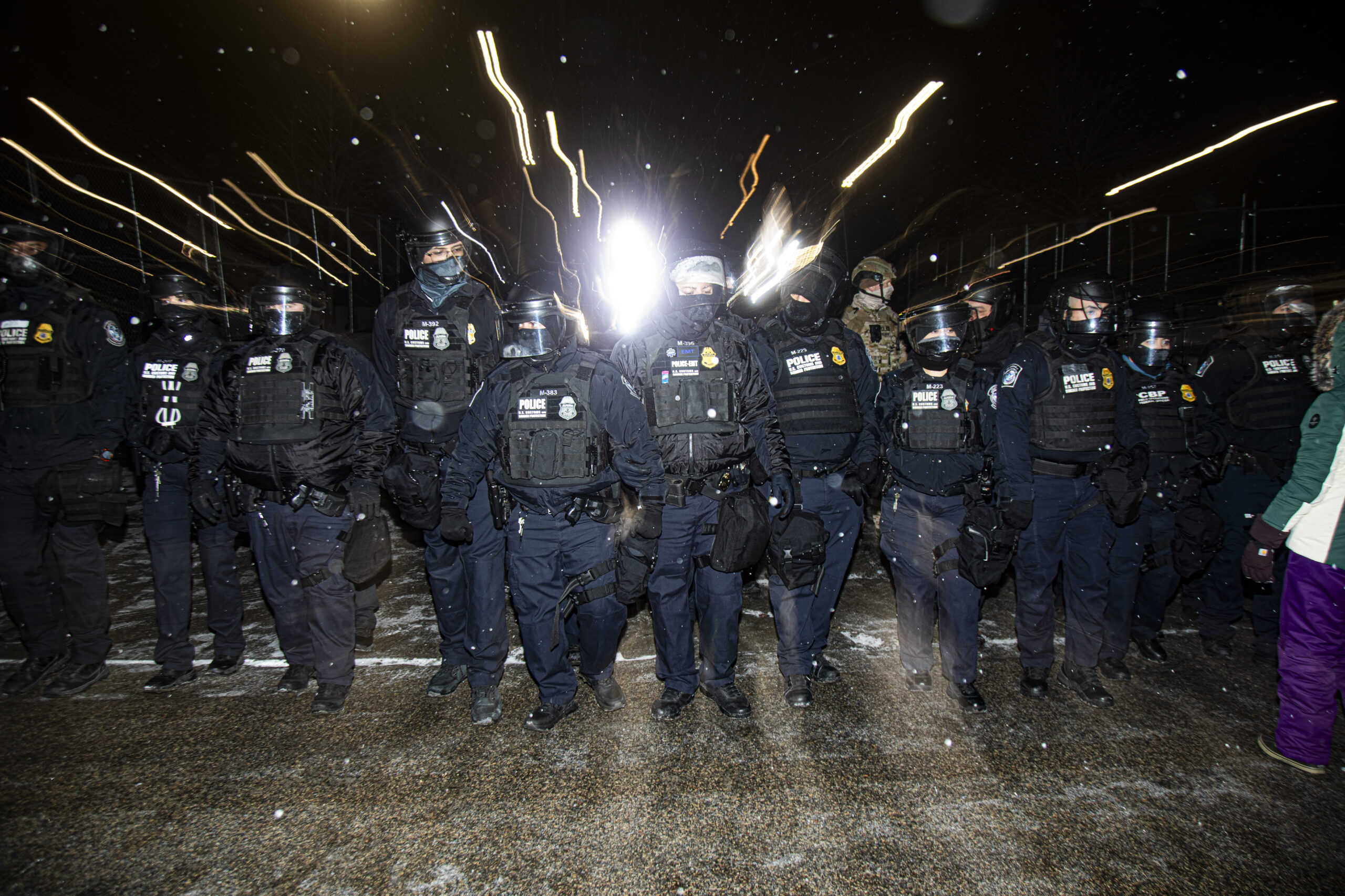
After a turbulent and deadly year, can Homeland Security recalibrate?
During President Trump's second administration, DHS has become defined by hardline immigration enforcement policies, controversy over violent tactics and internal turmoil.
The Department of Homeland Security has long been synonymous with the United States’ tumultuous relationship with immigration policy. In January 2026, that relationship reached a breaking point, escalating into a national crisis.
Two U.S. citizens lay dead in Minneapolis, shot and killed by federal agents during a stepped up deployment of immigration officers in the city that prompted widespread protest. Other cities had already witnessed similar operations, with military-style tactics that had grown violent and terrorized communities. Protests had erupted nationwide in response.
A push in Congress to impeach Kristi Noem, the Trump-appointed Secretary of Homeland Security, took on momentum as Noem was accused of violating the public trust by running a department whose agents used excessive force and acted with impunity, among other things.
Meanwhile, morale within DHS had been sinking, in spite of increased DHS funding. That same funding had led to an immigration enforcement hiring spree, with a rush to get new agents into the field that significantly shortened their training time – something that drew sharp criticism as immigration arrests and violence mounted.
Under normal circumstances, it’s not unusual for Homeland Security’s direction to shift from administration to administration, as immigration policies change relative to the priorities of the moment.
But during President Donald Trump’s second administration, DHS has become defined by hardline immigration enforcement policies, controversy and internal turmoil to an extent not seen before.
Beginning in the summer of 2025, Noem oversaw a series of city-by-city immigration crackdowns, starting in Los Angeles then moving on to other cities. Agents from U.S. Immigration and Customs Enforcement (ICE), the U.S. Border Patrol, and other federal agencies began conducting surprise raids and detaining people at-large in the community, typically wearing masks. In one instance in Los Angeles dubbed “Operation Trojan Horse,” Border Patrol agents – one in a cowboy hat – leaped out of the back of a rented truck at a Home Depot where immigrant day laborers gathered.
To lead these, Noem chose as “commander at large” Gregory Bovino, chief of the Border Patrol’s El Centro sector and a known immigration hardliner.
Things came to a head in early 2026 after the shooting deaths in Minneapolis of Renee Nicole Good, a mother of three who was shot in her car by an ICE agent as she tried to drive away, and of Alex Pretti, a protester who worked as an ICU nurse, who was shot by a Border Patrol agent and an agent from U.S. Customs and Border Enforcement, the DHS sub-agency that oversees the Border Patrol.
The blowback led to Bovino’s dismissal from his “commander” role and, eventually, to Noem’s ouster in March – but not before an impasse in Congress between Republicans and Democrats, who demanded reforms to the agency’s hardline tactics, prompted a record 76-day government shutdown.
Homeland Security is now under new leadership. But what direction it goes in next as the Trump administration continues its deportation push remains to be seen.
From INS to DHS
Long before the existence of DHS, the U.S. Immigration and Naturalization Service, or INS, was in charge of operating the U.S. immigration system.
When it was established in 1933 by then-President Franklin D. Roosevelt, the INS combined two agencies, the Bureau of Immigration and Bureau of Naturalization, and came to oversee the already-existing U.S. Border Patrol. It was launched as a way to consolidate federal immigration functions, including immigration enforcement and the administrative immigration process.
People who worked in the immigration field on both sides for decades remember what the agency was like before DHS was formed.
It was the INS that introduced Matthew Hudak into the immigration enforcement system back in 1997 when he joined as a Border Patrol agent. He worked in the Rio Grande Valley, at the southern tip of Texas.
“When I started, there was no DHS. We were under the Department of Justice,” Hudak recalls of his early years. “It was kind of the traditional cat and mouse operational context…We chase them, we arrest them — that kind of traditional model of what most people would kind of expect from the border.”
Hudak spent more than 26 years working in federal immigration enforcement. The majority of his career was spent working along the southwest border in states like Texas and Arizona. His early years with INS were primarily spent cracking down on border crossings and narcotics trafficking. Business as usual, as he saw it.
By the time Hudak joined the Border Patrol in the mid-1990s, attorney Alma Rosa Nieto had been practicing immigration law for more than a decade in Los Angeles.
Nieto worked with the local immigrant community, and she often interfaced with INS officials.
“Even though there was an enforcement component, the best I can describe it is it was humanistic,” Nieto said. “There was more give and take because of the family situations.”
For example, if an immigrant or someone in their family was ill, or there were other extenuating circumstances, “there was at least a listening to try to help the person so that they could achieve their goal,” she said.
Things began to change following the terrorist attacks of Sept. 11, 2001. The Department of Justice underwent an agency-wide restructuring. INS was dismantled, and the Department of Homeland Security was established the following year.
Immigration sub-agencies were created: U.S. Customs and Border Protection, or CBP, which oversees ports of entry and the U.S. Border Patrol; U.S. Immigration and Customs Enforcement, or ICE, which carries out immigration enforcement in the interior of the country; and U.S. Citizenship and Immigration Services, which processes immigration and naturalization applications.
From ‘chasing migrants to stopping terrorists’
For Hudak, the post-9/11 shift to national security as a priority was immediately noticeable. He was working in Arizona when DHS was established. As a Border Patrol agent, his job took on broader implications.
“Our mission really shifted from just, you know, chasing migrants to stopping terrorists,” he recalls. “It definitely kind of raised the stakes a little bit.”
Those higher stakes, as national security became a political priority, brought larger budgets, updated technology, and a more streamlined operation. The Department of Homeland Security transformed the one-time INS, and brought alongside it an overarching mission that Hudak believes unified all who worked within the agency.
“DHS, you know, as kind of having that mission set focused on really the security of the country — that changed just a lot of the way things happen,” Hudak said. “Everything from funding, the justifications for things, the resources that we started getting to do our job, the technology — all of that just moved much better.”
Hudak, who ultimately rose through the ranks to become Deputy Chief of the Border Patrol, witnessed DHS undergo a sizable upgrade, transforming into a highly intentional immigration apparatus.
But as the agency has evolved, his reservations lie not with its core mission, but with politicization from the top, and with sudden directional changes, which lately have grown increasingly dramatic.
The pendulum swings right
Hudak acknowledges that with every administration comes a general shift in priorities and expectations.
“Through the first several changes of administrations, the angle and trajectory change was relatively small,” he says. “With the Obama administration, that was where we almost saw a whole left turn and pivot.”
Then came Trump 1.0, and Biden and Trump once again. This time, the swings grew wider and became more disorienting.
“You ever driven on ice? What happens if you overcorrect? You start sliding, you turn too much this way — and then the next thing you know, you’re spinning out,” Hudak said. “That’s what I don’t want to see happen… these pendulum swings become so severe that there’s just no way to balance it.”
On the immigrant defense side, the recent change is stark. Nieto, who is now retired after 40 years of practice in Los Angeles, believes that under Trump 2.0, Homeland Security has taken a direction that she has never seen in her four decades of practice, with a loss of humanitarian safeguards.
“Trump 2.0 is completely radical and different, where they’ve lost all humanity, as far as I’m concerned,” Nieto said. “We’re seeing something that in 41 years of practice I’ve never seen, which is just enforcement — and not only enforcement, which is part of their role, but an enforcement under a guise of protecting the country – and (which is) hurting the country.”
Nieto describes an immigration system virtually unrecognizable from the one she worked with for the majority of her career.
Among the things that have struck her most is a rash of arrests this past year in immigration courts around the country, where agents have waited outside courtrooms to arrest people for deportation.
“We’ve seen the horrific examples that we’ve all witnessed on television or on social media of people doing the right thing, showing up to court…and actually being arrested in the hallways, and some even being tackled,” Nieto said.
More about DHS

On the road: South Omaha to ‘Cornhusker Clink’
Story by Justin Diep
ICE expansion after 9/11 attacks
Story by Cooper Andrews & Jack DiNapoli & Patricia Diaz Photos by Ike Wood

Children placed in adult detention centers
Story by Katrina Michalak & Sophie Schaeffer

DHS after a turbulent and deadly year
Story by Gian Marco Velásquez Photos by Ike Wood
Bonds without bounds
Story by Mia Osmonbekov
Hasty hiring, less training time
The passage of H.R. 1, also referred to as the “One Big Beautiful Bill,” in 2025 provided Homeland Security with an estimated $85 billion to help fund Immigration and Customs Enforcement operations. This has included quickly hiring more agents to carry out President Trump’s mass deportation goals.
DHS, ICE, and CBP have launched social media campaigns seemingly aimed at young men, encouraging them to join the agency. ICE specifically has marketed these positions as becoming a “deportation officer,” posting content that has garnered millions of views and public interactions.
Many of these help-wanted posts feature retro-patriotic imagery reminiscent of World War II recruitment posters and long-ago anti-immigrant political cartoons, imagery that has been criticized as white nationalist. Slogans like “Defend the Homeland” and “America Needs You” are frequently used; one ICE recruitment ad featured on the Homeland Security instagram page depicted a stern-looking Uncle Sam with the words “They have got to go!”
"We've seen the horrific examples that we’ve all witnessed on television or on social media of people doing the right thing, showing up to court…and actually being arrested in the hallways, and some even being tackled."
– Alma Rosa Nieto, Immigration attorney
Homeland Security also dropped age caps for ICE applicants. The agency also pushed signing bonuses of up to $50,000 and other perks as incentives. According to USAJOBS, the federal government’s official jobs portal, listed salaries for “deportation officer” positions range from $51,632 to $84,277 per year, making the bonus a significant financial draw.
These campaigns have seemingly been effective. In January 2026, ICE announced a 120% increase in hiring, more than doubling its workforce to a total of 22,000 agents. But along with this have also come reports of lax vetting amid the rush to fill positions.
Once hired, new recruits received less training time than in the past. Ryan Schwank, a former ICE attorney and training instructor, testified before Congress shortly after his resignation in February 2026 that ICE recruits’ training time had been cut from 72 days to 42, including training on critical issues like use of force and firearms safety.
An excerpt from Schwank’s testimony: “Without reform, ICE will graduate thousands of new officers who do not know their constitutional duty, do not know the limits of their authority, and do not have the training to recognize an unlawful order.”

Photo by X
Screen shot of a recruitment posted by U.S. Immigration and Custom Enforcements on X, formerly Twitter, in August 2025.
Shot by ICE in California
In April 2026, Carlos Ivan Mendoza Hernandez was shot and severely wounded by two ICE agents during a traffic stop in Northern California.
According to a federal complaint later filed against Mendoza, four federal immigration agents had been surveilling Mendoza to arrest him for deportation. On his way to work, he was pulled over on Interstate 5 about 90 miles from Sacramento. When approached by the officers, Mendoza reportedly did not want to exit the car, according to the complaint. After an agent broke the front passenger window, he attempted to flee, in the process hitting an agent as he moved forward, then hitting one of their vehicles as he reversed. This prompted multiple shots from the ICE agents, described as firing in self defense.
Mendoza has since been charged with assault on a federal officer with a deadly weapon and destruction of government property, to which he has pleaded not guilty. The federal government says he is an alleged gang member wanted in connection with murder in El Salvador.
According to his attorney, Patrick Kolasinski, those claims are false, with documents from the Salvadoran government supporting Mendoza’s innocence.
The Sacramento-based attorney draws parallels to the Minnesota shootings; Homeland Security similarly characterized the fatal shooting of Renee Nicole Good as self-defense, claiming she tried to run over the agent who shot her, although video evidence suggests otherwise.
Kolanski believes the shooting of Mendoza, who was shot seven times, is yet another demonstration of the failings in DHS recruitment and hiring.
“Unlike many of my colleagues, I don’t think they’re all evil,” said Kolasinski, referring to immigration agents. “They’re guys that are trying to do the best job they can according to their training. Their training sucks. It’s not their fault.”
It’s not clear how much experience or training the agents involved in Mendoza’s shooting had.
“Law enforcement is often taught to view the population they’re trying to detain as a threat, and they were not given the tools to detain that person in a manner that is safe to everybody around them,” Kolanski said.
‘At some point there has to be a reconciliation’
The Department of Homeland Security is now under the leadership of former Sen. Markwayne Mullin of Oklahoma, who was sworn in as secretary soon after Kristi Noem’s dismissal.
So far the department has canceled most pending contracts left over from Noem’s tenure, as Noem’s contracting practices have come under scrutiny and are being investigated.
And there has been a notable shift in immigration enforcement tactics, with the agency appearing to move away from military-style and more confrontational encounters, although immigration arrests continue.
Mullin is no less of an immigration hardliner: In late May, with weeks to go before the World Cup, he threatened to punish so-called “sanctuary cities” with international airports by reducing customs staffing and the processing of international passengers.
But on the immigration enforcement side, Mullin has promised to return to the previous, longer training schedule for new ICE recruits, what he has referred to as “regular standards,” by July 1. According to an internal memorandum obtained by CBS News, training is to be extended from 42 days to roughly 71 days.
Meanwhile, there continue to be legislative efforts to increase accountability and training for immigration officers, including a recent proposal from Democratic U.S. Rep. Emilia Sykes of Ohio that aims to improve training for agents on issues like de-escalation, officer safety, and crisis intervention.
California enacted two new laws in January intended to require federal agents to stop wearing masks and wear visible identification, although these have so far been struck down in court.
But so far, at-large immigration arrests in the community – which had led to a spike in the arrests of people with no criminal record – have dropped to a level seen roughly a year ago, before the enforcement surge.
Hudak, the former Border Patrol Deputy Chief, acknowledges that he wasn’t altogether surprised by how far the pendulum swung this time within DHS.
“You do see folks come in as change agents,” he said, “and sometimes when you bring in new leadership to do that, they break some china.”
But then “you don’t want to break any more china,” Hudak added, so the next step is to rebuild.
“At some point there has to be a reconciliation, right?” he said. “And either that trajectory comes back to where it needs to be or, you know, you make a change.”

A digital journalist from San Francisco, California.

A visual journalist from Syracuse, New York.
More Enforcement
Built in a flash: New satellite imagery shows rapid construction of “Alligator Alcatraz”
Story by Kairi Lowery
DHS after a turbulent and deadly year
Story by Gian Marco Velásquez Photos by Ike Wood
ICE expansion after 9/11 attacks
Story by Cooper Andrews & Jack DiNapoli & Patricia Diaz Photos by Ike Wood
Life inside Upstate New York’s ICE detention center
Story by Project Staff
N.J. protests meet tear gas as hunger strike ensues
Photos by Ike Wood

ICE split her family apart
Story by Elany Romero Cruz & Megan Ebken Photos by Ella Chan