


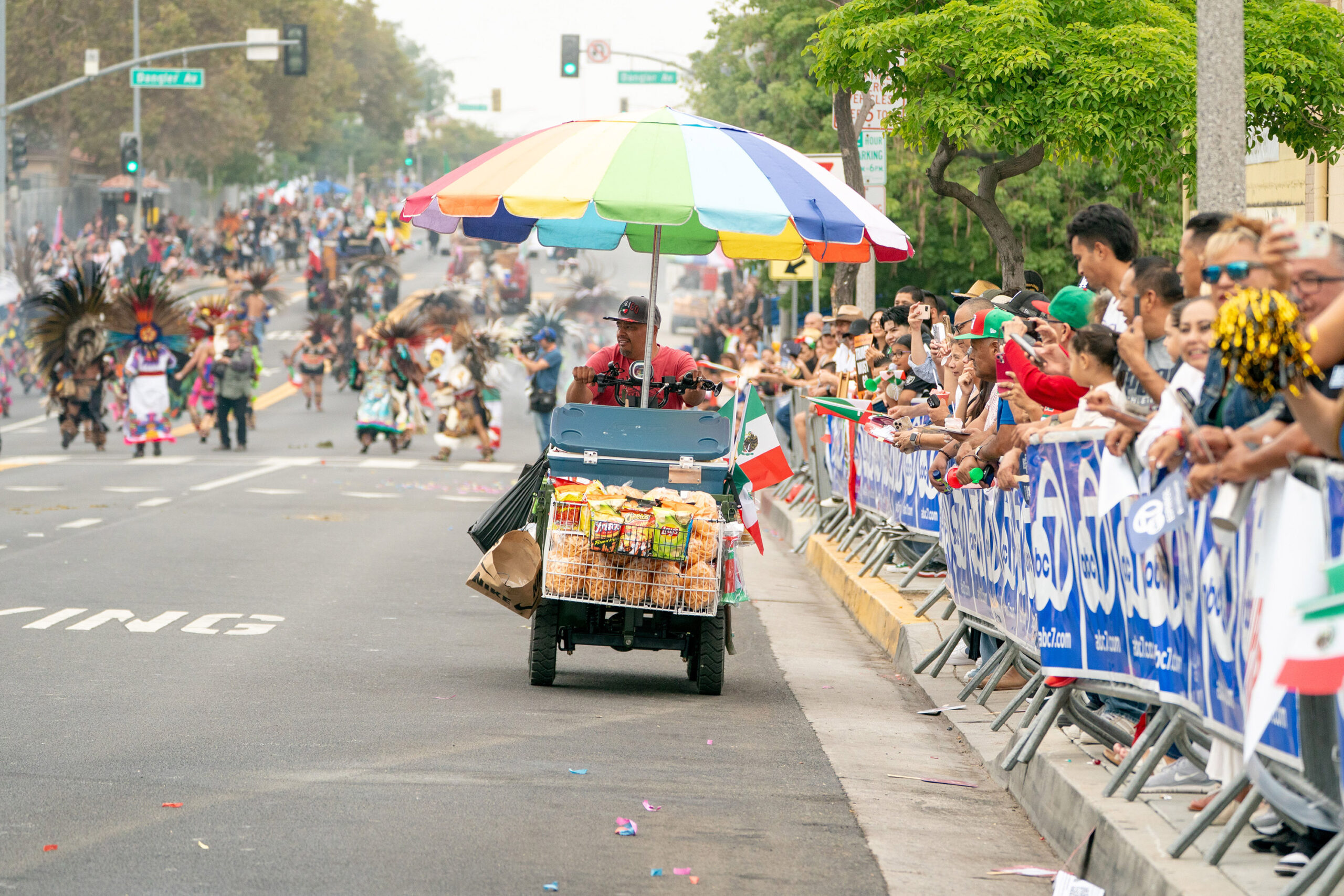
Los Angeles street vendors risk deportation to earn a living
As stepped-up immigration enforcement began in L.A. last year, street vendors were among those arrested. Vendors say they’re afraid – but they need to work.
Just outside USC Village, a shopping and housing area by the University of Southern California campus in South Los Angeles, street vendors set up every evening.
As the aroma of food sizzling on portable grills fills the air, one vendor proudly ticks off his menu: “We sell tacos, burritos, quesadillas, mulitas, tortas, carne asada, pastor, pollo, cabeza, chorizo…” he says in Spanish, reciting the offerings.
This particular vendor has been selling in the same location for about three years. He didn’t want his name used in this story – we’ll explain why in a minute.
Business near campus, with its ready-made clientele of students looking for cheap eats, is good, the vendor said. The location feels relatively safe. He recalls working in a different part of town before this, a place where vendors were sometimes robbed.
“They would assault us sometimes with guns,” he remembers, “but here, I feel a little bit better, safer…because there’s lots of security, and I sell a little more.”
But lately, for many of Los Angeles’ ubiquitous street vendors, no place feels that safe.
That’s because street vendors, many of them immigrants, are among the Angelenos who’ve been targeted in recent federal immigration raids. It’s why this street vendor, an immigrant from Guatemala, did not want his name used.
Down the street, another street vendor says the threat of being arrested by immigration agents is on her mind each time she goes out to work.
“We have to work for the rent, to pay our bills,” she said in Spanish, “(but) many people are staying home because they’re afraid of immigration agents showing up, and well, that’s sad.”
Street vendors and the economy
If street vendors can’t work, it’s a problem not just for individual vendors and their families, but for their communities as a whole.
There are an estimated 50,000 street vendors in Los Angeles, about 25% of whom sell food, like tacos, pupusas and the iconic bacon-wrapped hot dog that is an emblem of L.A. street food. The micro-businesses they operate are a lifeline for their families. They contribute to the local economy and help maintain other businesses, like the suppliers they buy products from.
But the immigration raids and at-large arrests of immigrants that began in 2025 under the Trump administration have made street vending in L.A. an especially risky business.
Many local street vendors are undocumented, and vendors have been arrested during recent immigration enforcement actions. Some were detained so quickly their carts were left behind on the sidewalk.
Giovanni Peri, a professor of international economics at UC Davis, said undocumented workers like these play a fundamental role in California’s economic success.
If undocumented workers can’t contribute to the economy, “this will render the economy poorer, will decrease the opportunity for Americans because a lot of jobs that citizens do, also, are benefiting from immigrant contribution and consumption.”
The Pew Research Center estimates there were about 14 million undocumented immigrants in the U.S. back in 2023. An estimated 9.7 million of these immigrants were participating in the labor force. It’s not clear how many of them have left or been deported since.
Peri says that with so many undocumented workers in the U.S., it’s impossible to deport them all, but it’s the fear of deportation that also disrupts the economy.
“So this situation in which there are raids, many of them are involving people who are workers, they are definitely not criminals,” Peri said. “They are just workers. And there is a lot of publicity that scares people, can really create an economic downturn and can really be very costly for a lot of communities in California.”
Peri says immigrants and U.S.-born workers boost the economy together.
“Places where immigrants have gone more are places that have created more jobs for Americans,” he said. “So it’s not just a theoretical possibility. It’s what we observe in the data.”
As fear has tightened its grip on Los Angeles street vendors, immigrant advocates have looked for ways to help vendors continue earning income.
‘To address the realities they’re facing’
As immigration raids and arrests became widespread in Los Angeles in the summer of 2025, some groups began raising money to buy out street vendors’ inventory so they didn’t have to take their chances on the street.
Street vendor advocates also consulted with local vendors to develop a state law known as SB 635 or the Street Vendor Protection Act, which took effect Jan. 1.
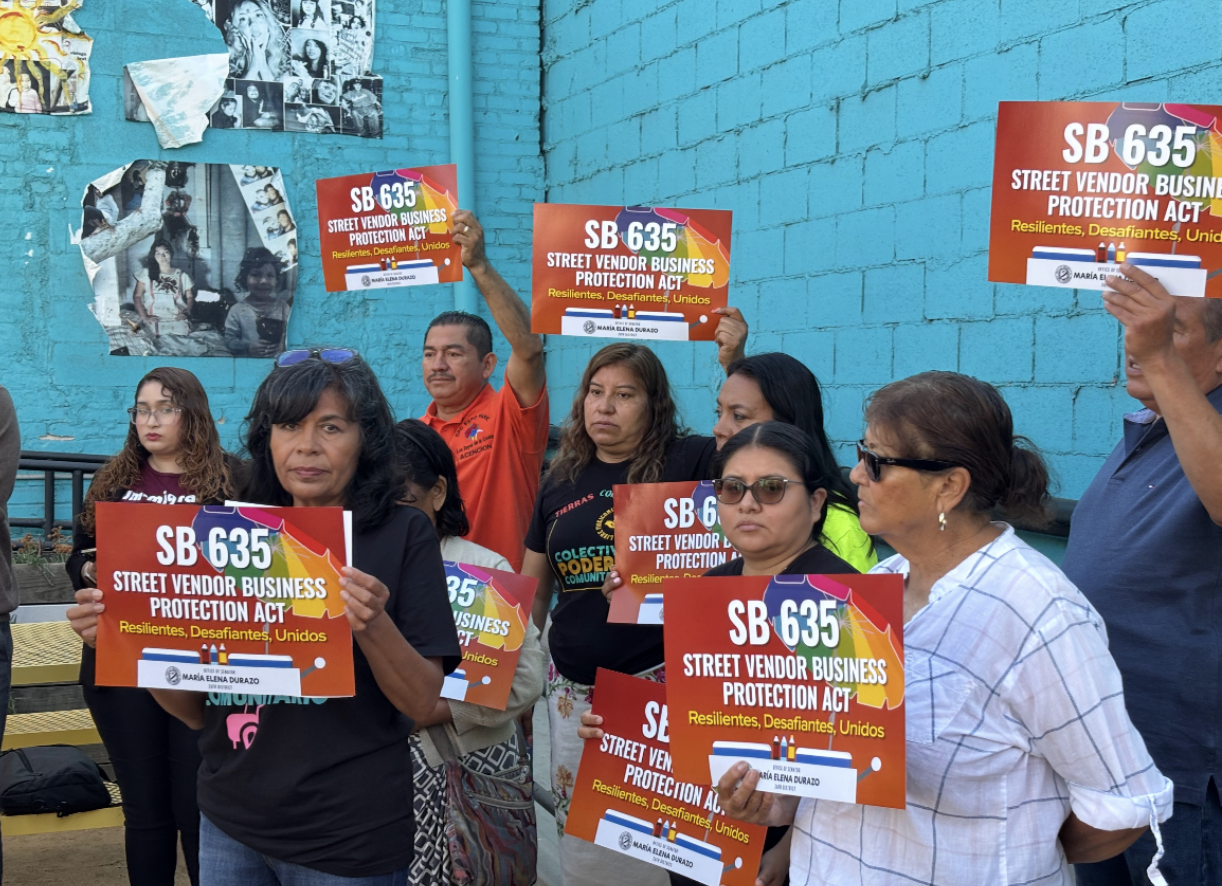
Photo by Lizbeth Solorzano
Street vendors and their supporters during a rally for SB 635 in Los Angeles in 2025.
The new measure aims to protect street vendors’ personal information from being accessed by immigration officials. Vendors’ personal information is collected by local agencies when they apply for street vending permits, and the measure prohibits the sharing of that information with federal officials.
Several organizations that co-sponsored the bill work with street vendors to obtain feedback and address any potential gaps that may interfere with their livelihood, said Shannon Camacho, senior associate of policy for Inclusive Action for the City, one of the organizations that campaigned to legalize street vending in California and that now provides various support to vendors.
“That helps inform what we need to do to address the realities they’re facing…in addition to the racial profiling, which I think is much more pronounced this time around,” Camacho said.
The LA Street Vendor Campaign coalition set up a cash assistance fund for street vendors, and Inclusive Action has a “Hire a Vendor” program that lets customers contract vendors through the organization for individual events.
The program trains street vendors to cater events in settings that are deemed safe, “to sell their food or merchandise and not face the same level of risk” as on the street, Camacho said.
‘We are seeking the same thing’
But rain or shine, risk or not, street vendors continue to take their chances and venture out daily on L.A. streets to earn a living.
Around USC Village, the street vendors who are working remain on the lookout.
The vendor from Guatemala – the man who recited his extensive menu – says he prays for the safety of those who work farther from campus, in places he fears are more exposed.
“People outside of here, in other places, I hope God takes care of them,” he said in Spanish. “Because we are seeking the same thing, the dream, which is why we come here from our countries.”
The woman selling nearby says she’s holding out hope that making a living as a street vendor won’t always be this risky.
“It would be great if they would at least let us work,” she said in Spanish, “and that immigration doesn’t take us away.”
She added, “and that in the future, we might be able to adjust our immigration status, too.”
But for now the vendors will hold on, because they have to.
Note: Versions of this story were previously aired and published by Annenberg Media. Also, the photo of the Los Angeles street vendor is by Getty Images.

A digital journalist at the University of Southern California.
More from Journeys
Immigrants and ethnic eats fuel Salt City in Syracuse
Story by Jai’La Du Rousseau

Suddenly uprooted
Story by Delia Rose Sauer & Vera Lucia Pappaterra
LA street vendors risk deportation to work
Story by Lizbeth Solorzano

European hockey prospects fight for their spot in the NHL
Story by Will Broad & Josh Solomon Photos by Ike Wood

Coming to Cuse Podcast
Story by Project Staff & Jai’La Du Rousseau & Patricia Diaz Graphics by Cayla Israel

How international students navigate collegiate soccer
Story by Rohan Borges & Felipe Ferraz de Souza Miranda Photos by Ella Chan