


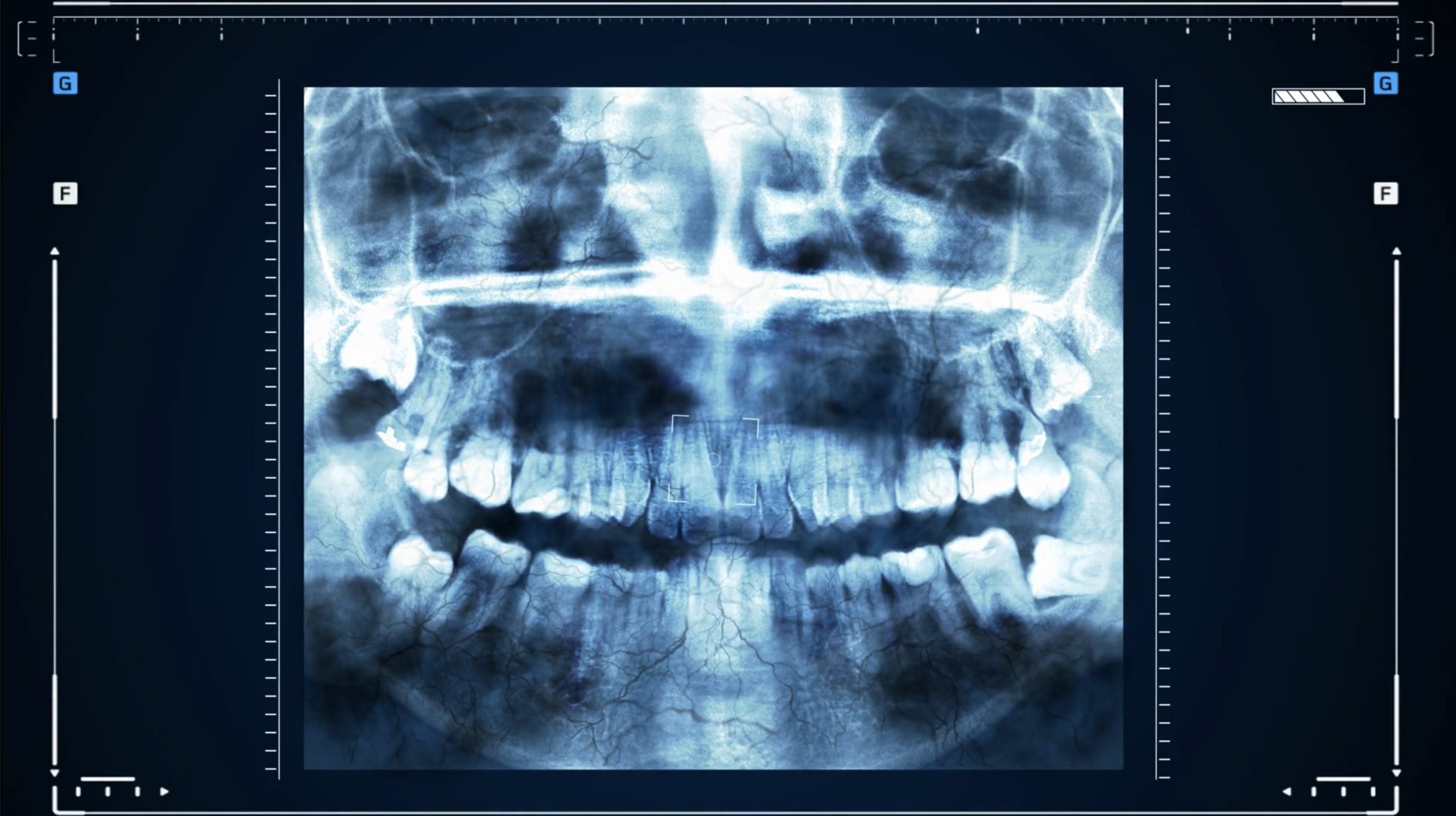
‘Murky’ science misplaces children
Despite being called unreliable, dental X-rays are still used to determine age, misplacing unaccompanied minors in ICE detention centers.
In May 2024 in Afghanistan, the Taliban forced a 14-year-old boy to attend a religious extremist boarding school and threatened to kill him if he tried to leave, according to his account in court records.
Fearing for his life, the boy fled to the U.S.
Carrying a fake passport and identification card that his family secured so he could pass as an adult and flee without alerting the Taliban, the boy arrived at the U.S. border in November 2024, one month after his 15th birthday. He told border officials the documents were forged, gave his true age and was processed as an unaccompanied minor. The Office of Refugee Resettlement placed him in a juvenile shelter in Fullerton, California, according to records filed by the boy’s lawyers.
But the agency still had doubts about his age. On May 8, 2025, court documents from a lawsuit the boy filed say ORR subjected him to a dental X-ray, a medical procedure that is controversial for age determination and exposed him to ionizing radiation. The report’s X-ray analysis, which found a strong chance the boy was an adult, would dramatically change his living conditions. Two weeks later, the government transferred him from the juvenile shelter to the Eloy Detention Center in Arizona, an adult Immigration and Customs Enforcement facility enclosed by rows of barbed-wire fences and secluded in the barren Sonoran Desert. The detention center lacks the schooling and foster care placement afforded to children in ORR shelters, which are intended to prioritize a child’s welfare.
“While no adult detention center is fit to house a child, Eloy is particularly unfit and has been described as the ‘deadliest immigration center in the U.S.,’ with at least 16 reported deaths, including five suicides,” the petition states.
The unaccompanied minor alleged in a lawsuit filed by the Immigrant Defenders Law Center that he suffered extreme stress and anxiety while at Eloy. He claimed he was abused by at least one adult detainee and feared for his safety. He also alleged the guards did not allow him to take medication prescribed for his anxiety.
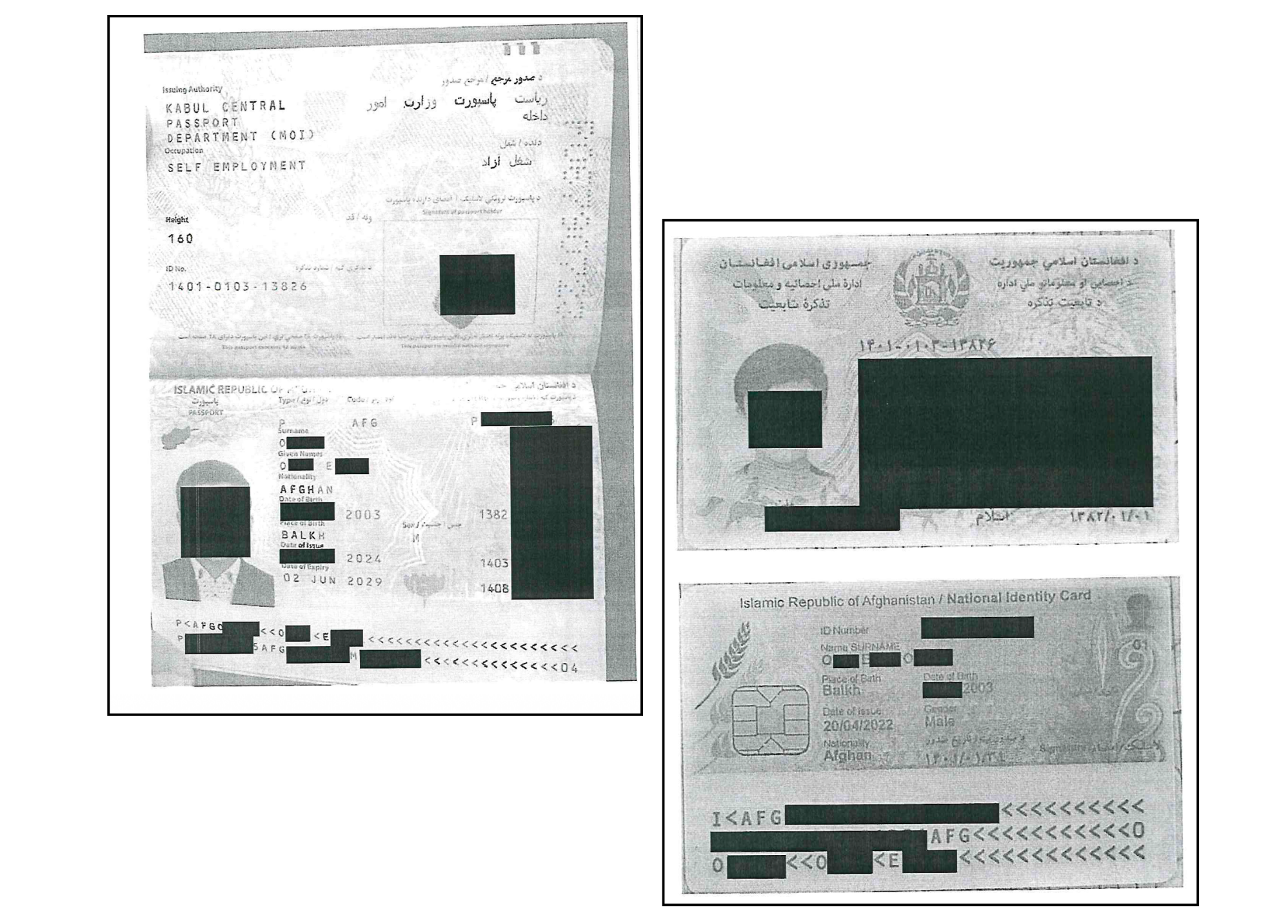
The immigrant from Afghanistan used a fake passport and identification card to flee without alerting the Taliban. (Source: Federal court records)
Thousands of other immigrants who told the U.S. government they were children were shifted to adult detention facilities after their ages were redetermined by U.S. officials. A team of researchers affiliated with Brigham Young University identified more than 6,000 children who went through similar age determination assessments while in ORR custody from 2014 to 2023 and were deemed adults.
ORR can conduct an age determination assessment of an unaccompanied minor in its custody if there is “reasonable suspicion” that the person is 18 or older, according to agency policy. Federal law requires age determination procedures to consider multiple forms of evidence, which can include dental X-rays, official government documents or personal statements. The BYU research, based on documents obtained through the Freedom of Information Act, does not state how many of the 6,000 cases involved dental X-rays or ionizing radiation.
The Howard Center for Investigative Journalism at Arizona State University reviewed hundreds of pages of court documents, government reports, scholarly articles and interviews with forensic dentists and found that the government’s long-standing use of dental X-rays for age determination is considered unreliable by leading dentistry organizations and scientific researchers. ORR policy also requires age assessment methods to factor in an immigrant’s ethnic and genetic background, but the Howard Center found that medical professionals often fail to do so or account for environmental factors that affect tooth development.
Dr. Adam Freeman, a dentist at Westport Dental Associates in Connecticut and a past president of the American Board of Forensic Odontology, characterized the practice as imprecise.
“It’s not kind of murky; it’s murky,” he said. “It’s like swimming in muddy water.”
Using dental X-rays to determine age and not for the purposes of patient care raises ethical questions, according to advocacy groups such as Physicians for Human Rights and some forensic experts. A standard X-ray involves a small amount of radiation — which the medical community condones because detecting problems early can avoid more invasive treatments later. Irradiating a minor for non-diagnostic reasons would violate medical standards of care.
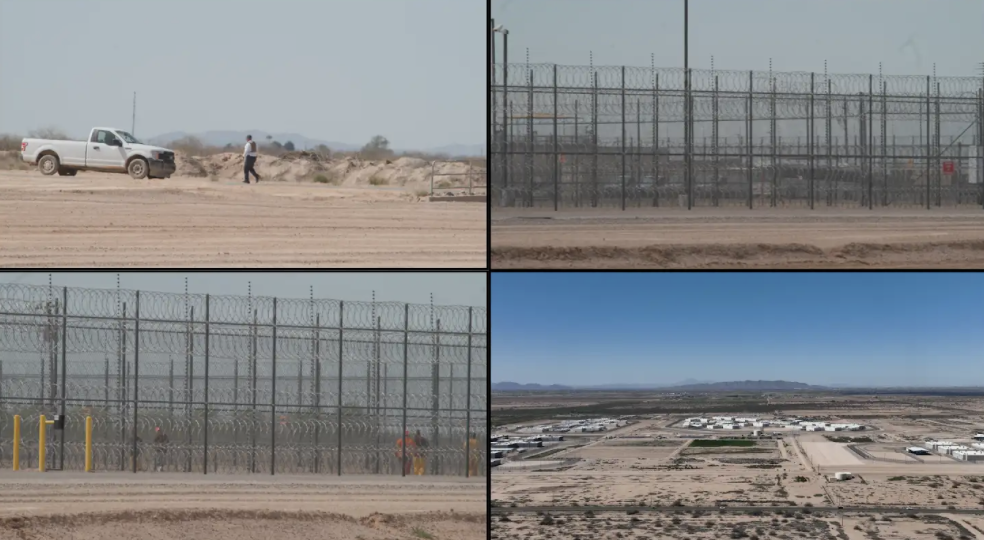
Photo by Lavanya Paliwal / Howard Center for Investigative Journalism and Bella Mazzilli / Cronkite News
Eloy Detention Center, photographed on March 3-4, 2026, is a private immigration prison in Eloy, Arizona owned and operated by CoreCivic under contract with the U.S. Immigration and Customs Enforcement.
In 2018, several dozen legal services, health and community organizations appealed to the Department of Health and Human Services to ban the government’s use of dental X-rays with ionizing radiation to determine the ages of minors in custody. The groups included The American Association of Public Health Dentistry, The Center for Law and Social Policy, and a number of academics and physicians. They cited the lack of precise science and the severe consequences of getting the determination wrong.
For example, the head of HEAL Trafficking, a non-governmental advocacy group focused on human trafficking as a health issue, said “the use of medical and dental examinations exacerbates the trauma” unaccompanied migrant children experience—many of whom are trafficked. “Such examinations are considered disproportionately invasive by UN institutions, the Council of Europe, healthcare providers, and EU institutions,” wrote Dr. Hanni Stoklosa, executive director at the time.
“In U.S. law, the difference between the way a person under 18 [and] a person over 18 really is treated, really is quite stark,” said Laura Belous, an attorney at the Florence Immigrant and Refugee Rights Project, a nonprofit that provides free legal services, social support and advocacy to immigrants in Arizona facing detention and potential deportation. “If a child comes, they are guaranteed certain protections under the law, which are really, really important. They’re in a less restricted placement. They have a different asylum processing law that applies to them.”
The only way the boy from Afghanistan could challenge his detention in an adult facility was to file a habeas corpus petition — an appeal to federal courts that seeks to compel the government to provide reliable evidence justifying someone’s continued imprisonment. In June 2025, the boy asked the U.S. District Court for the District of Arizona to step in. He presented evidence including his Tazkira, an Afghan identification card; a note from his doctor; and his Afghan school records to challenge the results of his dental X-ray.
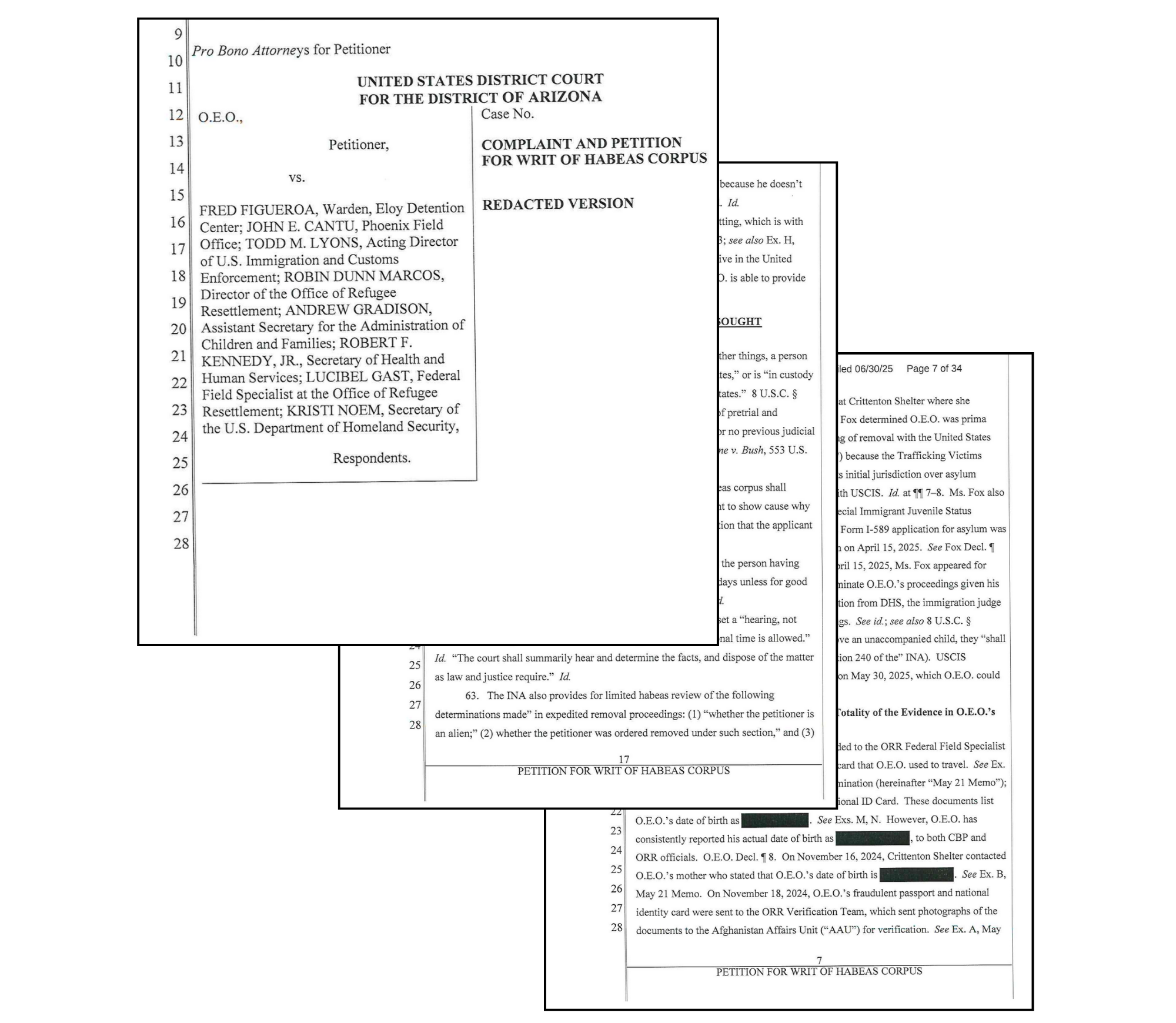
The immigrant from Afghanistan filed a petition for a writ of habeas corpus on June 30, 2025 in the U.S. District Court for the District of Arizona to challenge the legality of his detention in an adult ICE facility. (Source: Federal court records)
A disputed test with life-changing consequences
Dental radiographs, or X-rays, became a standard method for assessing age in the 1980s, when digital technology in the field advanced. A tiny beam of ionizing radiation is emitted into one’s mouth to capture images of teeth, bone, gums and problems such as cavities or infections. Critics have disputed the technology’s reliability for years.
The Trafficking Victims Protection Reauthorization Act of 2008, a federal law, states that radiographs cannot be used exclusively to determine age. Other forms of identification, such as birth certificates or baptismal records, must be taken into account.
According to the ORR Unaccompanied Alien Children Bureau Policy Guide, “a medical professional experienced in age assessment methods” submits a written report indicating the probability that the immigrant is a minor or an adult. An ORR federal field specialist must review the report. If there is a 75% or greater probability that the person is older than 18, and other evidence also suggests so, the person is processed as an adult.
In September 2024, the Florence Project sued the federal government to release records related to the use of dental X-rays to determine the age of unaccompanied migrant children.
The complaint stated that the analyses of dental X-rays are based on studies that often do not account for differences that can occur because of immigrants’ ethnic backgrounds.
“The dental analysis that the government has relied on to make age determination decisions is based on unethical race science,” the suit said.
For example, anyone deemed to be of Asian origin is compared with a study of Japanese juveniles. Someone who is European may be compared only with “a study of American and Canadian whites,” according to the complaint.
Dr. Robert M. Trager, who practices dentistry out of John F. Kennedy International Airport and LaGuardia Airport, said he has done a couple hundred dental X-rays in the past four to five years.
He said that while examining an immigrant’s teeth can help determine age, it is not conclusive.
“Over the years, I found out that people from … places in West Africa, because of their diets I would believe, their wisdom teeth erupted with the ages of 15 and 16,” Trager said. “So if you use that as a determination, you’d say, ‘Oh my god, they’re an adult,’ when they’re not.”
In the 2024 complaint against federal immigration enforcement agencies, the Florence Project stated that of the 50 children it had represented who were misclassified as adults based solely on dental X-rays, almost all were immigrants from African or South Asian countries.
Brigham Young researchers made a similar finding in their study of ORR data from October 2014 to March 2023: Immigrants from African countries were redetermined to be adults 10 times more often than those from other countries.
Dr. David Senn is a forensic dentist and former director of the Center for Education and Research in Forensics at the University of Texas Health San Antonio. In a 2019 interview with the Los Angeles Times, he said he worked on more than 2,000 age determination cases over the last two decades.
That year, he also worked on an age assessment for an immigrant from Eritrea, a country in East Africa.
On Jan. 4, 2018, the immigrant arrived at the U.S. border and verbally gave border officials a birthdate that would make the person 17 years old, according to a petition he filed in federal court.
ORR sent the immigrant to a juvenile residential facility in California. Two months later, the agency subjected the Eritrean to a dental X-ray reviewed by Senn, who determined the immigrant was likely between 17.1 and 23.7 years old, according to a court copy of the radiographic analysis.
Senn wrote in his report that the statistical probability the immigrant had turned 18 was 92.55%.
To comply with ORR policy requiring age determination assessments to consider ethnic and genetic backgrounds, Senn wrote in his report that he used a study on tooth development that compared “American Blacks” with “Whites.”
Nothing happened at first.
Not until later that same year, when an alleged bullying incident occurred at the Arizona juvenile facility holding the Eritrean immigrant, did ORR revisit the question of the person’s age. An ORR field specialist deemed the person to be an adult, citing two forms of evidence: Senn’s dental X-ray analysis and a field specialist’s sentiment that the individual “acts like an early 20’s person,” according to court documents. That decision sent the immigrant to an adult detention center in Florence, Arizona.
The immigrant and counsel submitted a habeas corpus petition in Arizona federal court and obtained a trio of experts to review Senn’s findings: Drs. Elizabeth DiGangi and Dawnie Steadman, two forensic anthropologists, and Dr. Iain Alastair Pretty, a dental surgeon and former chair of the odontology section of the American Academy of Forensic Sciences.
In an affidavit signed by these forensic experts, they agreed Senn’s conclusion that the probability the boy had turned 18 was “scientifically indefensible.” In particular, they questioned his decision to compare a person Eritrea using data on chronological age from Blacks in the U.S.
“There is no basis for assuming the African-American population is representative of someone from Eritrea.” The experts listed other variables that can affect the ages associated with each stage of dental development for a specific population, including nutrition, sanitation, vaccination status, climate, genetics and even psychosocial stress.
“Dental age estimation can, at best, provide a range of a number of years,” the experts said in their affidavit, adding that “the current recommendation regarding dental maturation age estimation is that experts provide an interval…rather than a point estimate of age.”
![The dental age estimation analysis performed on the Eritrean immigrant by Dr. David Senn, obtained through court records, concluded that the mean age for a male with third molar development such as his is “20.40 plus or minus 3.30 years. The range of possible ages for such a male is 17.10 to 23.70 years. The empirical statistical probability of [the boy] having attained 18 years of age is 92.55.”](https://livesinthebalance.news/wp-content/uploads/2026/06/lb_dental_exam-scaled.jpg)
The dental age estimation analysis performed on the Eritrean immigrant by Dr. David Senn, obtained through court records, concluded that the mean age for a male with third molar development such as his is “20.40 plus or minus 3.30 years. The range of possible ages for such a male is 17.10 to 23.70 years. The empirical statistical probability of [the boy] having attained 18 years of age is 92.55.” (Source: Federal court records)
The Howard Center asked Senn to address the validity of using broad study models globally, despite the lack of data accounting for the distinct environmental and ethnic variations between populations, especially when organizations such as the Center for Constitutional Rights have argued the practice is “unethical race science.”
“I, like you, very much want to help protect children even if they are in custody. It is demonstrably unsafe to house children together with unrelated adults and to house adults with unrelated children,” Senn told the Howard Center in an email.
“I also do not believe that dental radiographs are ‘racist and unethical,’” Senn added. “There are ample studies both challenging and supporting the use of the various dental development methods for age estimation.”
Freeman said the generalization of communities across many races is one reason dental radiographs do not accurately determine someone’s age.
“When they look at a Mexican-specific population, northern Mexico and southern Mexico may be very different for lots of reasons. So it doesn’t work because of that,” Freeman said. “When you look at the way they do age estimations, they use very broad populations.
“Because they don’t do, nor is it realistic to do, population studies that are so specific like the town of Westport, Connecticut,” he said.
Senn also did the dental X-ray analysis from the unaccompanied minor who fled the Taliban in Afghanistan.
In that case, Senn found that the boy’s tooth development was between 16.22 and 22.47 years old, according to a court copy of the dental analysis. Senn said the statistical probability that the immigrant had already turned 18 years old was 77.55%, according to the court record.
The dental report cited data from tooth development studies on “Japanese juveniles,” “a North Texas Hispanic population” and “American Blacks as Compared With Whites.”
Continuing the use of medical exams
During the first Trump administration, HHS and DHS proposed a rule governing the “Apprehension, Processing, Care, and Custody of Alien Minors and Unaccompanied Alien Children.” The proposal covered age determination, among other things.
A number of medical professionals, attorneys and elected officials submitted public comments arguing against the continued use of X-rays. One Texas state lawmaker, Armando “Mando” Martinez, called the practice “unreliable and unethical” in comments responding to the U.S. government.
“[T]here is no scientific or medical consensus on a reliable and ethical clinical method of age assessment,” Martinez said.
NC Child, a North Carolina non-profit, stated, “Children should be offered a range of options through which to prove their age and should have the right to refuse to undergo a procedure which subjects them to medical risks.”
In April 2022, HHS changed its age determination rules and removed one kind of medical exam from its list of acceptable methods for conducting age determination: “skeletal (bone) maturity assessments.” But it left the dental exam procedures in place, so long as it is considered as part of the “totality of evidence.” HHS policy states that bone maturity exams were removed because DHS no longer considers these an acceptable medical assessment for age determinations.
Physicians for Human Rights stated, “Skeletal maturity data is unreliable because skeletal tissue development is impacted by nutritional and environmental influences, not solely chronological age.”
HHS and DHS did not respond to questions about why bone exams are no longer accepted while dental exams are.
In Senn’s written statement, he also said he always followed the guidelines and procedures provided by ICE and the American Board of Forensic Odontology. He said he also included a dental health section in his reports detailing pathology and other problems highlighted by the radiograph.
“I also believe that children and adults benefit from regular dental examination, including the safe use of radiographs,” Senn said.
Freeman expressed concern about increasing long-term health risks for children in custody that might result from subjecting them to X-rays.
“Radiation is cumulative,” he said.
Freeman also noted the gray area around receiving consent from a minor in custody.
“We are supposed to be clinicians and there should be a risk-benefit association here, and there’s risk without a lot of benefit to the child,” Freeman said.
According to the American Dental Association’s recommendations, “Radiographic exposure should be justified when the potential diagnostic or treatment benefit outweighs the associated risks.”
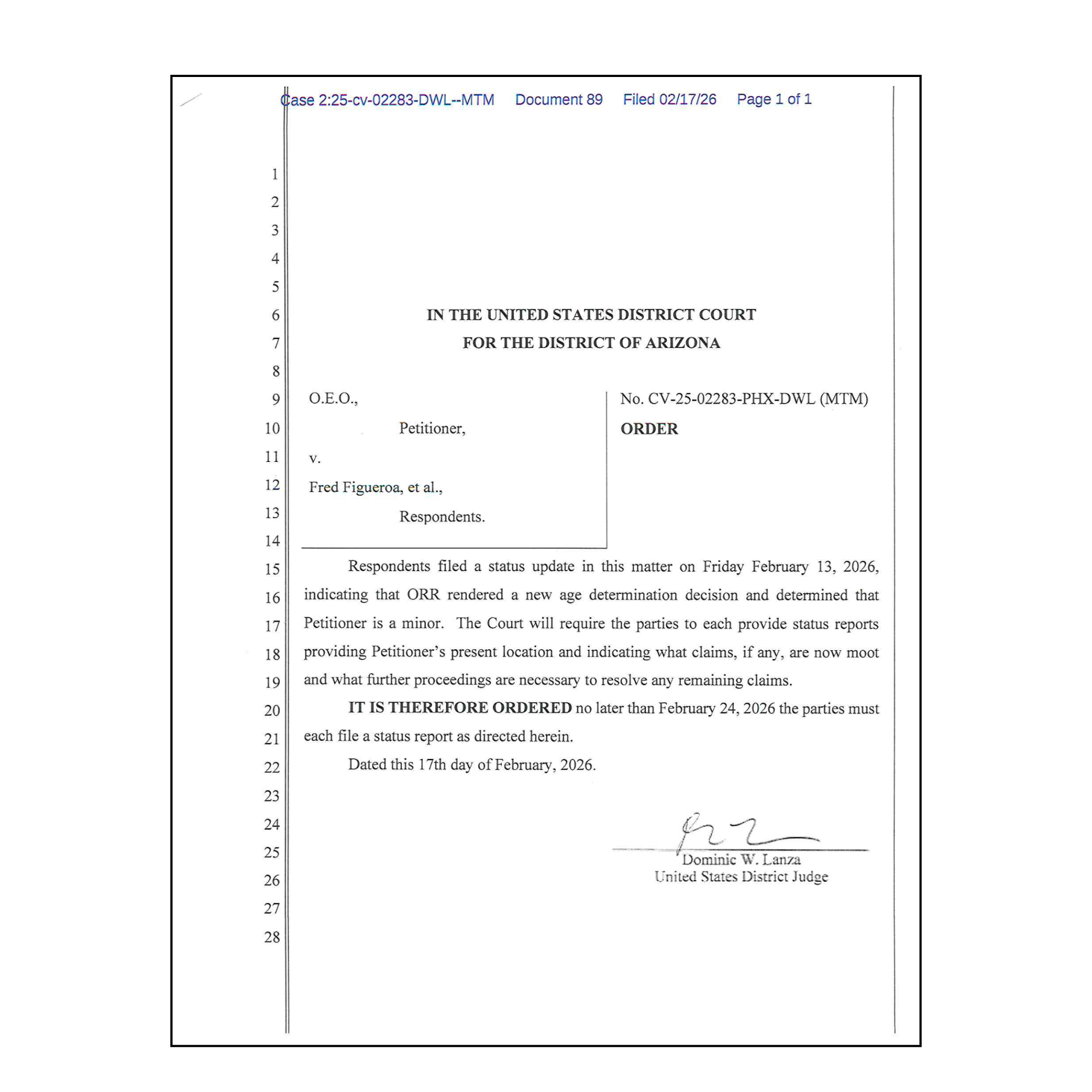
This February 17, 2026 court order acknowledges that ORR rendered a new age determination decision on the immigrant from Afghanistan, finding that he is in fact a minor. The court asks that both ORR and the immigrant’s counsel provide status reports within a week on the boy’s location and any outstanding claims. (Source: Federal court records)
In a written statement, HHS said that “dental radiographs and other assessments may be used as one factor when reliable documentation like a birth certificate is unavailable.”
The agency said accurate age determinations help prevent adults from being placed in a location intended only for minors, reducing the risks of exploitation, abuse or trafficking.
DHS did not respond to multiple requests for comment.
As for the unaccompanied minor from Afghanistan, following his federal lawsuit, ORR officially reversed its determination that he was an adult and acknowledged he was, in fact, a minor. The boy was moved in February or March 2026 from the barbed wire-enclosed detention center in the Arizona desert back to an ORR juvenile shelter, where he was continuing to fight his removal proceedings.
Note: This story was produced by the Howard Center for Investigative Journalism at Arizona State University’s Walter Cronkite School of Journalism and Mass Communication, an initiative of the Scripps Howard Foundation in honor of the late news industry executive and pioneer Roy W. Howard.
Contact us at howardcenter@asu.edu, visit us at https://howardcenter.asu.edu/ and follow us on Instagram and X @HowardCenterASU.
A digital journalist from Boston, Massachusetts.
A digital journalist from Kentucky.
More from The System
Your judge may matter more than your immigration case
Story by Laura Robertson & Mikayla Melo

Funding cut halts farm dream
Story by Wesley J. Pérez Vidal Graphics by Jesse Renee Kennedy
On the road: South Omaha to ‘Cornhusker Clink’
Story by Justin Diep
The chilling effect on international student journalists
Story by Charlotte Calmès Graphics by Jesse Renee Kennedy

The cost of deportation
Story by Lilly Roseburrough
“We couldn’t take it anymore”
Story by Bea Anhuci