


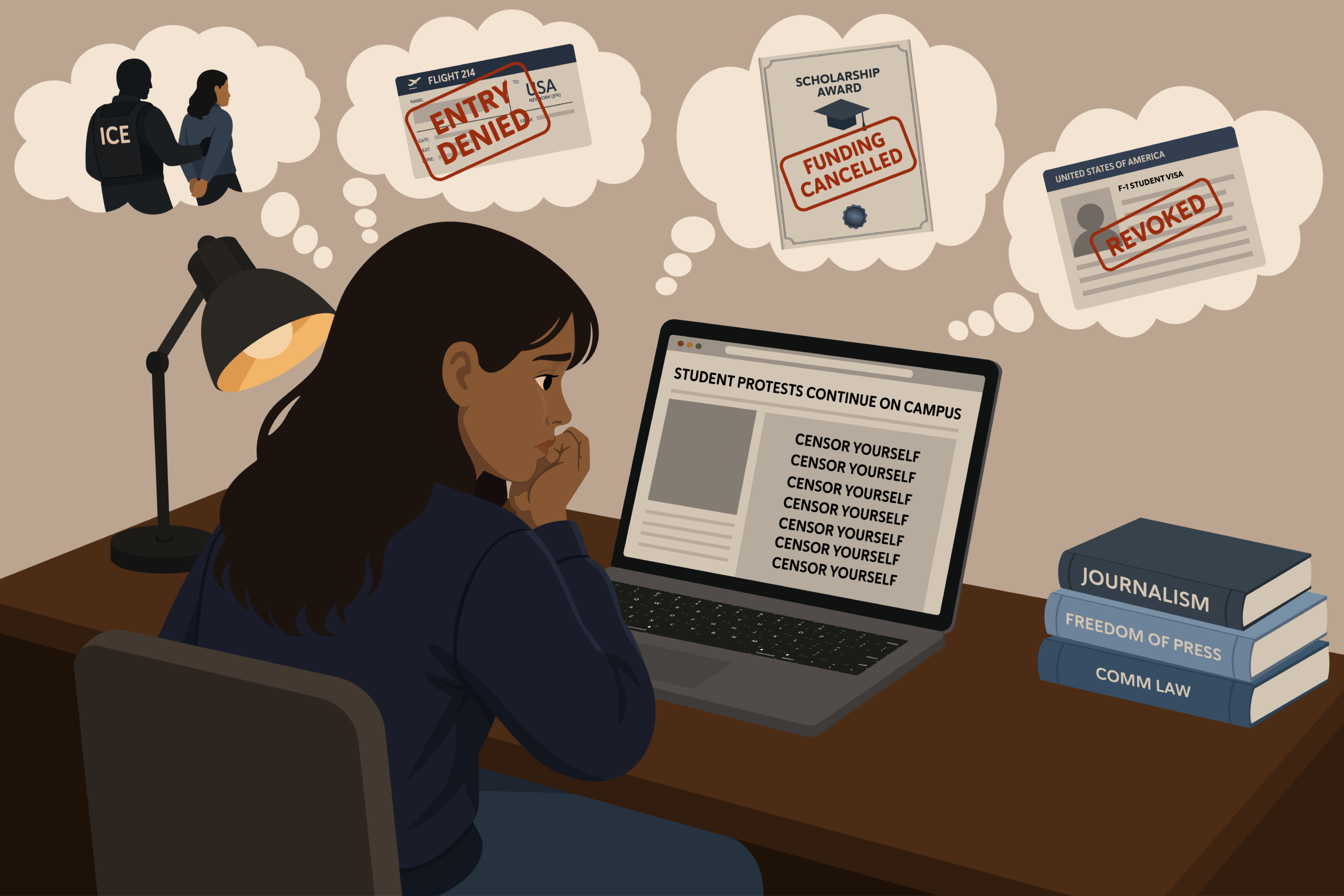
How threats against student visa holders have had a chilling effect on international student journalists
The arrest last year of a Tufts doctoral student following a critical op-ed, followed by a rash of student visa revocations, has led some international and immigrant student journalists to step back. Others continue reporting amid fear and uncertainty.
After masked federal agents detained Tufts University doctoral student Rümeysa Öztürk on a suburban Boston street in March of 2025, one University of Southern California student and USC Annenberg Media reporter developed a new daily habit rooted in fear.
“Before I slept every night, I would look up my name on an incognito browser to see what bylines came up, and how they came up,” the student journalist said. “just to see, if someone who did not know me read this, what would they think of me?”
Öztürk, a student visa holder from Turkey, had written an op-ed for her student publication in the spring of 2024 that was critical of Tufts leaders’ response to the Israel-Hamas conflict.
The USC student journalist had reported on related protests at USC during that time, as had many student newsroom peers. But unlike most of them, this young reporter was also here on a student visa.
Over a year later, putting themselves in the shoes of both an average reader and a federal immigration enforcement agent, the student would go online and scan every search result that came up for their name, making sure nothing stood out.
“I was always stressed,” said the former student, who requested anonymity due to the ongoing vulnerability of their immigration status. They regularly checked a government website where students could see whether their visas had been revoked, monitoring the page to ensure their status had not changed.
“My biggest fear was, what if someone literally just showed up to my door to say, ‘Oh, my visa is gone, I need to leave the country?’” the former student said. “So I would look up my name to make sure.”
Ever since Öztürk’s arrest last year, vulnerable student journalists have begun taking extra precautions like these to ensure their safety in a period where many noncitizen students are “constantly looking over [their] shoulder,” the former student reporter described.
Some student contributors have withdrawn from campus outlets entirely, editors say, while others continue to report under mounting pressure, adopting new measures to protect themselves while continuing to make their voices heard.
Adam Kinder, until recently editor-in-chief of the Columbia Political Review and a 2026 Columbia graduate, said that incidents such as the detainment of pro-Palestinian student activists Mahmoud Khalil and Mohsen Mahdawi in early 2025, as well as the arrest of Öztürk, created a pervasive “climate of fear” on the Columbia University campus. Many students, he said, no longer felt safe expressing political views or covering geopolitical conflicts.
“We’ve had at least a couple of writers say, ‘I want to take a hiatus so as to avoid jeopardizing my education,’” Kinder said, “or, ‘I want to take a pause on writing until we have kind of a clearer understanding of where things lie and what liberties I do have.’”
Silence as self-protection
In spring 2024, students and faculty at nearly 150 colleges and universities, including USC, staged protests and formed encampments calling for an end to the war in Gaza and for their institutions to divest from companies linked to the conflict.
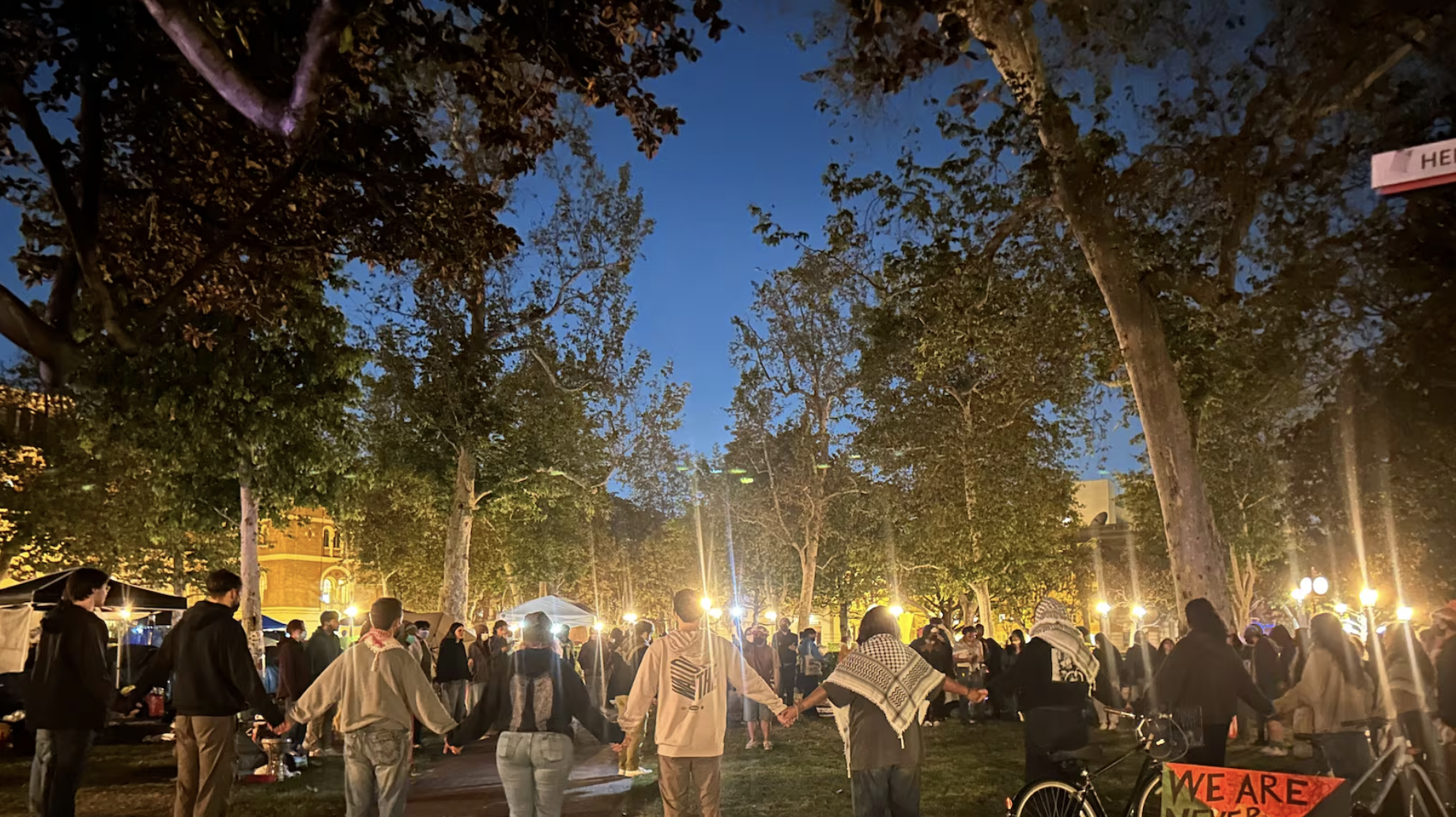
Photo by Ari Rose-Marquez | Annenberg Media
Pro-Palestinian protesters on the USC campus form a circle to perform a folk dance in April 2024.
Hundreds of protesters were arrested at Columbia, where administrators permitted police intervention in campus protests for the first time since 1968. On April 18, the NYPD arrested more than 100 participants during an encampment protest on the university’s South Lawn.
Less than two weeks later, on April 30, police arrested another 109 demonstrators in a sweep of the occupied Hamilton Hall and what was called the “Gaza Solidarity Encampment.”
As of this past April, the visas of at least four international students of Columbia University had been revoked. In February, protests erupted again after U.S. Immigration and Customs Enforcement (ICE) agents arrested Columbia senior Elmina Aghayeva, who is from Azerbaijan, inside her student apartment. Acting President Claire Shipman later shared that the agents had misrepresented themselves to gain access to the residence.
Kinder said events like these have led some student journalists — particularly those in the U.S. on visas — to request the removal of their published articles. Their hope, he said, is to avoid university or federal attention and scrutiny.
“We’ve had at least a couple of writers say, ‘I want to take a hiatus so as to avoid jeopardizing my education, or, ‘I want to take a pause on writing until we have kind of a clearer understanding of where things lie and what liberties I do have.’”
– Adam Kinder, former editor-in-chief of the Columbia Political Review
Even during the spring of 2024, when Kinder served as managing editor, at least half a dozen current and former contributors asked the Review to take down articles from its website, he said, forcing the publication’s leadership to adapt to these new risks.
“We were not going to allow the work that they had done with us to jeopardize their future,” Kinder said. “So we simply saved those articles, should they ever want to repost them, and took them down in the meantime.”
While some contributors asked to have their articles removed due to concerns about future employability, Kinder said the “vast majority” of the fears students shared with him were “overwhelmingly related to immigration.”
At USC, Malcolm Caminero, until recently co-executive editor of Annenberg Media, said that since stepping into the role in fall 2025, he has seen both citizen and noncitizen reporters hesitate to attach their names to stories or ask for previously published articles — especially opinion or political pieces — to be removed from the publication’s website.
He said the majority of those requests have come from international students, undocumented students, or students with undocumented family members who fear being targeted by the federal government.
“We want students to tell those hard-hitting stories as often as possible,” said Caminero, who graduated in May, “but we also tell them up front the possible dangers and drawbacks of telling those stories.”
Last January, the State Department announced on social media that it had revoked more than 8,000 student visas since President Trump returned to office. Administration officials have also warned that students and green card holders could face deportation for expressing support for Palestine or criticizing Israel’s actions in Gaza, framing such speech as a threat to U.S. foreign policy and labeling those individuals as “pro-Hamas.”
Kinder said that while contributors’ initial fears mostly focused on stories related to Gaza, they have since expanded to stories on a wide range of political topics, including commentary on China and Iran, and broader criticism of the Trump administration.
Concerns about retribution
The fear of retaliation extends far beyond student journalists.
Katherine Jacobsen, the U.S., Canada, and Caribbean program coordinator with the Committee to Protect Journalists, said these concerns about retribution span across the journalism industry. They reflect an “overall democratic backsliding” in the U.S. that “undercuts a journalist’s ability to do their job,” she said, and leaves reporters who are not U.S. citizens particularly vulnerable.
“The administration has shown that they’re willing to…go through various types of legal maneuverings to remove individuals whose speech they do not like,” Jacobsen said. “That puts certainly even the most seasoned reporter with massive institutional support on their heels.”
Jacobsen said that while these tactics are not new, they represent a “ratcheted-up version” of strategies first used to intimidate and silence journalists under the first Trump administration.
“We are in a situation where alarm bells should be ringing,” Jacobsen said. “If the U.S. was another country overseas, we would be covering this as the decline of democracy.”
In recent months, Jacobsen said CPJ has seen a surge in journalists reaching out about both online and real-world threats related to their political coverage, with several contacting the organization over concerns about their rights when covering events like local protests.
She described the detainment and deportation of Emmy-winning Salvadoran reporter Mario Guevara, arrested in Atlanta while covering a “No Kings” protest against the administration’s policies, as a “watershed moment” that heightened fears among international reporters in the U.S. and across the broader reporting community.
“It shows that the administration is very willing to disregard procedure to accomplish their end goals,” Jacobsen added.
A lawsuit to protect students
To justify recent punishments of noncitizen student speech and published articles, Secretary of State Marco Rubio and the Trump administration have pointed to the Immigration and Nationality Act of 1952. This federal law grants the Secretary of State the authority to deport any individual who is “adversarial to the foreign policy and national security interests of the United States of America.”
The administration cited this law in its actions against both Mahmoud Khalil and Rümeysa Öztürk, the former Columbia activist and the Tufts student who were arrested in early 2025.
Last August, the Foundation for Individual Rights and Expression (FIRE) sued Rubio and the Trump administration, arguing in the complaint that this use of the Immigration and Nationality Act represents an attack on free speech.
The lawsuit was filed on behalf of The Stanford Daily, along with plaintiffs Jane Doe and John Doe, student visa holders who have engaged in pro-Palestinian advocacy and spoken out publicly online. The complaint outlines that writers on student visas at the publication are declining assignments related to the conflict in the Middle East, fearing that even straightforward reporting could “endanger their lawful immigration status.”
On the same day the lawsuit was filed, FIRE also asked the court to temporarily prevent the government from revoking visas based on protected speech.
In January, U.S. District Judge Noël Wise denied the Trump administration’s motion to dismiss the lawsuit. The judge is seeking further information in the Daily’s lawsuit after a hearing in late May, where constitutional questions were raised about the government’s alleged use of immigration laws to deport people for their speech. The next hearing is scheduled for July 28.
According to the lawsuit, Rubio is relying on two specific provisions to target non-U.S. citizen student reporters. The first allows the Secretary of State to move forward with deportation of someone if the secretary personally determines their speech “compromises a compelling United States foreign policy interest.” The second gives the secretary the power to revoke an individual’s visa or other documentation at any time and for any reason.
Dominic Coletti, program officer for FIRE’s Student Press Freedom Initiative, said the Trump administration’s use of these provisions constitutes an “unprecedented assault” on “bedrock First Amendment activities.”
“Even something that is nominally unrelated to journalism — immigration policy — is having a chilling effect on what the media are saying,” Coletti explained.
He says these actions not only represent “formal censorship” of journalists, but also serve as warning signs for the future of press freedom in the United States.
“If this becomes not just one administration, but the norm and the expectation for what the government does when it’s confronted with speech it doesn’t like from noncitizens,” Coletti said, “I think it’ll be a difficult time to be a noncitizen working in media.”
In mid-October, a coalition of 55 student news organizations and newsroom leaders, led by the Student Press Law Center, Associated Collegiate Press and the College Media Association, filed an amicus brief in support of The Stanford Daily. The brief argues that student outlets nationwide have also felt the effects of this “real, persistent, and devastating chilling effect” from the government’s targeting of unfavorable political speech by international and immigrant students, hindering their ability to write freely.
“The stakes for student journalism, journalism education, and the democratic values underlying those pursuits could hardly be higher,” the amicus brief reads.
Julia Senzon, until recently editor-in-chief of The Cornell Daily Sun, said signing onto the amicus brief was a “no-brainer.” Concerns about the potential consequences of attaching names to bylines, she said, steadily increased during her time at the paper. Since the spring 2024 protests, Senzon said she saw a broader shift in contributors’ willingness to cover sensitive issues, regardless of their immigration status.
“If this becomes not just one administration, but the norm and the expectation for what the government does when it's confronted with speech it doesn't like from noncitizens. I think it'll be a difficult time to be a noncitizen working in media.”
– Dominic Coletti, program officer for FIRE’s Student Press Freedom Initiative
Senzon, now a recent graduate, added that this trend not only highlights “one of the most important issues affecting student journalism today,” but also directly contradicts Cornell’s own founding principle of “… any person … any study.”
“I think that ‘any person’ definitely includes international, noncitizen students,” Senzon said, “and that should be reflected in their ability to be admitted, in their ability to participate fully in campus culture, and also to speak out.”
‘Some kind of clarity’
In the current political climate, Senzon said international and immigrant students often hesitate to publish not only because they fear federal repercussions, but also because of uncertainty about how their universities might respond.
“There are ways for university action to have more clarity around the risks and processes surrounding international students, especially for students involved in protesting,” Senzon said, “and they kind of fail to do their job there.”
Kinder at Columbia said that more clearly defined boundaries — or transparent communication that no such boundaries exist — would help to foster more honest and transparent relationships between student publication leaders and their universities.
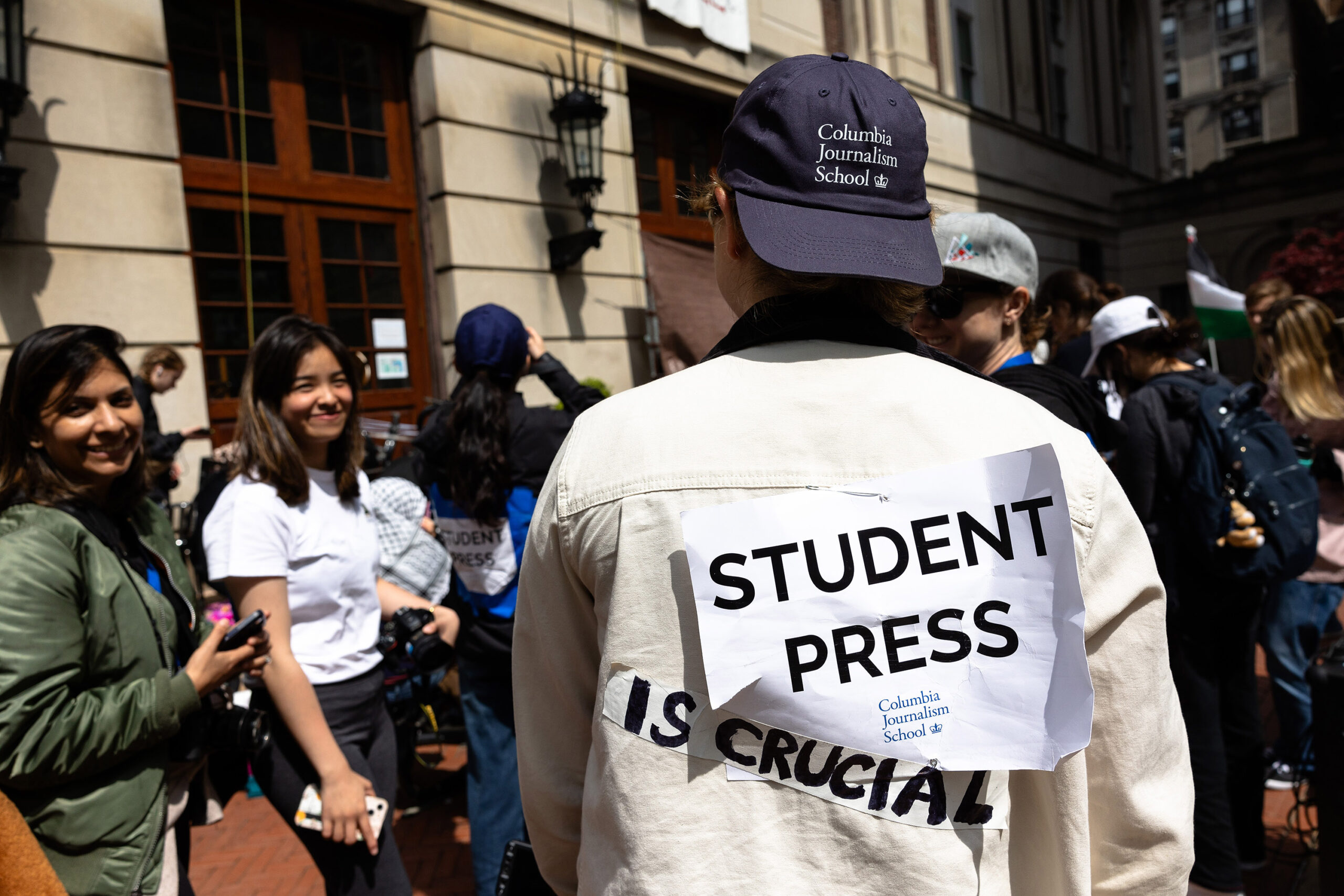
Photo by Getty Images
A Columbia Journalism student journalist shows off their sign as they cover the events at Hamilton Hall at Columbia University on April 30, 2024 in New York City.
“We just don’t know where exactly that red line is in the written form,” Kinder said, “and all that we really are asking for is some kind of clarity.”
Still, many immigrant and visa-holding student writers — including at The Cornell Sun and the Columbia Political Review — have continued their work, turning to measures such as anonymity and shared bylines to reduce individual risk.
Kinder has encouraged students, regardless of their citizenship status, to continue to “write with everything [they] have,” stressing that their ideas, rather than their identities, should remain at the forefront.
“The more we can embrace a plurality of ideas, the better off we are going to be in the long run,” Kinder said, “and in my opinion, the more effective we are going to be able to inherit the political situation that we do as young people and try and bring ourselves to a better place as a country.”
Fear of leaving the country
Despite being keenly aware of the risks, the former Annenberg Media student reporter continued covering campus and political affairs during their time at USC.
But the stress didn’t go away: Every time they left the country for a holiday or break, they feared they would not be allowed back in if an immigration agent came across an article or op-ed they didn’t like.
Every time they went out to report on the encampment protests on campus, they told their parents they were studying in the library, knowing the truth would only cause worry. Months later, as news of student visa revocations circulated, the student began waking in the middle of the night with panic attacks, afraid that ICE might show up at the door.
“Even my mom, when she came for graduation, she deleted all the articles I would send her after writing them,” the former student said.
Reporting became not simply a matter of covering the news, but “constantly wrestling” between a sense of responsibility to produce stories and the need to protect their mental health and physical safety, the former student said.
Now in the professional world, they said they have “become ten times more cautious than I was when I was in school,” explaining that without the protection of student status and the backing of a faculty-supported newsroom, the risks feel even more acute.
“What privileges I do have on these visas are so arbitrary that one day, the visa exists, and then the next day, it doesn’t,” the former student reporter said.
But this is a risk the former student is willing to accept. All they want, they said, is to keep writing.
“Four years of my college life, I dedicated it all to journalism,” they added. “Almost every club I was involved in had an aspect of journalism involved in it. Almost every friend I made was, or is, a journalist. Every professor or mentor I had was, or is, a journalist.”
“It’s the only thing I know.”
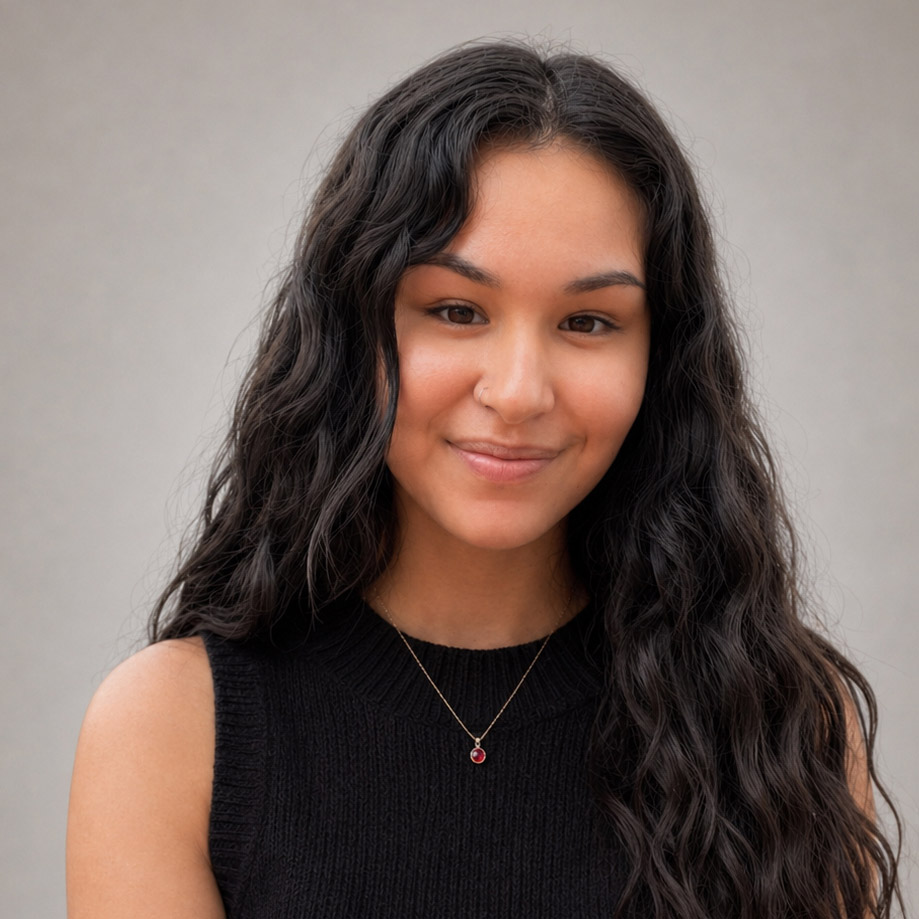
A digital journalist at the University of Southern California.
A designer at Syracuse University.