



South Omaha to McCook
A freshman senator's unexpected fight for Nebraska’s immigrant community.
Inside Nebraska state Sen. Margo Juarez’s car, the atmosphere on Dec. 15, 2025 was festive.
Christmas carols filled her car as she navigated the shifting landscapes from her urban district in South Omaha to the open plains of rural McCook. But the holiday cheer was interrupted by a phone call.
It was a reporter calling Juarez, asking about her destination: a former state prison turned into a federal immigration detention center nicknamed “Cornhusker Clink.”
It’s become the norm for the 67-year-old freshman senator. In just a year, she went from a retired federal employee on the school board to one of the most vocal critics of Gov. Jim Pillen’s cooperation with the Trump administration’s mass deportation efforts.
It is a role Juarez never considered when she ran for office, but now embraces.
“It’s very important for me to get there,” she said of the trip. “I want the immigrants to know that there are people who are supportive of them.”
The push for Juarez to advocate for immigrants, she said, “comes from the heart.”
Her grandparents immigrated to the U.S. from Mexico, drawn by the growing railroad industry. They laid the tracks for her to be born and raised in South Omaha, where she graduated from Omaha South High in 1976.
“That’s what they would want me to do, advocate for the immigrants,” she said.
After earning a business degree from the University of Nebraska at Omaha on a Goodrich scholarship, Juarez spent her career as a federal employee with the IRS and the Social Security Administration, following her then-husband to Utah, Colorado, and Oregon. She retired early at 57 in 2014, returning to her hometown and following her ex-husband and two children back to the Cornhusker state.
“Everybody was here but me,” she said. “I was the last one to get back.”
Juarez spent much of that time caring for her parents, which she believes contributed to their long lives. Her father died in 2018 at 90. Her mother got to see Juarez’s new career in public service before dying in February at 100.
School board to statehouse
A community member pushed Juarez to fill a vacant seat on the Omaha Public Schools Board of Education in 2021, starting a new career in public service. She initially declined but decided to just try it out to serve the remainder of the term left by Kimara Snipes, who was forced to resign when she moved out of Subdistrict 8.
“I could do anything for a year,” Juarez recalls thinking at the time.
Juarez said she grew to love elected office while on the school board, but added she now regrets not looking into public service earlier.
“I just love being in a place to make decisions,” she said. “I really do appreciate that challenge.”
Juarez won her re-election bid to the board in 2022.

Photo by Justin Diep
State Sen. Margo Juarez of Omaha sifts through papers in her office in the Nebraska State Capitol on Tuesday, Oct. 28, 2025, in Lincoln.
The work intrigued her enough to seek a higher office, first at the Omaha City Council, where she hoped to bring Hispanic representation to the table after Vinny Palermo was ousted in 2023 for his involvement in a federal fraud case.
Juarez was one of a dozen who applied to represent District 4, which encompasses much of South Omaha, where 44% of residents identify as Latino.
“It’s important that people at government levels, at seats, reflect the population that they serve,” she said.
Her mom had other thoughts.
“‘Do you think you’re going to change those people down there?” Juarez recalls her mom asking her. “She goes, ‘Why are you doing that? You’re not going to change them.’
The city council picked Ron Hug, a longtime Metropolitan Community College board member, to fill the seat.
“She was right,” Juarez said.
"The immigration issues, I had no idea that they would come up to the extent that they have."
– Margo Juarez, Nebraska state senator
Then came school choice. Juarez was frustrated that state lawmakers pushed for LB 1402, a bill that provides taxpayer-funded scholarships to certain students attending private schools.
“I got so mad I went to the election commissioner’s office and signed up,” Juarez said.
While canvassing for her seat, Juarez knocked on the door of a woman in her district who told her, to her face, that she wouldn’t vote for her because she is Latina.
“I just remember turning around and walking away because I was so shocked that somebody would say that to my face,” Juarez said.
She won 57.6% of the vote in 2024 to represent District 5 in the Legislature, the same night Donald Trump secured a second term, promising to be tough on immigration.
Even after her victory, Juarez still faced discrimination, she said. Soon after she took office, one of her Republican colleagues told her that her vote didn’t matter.
“It was really a reflection of ‘you’re not valued,’” she said. “I’m here because I’m going to prove them wrong.”
Sen. Danielle Conrad of Lincoln, a fellow Democrat who serves with Juarez on the Education, Retirement Systems and Natural Resources committees, said the rookie senator wasted no time learning the ropes of state government.
“Her tireless efforts and authentic community connections are invaluable in state leadership more than ever,” Conrad said in an email to Nebraska News Service.
Juarez introduced 16 bills in her first year focused on criminal justice system reform, increasing transparency in state government, and prioritizing investments in education and the workforce.
One of them, LB519, was signed into law. It now requires independent confirmatory testing of potential contraband or drugs in prisons before a prisoner can face disciplinary action.
She introduced one bill addressing immigrants, LB299, which would allow immigrants authorized to work in the U.S. and their dependents to receive public benefits from their employment. The bill is awaiting a vote in the Legislature.
Then came June, when 76 workers were detained during an immigration raid at Glenn Valley Foods, a meatpacking plant in Juarez’s district.
“The immigration issues, I had no idea that they would come up to the extent that they have,” she said.
Hours after the raid, Juarez took to the streets and stood alongside hundreds in her district, lining 33rd and L streets in the near 90-degree June heat, protesting against Immigration and Customs Enforcement. Days later, she did the same, joining Sen. Dunixi Guereca of Omaha and hundreds of others outside Charles Schwab Field to take their message to the College World Series.
Keeping an eye on McCook
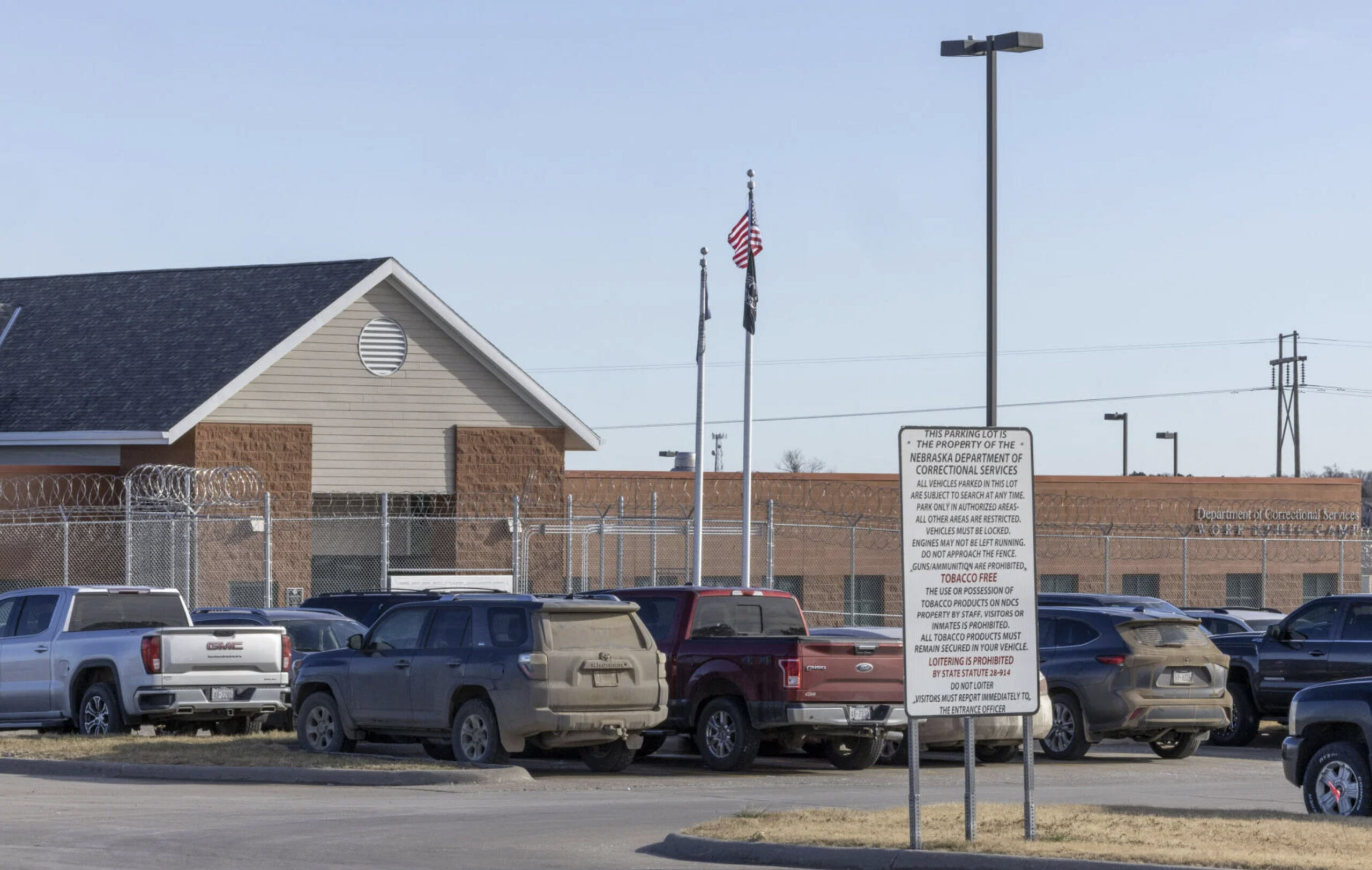
Photo by Justin Diep
A look at the “Cornhusker Clink” federal immigration detention center on Monday, Dec. 15, 2025 in McCook, Nebraska. The former Work Ethic Camp will house detainees awating deportation hearings under two-year contract with the state and U.S. Department of Homeland Security.
Juarez first made the drive to McCook in September, shortly after Pillen announced the Work Ethic Camp would become a federal immigration detention center.
She first stopped at the Lincoln County Jail in North Platte, where 63 of the Glenn Valley workers were sent.
“I was very concerned with how they were going to be treated,” she said.
When Juarez arrived at the McCook facility, she said she saw bunk beds with “not much room in between.”
As the Work Ethic Camp, the facility housed under 200 prisoners, according to its 2024 annual report. As an ICE detention center, it plans to accommodate up to 300 detainees, as listed in the 183-page, two-year contract between the state and the U.S. Department of Homeland Security.
Her return trip on Dec. 15 was different. The “Cornhusker Clink” now houses detainees awaiting deportation hearings that will determine their future in the United States.
Juarez originally planned a solo trip, but her schedule was interrupted by Republican Sen. Myron Dorn of Adams, chair of the Legislature’s Oversight Committee. He told lawmakers in an email on Dec. 10 that he worked with Pillen’s office to arrange a group walkthrough of the facility, open to all 49 senators, on the same day and time Juarez planned.
The invitation turned Juarez’s trip into a supervised group tour, where she expected very few lawmakers would bother to go.
Five did: Republican Sens. Dorn, Tom Brandt of Plymouth, Robert Clements of Elmwood and Dan Lonowski of Hastings drove together to McCook. Juarez, the lone Democrat on the visit, drove separately

Photo by Nebraska Department of Correctional Services
State Sen. Margo Juarez of Omaha, left, tours the McCook ICE detention center, nicknamed “Cornhusker Clink,” on Monday, Dec. 15, 2025.
Inside, Juarez said she didn’t notice any significant changes from her September visit.
“I was surprised about how much of it really hasn’t changed,” she said. “It’s really very similar to my prior visit.”
Juarez said the detainees still have access to the same accommodations as the former prisoners she saw in her September visit, such as a library, TVs and tablets.
“I question everything now; that’s what this has done to me."
– Margo Juarez, Nebraska state senator
She saw offices being converted into housing units to reach the contracted 300 beds DHS is paying the state for. She was told on the tour that they would be constructing a new building for office space.
“They’re definitely going to take up the space to the max to house the detainees,” Juarez said.
Juarez estimates she saw around 100 to 150 male detainees of various nationalities, most of whom appeared Hispanic. She did not see any female detainees in McCook.
She was satisfied with what she saw but still opposes the McCook detention center, which has put her at odds with Pillen, who, in August, voluntarily offered the Work Ethic Camp to the federal government as Nebraska’s part in the Trump administration’s mass deportation efforts.
“I question everything now; that’s what this has done to me,” Juarez said.
The facility began housing ICE detainees in November, with DHS paying Nebraska $269.17 per bed a day. Detainees in McCook have appeared in hearings over video at Omaha’s immigration court and been ordered removed from the country.
She and other state lawmakers questioned Pillen’s authority to turn over a state prison to the federal government without their approval. The Nebraska Constitution gives the Legislature control and oversight of all state prisons.
Juarez said she worries McCook is a sign of growing, unchecked power in the state executive branch.
“He made the decision without being able to get approval from us to flip that facility like he did. That is outrageous to me,” Juarez said. “I don’t think that an action of that nature should have been that simple to accomplish by his sole discretion. It’s absolutely scary to think of the power he has and the decisions that he can make and the impact it has on people’s lives.”
She worries that nothing is stopping Pillen from going further and turning over local jails to ICE.
“That’s what scares me,” she said.
Several McCook residents and a former state lawmaker who authored the bill creating the Work Ethic Camp sued Pillen and Rob Jeffreys, director of the Nebraska Department of Corrections, claiming that turning the facility over to ICE usurps legislative authority and violates separation of powers under the Nebraska Constitution and state law.
The lawsuit, filed in the Red Willow District Court, is pending. A preliminary injunction to stop “Cornhusker Clink” from opening was denied.
Juarez said she believes that the billions the federal government spends on detention would be better used to clear the backlog in immigration courts. The so-called One Big Beautiful Bill Act, signed into law in July, gives $170 billion to federal agencies for immigrant enforcement, detention and deportation.
In Omaha’s immigration court, more than 43,000 cases are backlogged with average wait times reaching three years, according to data from Transactional Records Access Clearinghouse, an immigration court and detention research center at Syracuse University.
“It’s really unfortunate that there have been people who have been here for years and years and now are facing an unknown about their future,” Juarez said.
In October, Pillen said in a press release that using the Work Ethic Camp as a federal detention center will save Nebraska taxpayers money. The state is expected to realize $14.25 million annually from the contract, at a time when Nebraska’s projected budget deficit is $471 million.
“Wonderful for him to take advantage of exploiting my community to get his dollars,” Juarez said. “I consider it an absolute exploitation.”
“Our governor definitely hasn’t made my community feel welcomed."
– Margo Juarez, Nebraska state senator
Pillen’s office did not respond to Nebraska News Service’s request for comment.
Speaking out can come with risks for a senator’s political future, according to term-limited Sen. Wendy DeBoer of Omaha.
During a panel at the Young Democrats’ winter meeting in Omaha on immigration policy, DeBoer said some lawmakers are unwilling to speak out publicly against Trump or the governor out of fear of losing their ability to pass bills or their reelection bids.
Juarez, who was also on the panel, told the audience she didn’t think that way as an outspoken critic of the governor.
“I’m not going to worry about that until when I run again, and then the voters will speak out,” Juarez said during the panel.
Her actions caught the attention of Paul Feilmann, a retired mental health counselor from Yutan, who organized protests against the McCook facility outside the Governor’s Mansion in September. He watched to see who would show up.
Juarez did.
“I just see her being very personally connected to people,” Feilmann said. “She relates very personally, and she’s very supportive and connects at a kind of emotional level with people’s needs.”
Juarez questions Pillen and other state officials’ reasoning for their support of the Trump administration’s immigration crackdown efforts, which have sparked fear in her community.
She pointed to an appreciation dinner in November where Pillen and other state officials were honored by the Ukrainian community in Lincoln, who had arrived here as refugees of the ongoing Russia-Ukraine war.
“All of us from Nebraska want to simply say: ‘Welcome,’ because you are Nebraskans now,” Pillen told the crowd that night at the House of Prayer in north Lincoln.
The welcoming tone Pillen has with the Ukrainian refugees is in stark contrast with the message Juarez felt he sent to other immigrant communities by turning over the McCook facility to ICE.
“Our governor definitely hasn’t made my community feel welcomed,” Juarez said. “I want to welcome everyone.”
Note: This story was previously published by the Nebraska News Service. It was reported and written as part a 2025 class at the University of Nebraska – Lincoln College of Journalism and Mass Communications that devoted reporting on the issue of immigration from various voices and communities.

A digital journalist from Omaha, Nebraska.
More from The System

On the road: South Omaha to ‘Cornhusker Clink’
Story by Justin Diep

Your judge may matter more than your immigration case
Story by Laura Robertson & Mikayla Melo

Syracuse Cuban couple detained amid Trump immigration crackdown
Photos by Ella Chan & Cassie Roshu Story by Anna Momo

Out of ICE detention, a Syracuse man still lives in fear of deportation
Story by Laura Robertson & Mikayla Melo Photos by Liam Kennedy

“We couldn’t take it anymore”
Story by Bea Anhuci

‘It’s modern slavery’
Story by Elany Romero Cruz