


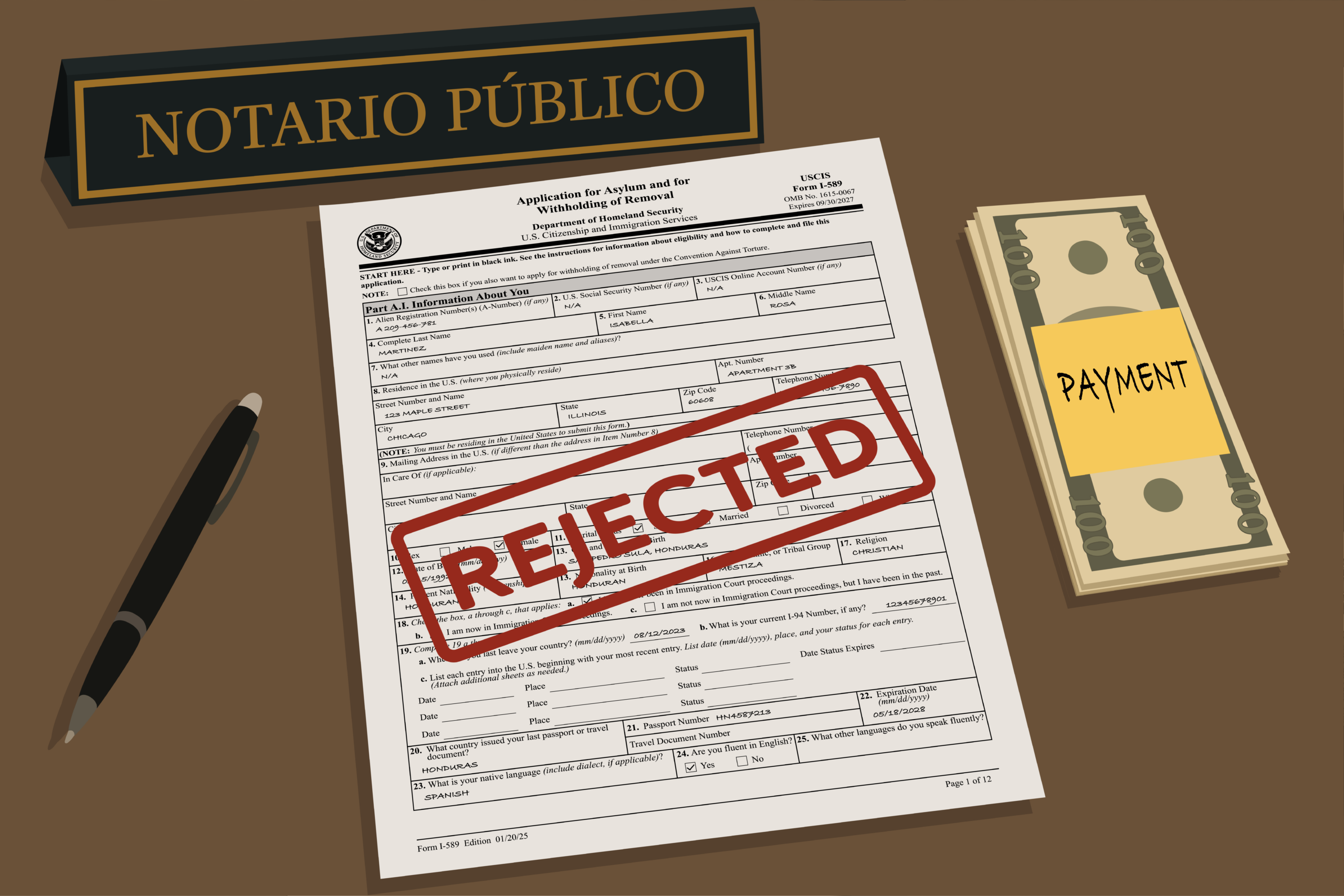
Notario fraud persists in Chicago as the Trump Administration toys with immigration courts
In Chicago, people looking for assistance with immigration paperwork have the chance of being taken advantage of by notario públicos.
If you throw a stone on Little Village’s West 26th Street, you’ll hit the office of someone offering immigration help. Some are attorneys, seated in pristine white and grey offices and ready to help with asylum applications – usually for a fee. Some are notario públicos — which directly translates to notary publics — stamping forms and providing travel guidance. If they’re asked to assist with immigration paperwork, they’ll typically decline and direct the person to a nearby attorney’s office.
Some notario públicos don’t say no.
For individuals seeking asylum, navigating the legal system is a task ridden with complexity. Many seek legal assistance and sometimes, because of cultural and language differences, they assume that a notary public in the United States is a licensed attorney because, in many Spanish-speaking countries, a notario público is a high-level lawyer. For a notary public, or anyone, to provide immigration assistance, they must be accredited by the Department of Justice. Some notary publics do receive the necessary accreditation to provide immigration assistance, but many don’t — providing illegitimate advice and leading people into a possible scam.
Some notarios advertise themselves as attorneys, implying to immigrants that they can guide a respondent through the immigration system and provide representation in court. But others just refer to themselves as notarios, relying on linguistic differences to bring them clients who assume they’re highly-trained lawyers.
In the American Bar Association’s description of notario fraud, they state that notarios might request large sums of money for the filing of immigration forms. They might intentionally file the forms incorrectly, file them late, or even disappear with a person’s money without providing assistance at all. According to Elizabeth Gibson, managing attorney for capacity building at the National Immigrant Justice Center, notarios might help someone get a work permit by filing an application with a generic claim that doesn’t represent the applicant’s real situation. The applicant might receive the permit, but years later, after the application is fully processed, be placed in immigration court because the asylum documents filed were baseless.
There’s also cancellation of removal, a very risky form of relief which can only be filed in court after a respondent has lived in the U.S. for 10 years without documents. Gibson called this form of relief the “application of last resort.” She said that some notarios will file a weak asylum application that will be denied, so that the immigrant is placed in removal proceedings and summoned to court — making it possible to apply for cancellation of removal.
“They’re intentionally getting that person put in immigration court so that they can then apply for cancellation of removal even though that’s really hard to get, and sometimes they’re not doing a good job of screening [the applicant] to make sure they qualify,” Gibson said. “Next thing they know, they’re in immigration court and being ordered deported, because this whole process has happened without them understanding what’s actually going on.”
One staff member at a law office on West 26th Street remembers a notario coming by, requesting the attending attorney submit forms for an asylum seeker on their behalf. This notario might have had the intention of helping someone with their asylum case, but because they aren’t accredited, what they’re doing is still fraud, the staff member said.
According to Chicago attorney John Heiderscheidt, it is a notario’s lack of legal training, as well as possible malicious intent, that makes their involvement in immigration cases so dangerous.
“Oftentimes mistakes are made that maybe wouldn’t seem so obvious to an untrained legal eye,” he said. “It has catastrophic consequences for an individual’s ability to stay here in the United States.”
The need for representation in the courtroom
It took Immigration Judge Samuel Cole a trip to Mexico to learn about notarios. By then, he was no longer a judge.
During his stay with a family in Oaxaca, the conversation turned to notarios, and they told him about the linguistic and cultural differences that stump so many navigating immigration courts.
“I didn’t know about this language issue until I left the bench,” he said. Though belated, he finally understood why many in court were putting their faith and money behind untrained and frequently problematic notarios.
Cole served as a judge in Chicago’s immigration court for almost 10 years. In 2025, he left the bench due to the Trump Administration’s crackdown on the independence of immigration judges. During his tenure, cases of misrepresentation and immigration scams came up amongst respondents, but Cole’s interactions with notario fraud were far more limited. In fact, he wasn’t sure that the majority of judges in Chicago’s court knew about the linguistic discrepancy he learned about in Oaxaca, that leads to notario fraud.
“They're intentionally getting that person put in immigration court so that they can then apply for cancellation of removal even though that's really hard to get, and sometimes they’re not doing a good job of screening [the applicant] to make sure they qualify. Next thing they know, they're in immigration court and being ordered deported, because this whole process has happened without them understanding what's actually going on.”
– Elizabeth Gibson, Managing attorney for capacity building at the National Immigrant Justice Center
Immigration judges, like Cole, tell respondents that they have the right to legal counsel, but not at the expense of the government. As noted in a 2024 Borderless piece, an attorney can boost the chances of a successful asylum application, but the respondent must pay for it themself. The Chicago immigration court provides a list of attorneys that might offer counsel for a free or reduced price, but there are not enough lawyers for every respondent in court. And not all respondents have the funds for a lawyer even at reduced prices.
Nubia Willman is the chief programs officer at Latinos Progresando, a Chicago nonprofit that provides immigrant communities with programs and legal assistance. As immigration policies tighten under the Trump Administration, she said that organizations like Latinos Progresando have noticed an uptick in notario fraud.
“We have seen that whenever there is an increase in immigration, whether it’s a good or bad immigration policy, there’s always been an increase of fraud because people tap into the needs of the community,” Willman said. “When folks are desperate and vulnerable, the sharks can smell the blood in the water, and they’ll come out and try to defraud people.”
Sheila McNulty, former chief immigration judge, recalls a similar phenomenon occurring when the 245(i) provision’s end date was announced for 2001. The provision allowed immigrants without documents the opportunity to receive permanent residency status.
McNulty remembers a line wrapping around several city blocks outside the Chicago immigration court building, as immigrants scrambled to establish their immigration status before the program expired.
“They were sending people away saying they didn’t have the right documents. It was kind of a mess,” she said. “These kinds of mass ‘sign up now’ or ‘sign up by a certain deadline’ programs tend to lend themselves to some fraud, because people are desperate. They’re getting misinformation.”
Being tricked into notario fraud is often an accident, but at times of increased urgency, people may turn to notarios for assistance, even if they know they aren’t accredited.
Willman acknowledges how difficult it is to access actual accredited representation, especially in times of immense turmoil in the immigration system, like the second Trump administration.
“I recognize, as an attorney myself, that there is a lack of access to legal systems to affordable attorneys,” she said. “I understand that folks are very desperate for support and for help.”
While turning to anyone for help in such a crisis might seem necessary, Willman advised that, like driving home drunk, the best way to prevent possible injury is to avoid the danger altogether.
“The potential to cause harm, that is the risk factor that we have to assess.”
The ever-shifting nature of notario fraud
When McNulty started working in immigration law, she saw notario fraud manifesting itself in communities through word of mouth.
“I think in times past, you probably literally had to walk into a mom and pop kind of place, or walk into a travel agency who would then set you up with somebody who would then probably fill out various applications for you, take your money and then you find out years later that it was part of a fraudulent scheme,” she said.
While physical instances of notario fraud are still present, Willman said that Latinos Progresandos has witnessed a shift in how fraudsters are accessing the population of people desperate for legal assistance.
“We are seeing folks who are using AI to create fake websites and things of that nature to just seem a little bit more polished, and that has been sort of the fraud that we’ve been seeing as of late,” Willman said.
Fraud – involving notarios and others – runs rampant online, especially in Facebook and WhatsApp groups.
In one complaint reported to the Illinois Attorney General, an individual recounted their experience with Nueva Visión Latinoamerica, a company out of Bloomington, Minnesota. The company charges clients thousands of dollars to seek 10-year tourist visas for loved ones, which cost $185, in addition to a $250 visa integrity fee.
Nueva Visión Latinoamerica and its executive director, Christian Palacios, have been accused of fraud by several former clients, including the individual who filed a complaint with the Illinois Attorney General. For years, that person communicated with the company over WhatsApp and transferred money. Palacios claimed she had completed a visa application and scheduled an appointment with the American embassy in Mexico for the client’s mother. The company never scheduled a meeting. In fact, the client’s mother was never even eligible for a visa. An attorney told Sahan Journal that the situation appeared to be notario fraud.
“Justice, that’s what I’m asking for, justice, because even recovering the money won’t compensate for the sadness of not being able to recover the lost time,” they wrote in Spanish in their complaint, obtained by Borderless. “[Palacios] never made the effort and always lied to me, even though I was responsible for paying on time… she continues to deceive people, claiming to process visas when she’s just scamming them.”
Community efforts to combat notario fraud
The attorney general has held some fraudsters accountable — there is a lawsuit underway against Nueva Visión Latinoamerica — but some attorneys like Willman believe that the government hasn’t been doing everything in its power to prevent fraud and hold notarios liable.
“From my perspective, where there is a gap is the government entities who should be responsible for this,” she said. “These are people who have the ability to have real teeth to try to put a stop to [notario fraud]. And I have not seen a coordinated effort to address it.”
The entities she refers to include states’ Attorneys General and cities’ consumer protection departments. Both typically take reports about and investigate fraud, though it can be difficult for government agencies to take action against notarios, especially in other states.
“What law are they violating?” asked Gibson of the National Immigrant Justice Center. “Are they committing fraud? Are they taking people’s money and then not delivering things? Are they misrepresenting themselves and what they’re legally able to do?”
Gibson noted that a complaint rarely helps an applicant receive relief in court, though it’s important to report fraud, including to stop disingenuous notarios from operating.
Organizations like Latinos Progresando aren’t waiting for the government to hold notarios accountable and warn at-risk communities.
“We do a lot of client education when we’re doing outreach, when we’re doing know your rights programs, we definitely talk about the concerns about fraud,” said Willman.
The staff of Latinos Progresando are all accredited Department of Justice representatives, so they can provide legal support to clients without being licensed attorneys. They also avoid having notary publics on staff at all, to avoid any confusion.
Latinos Progresando’s outreach has manifested itself beyond the programs they put on. Willman recalls one instance of near-fraud that was avoided by a lucky encounter.
“We had a situation where someone was going to the bank to wire some money to what they thought was an immigration attorney, and our client happened to be one of the bank tellers,” Willman said. “Red flags went up for her, and she told this person, ‘Hey, before you wire this money, why don’t you call my legal rep to see what they think?’”
It turned out that the person wasn’t eligible for the relief they were applying for; word-of-mouth saved them from an incorrect application, a significant amount of money and the heightened possibility of deportation.
“That was just a community looking out for each other,” Willman said.
Even in the courtroom, community has shown up to keep an eye on proceedings and support people applying for asylum. Court watchers for the Illinois Coalition for Immigrant and Refugee Rights are often present at hearings, documenting case outcomes, whether judges read people their rights, and other courtroom observations.
There are signs in the court’s lobby reading “HAVE YOU BEEN A VICTIM OF IMMIGRATION FRAUD?” The signs point people to the Executive Office for Immigration Review’s Fraud and Abuse Prevention Program. The signs describe some common scams, including notario fraud, but only in English.
At a hearing in May, Judge Peter Kim read respondents their rights and warned them about notario fraud.
“The worst thing you can do is go to a notary public or paralegal. They don’t have the right license,” he says. “They’ll just take your money and you’ll be, for lack of a better term, screwed.”

A digital journalist from Sycamore, Illinois.

A designer at Syracuse University.