


Closed-door justice
Policies and practices are increasingly restricting public access to immigration court
Just months after President Donald Trump began his second term, courtroom doors were locked to outside observers at Fort Snelling Immigration Court in Minnesota.
Since 2017, volunteers with The Advocates for Human Rights, a Minneapolis-based nonprofit, had sat in on the court’s immigration hearings as part of a court monitoring program to improve transparency and accountability in the immigration court system. But in October 2025, courtroom doors were locked, video conference access was cut off and observers were given shifting explanations about whether they could watch proceedings, according to a federal lawsuit filed by the group in March.
“These access restrictions at the Fort Snelling Immigration Court are arbitrary, capricious, an abuse of discretion, or otherwise not in accordance with law,” the complaint says.
Under federal law, immigration court hearings can be closed only in specific circumstances, including space limitations; the need to protect witnesses, parties or the public interest; and cases involving an abused child or an abused spouse who does not consent to an open hearing.
The Fort Snelling case reflects a broader national pattern: Immigration advocates, attorneys and major news organizations allege public access to immigration courts is being narrowed despite federal rules that generally make hearings open to the public. An investigation by the Howard Center for Investigative Journalism at Arizona State University — based on courtroom observations, court records and interviews — has found that public access is often determined not by law, but by the discretion of individual judges, court staff and security officials. These restrictions, which often go beyond what the law allows, now face legal challenges.
On Feb. 9, 2026, at the Florence Immigration Court in Arizona, security officers and court staff told Howard Center reporters that attendance at all hearings required judicial approval. The reporters were allowed to observe proceedings only after receiving that approval — which came after security assured a judge they posed no threat.
“You cannot attend any hearing without the approval of the judge. So we have to ask the judge if they can let in observers or members of the public,” said a security officer at Florence Immigration Court — a statement that another staffer confirmed was the standard practice at the court.
This appeared to depart from the language in the February 2026 fact sheet from the Executive Office of Immigration Review, or EOIR, which stated, “Visitors are not required to check in with court personnel before entering a courtroom to observe, although the presiding Immigration Judge may ask all visitors to identify themselves at the start of the hearing.” Howard Center reporters observed the same procedure during visits to the Eloy Detention Center Immigration Court and the Phoenix Immigration Court on Feb. 11 and April 30, 2026, respectively.
“Transparency in courts is a key hallmark of democracy because it is the only way to hold our officials accountable."
– Madeline Lohman, Advocacy and Outreach Director, The Advocates for Human Rights
At least two federal lawsuits, filed in New York and Washington, D.C., argue that these kinds of restrictions are not isolated courtroom management decisions but instead belong to a broader erosion of transparency in one of the nation’s busiest court systems.
In March 2026, a group of five New York City residents, including a lawyer, a journalist and a priest, filed a lawsuit in the Southern District of New York. It alleges that each had either been denied entry to the court or asked to leave on several occasions between June 2025 and March 2026.
According to the lawsuit, plaintiff Stephen Kelly, an attorney representing the group, has been denied courtroom access about 20 times. Another plaintiff, the Rev. Fabián Arias, a Manhattan Lutheran priest who for 20 years had regularly attended immigration hearings in New York City to support respondents, said he too has been denied access dozens of times and removed from courtrooms more than 20 times since June 2025. It is a similar story for the three other plaintiffs: a journalist, a psychologist and an educator.
“As a direct result of these actions, Father Arias has been prevented from carrying out his religious and pastoral duties at the precise moments when they are most essential,” the court document says. “Members of his ministry who rely on his knowledge, guidance, and spiritual presence are left alone inside an intimidating and confusing legal process. Immigrants who depend on his accompaniment are deprived of support not because they rejected it, but because he was forcibly excluded.”
The five New Yorkers are asking the court to declare that the restrictions violate their rights under the First Amendment and other relevant laws. They also want the court to grant a permanent injunction against enforcing policies that restrict public access to immigration courts beyond what the law allows.
The New York City lawsuit came four days after AHR filed a similar challenge against restrictions limiting public access to immigration court proceedings. Although the lawsuit concerns the Fort Snelling Immigration Court in Minnesota, it was filed in the U.S. District Court for the District of Columbia.
Kelly said he was not aware of the Washington, D.C., lawsuit.
“The courts have been very open about their misconduct. So I’m not surprised that more than one lawsuit has been filed on this, but I wish it was more. The timing is a total coincidence,” Kelly said.
“Transparency in courts is a key hallmark of democracy because it is the only way to hold our officials accountable,” said Madeline Lohman, advocacy and outreach director for AHR. “And in the absence of a threat to the respondent or a serious threat to public safety, the only people who are being protected when the courts are closed are judges and government attorneys. And they should be taking their action in full view of the public because they are, in the end, accountable to us for their behavior.”
In January 2026, AHR sent a letter to EOIR, a division of the U.S. Department of Justice, arguing for the right to witness immigration proceedings at Fort Snelling. In a written response, EOIR press secretary Kathryn Mattingly said, “Immigration judges are independent adjudicators and may determine that a hearing should be closed or held with limited attendance.”
The lack of a meaningful response from the federal government, Lohman said, is why AHR filed its lawsuit this March. The organization is seeking a declaration that the government’s restrictions violate federal law and the First Amendment. It is also calling for an injunction and an order requiring officials to justify any future closure on the record and give the public an opportunity to object before access is denied.
In a response filed in April 2026, the federal government argued the lawsuit should be dismissed because the plaintiff failed to demonstrate irreparable harm and the examples cited represent a tiny fraction of the number of immigration hearings held each year.
“In comparison to the more than 47,000 hearings occurring in the last year at Fort Snelling, Plaintiff presents a small number of asserted one-off errors by individual Immigration Judges and court staff, not any official policy or consistent practice,” the government filing says.
The response also stated that requiring judges to explain every closure on the record would burden already strained courts and interfere with their operations. The government further argued the plaintiffs cannot seek an order that binds all immigration courts when they have not shown “any relationship to any immigration court other than the one at Fort Snelling.”
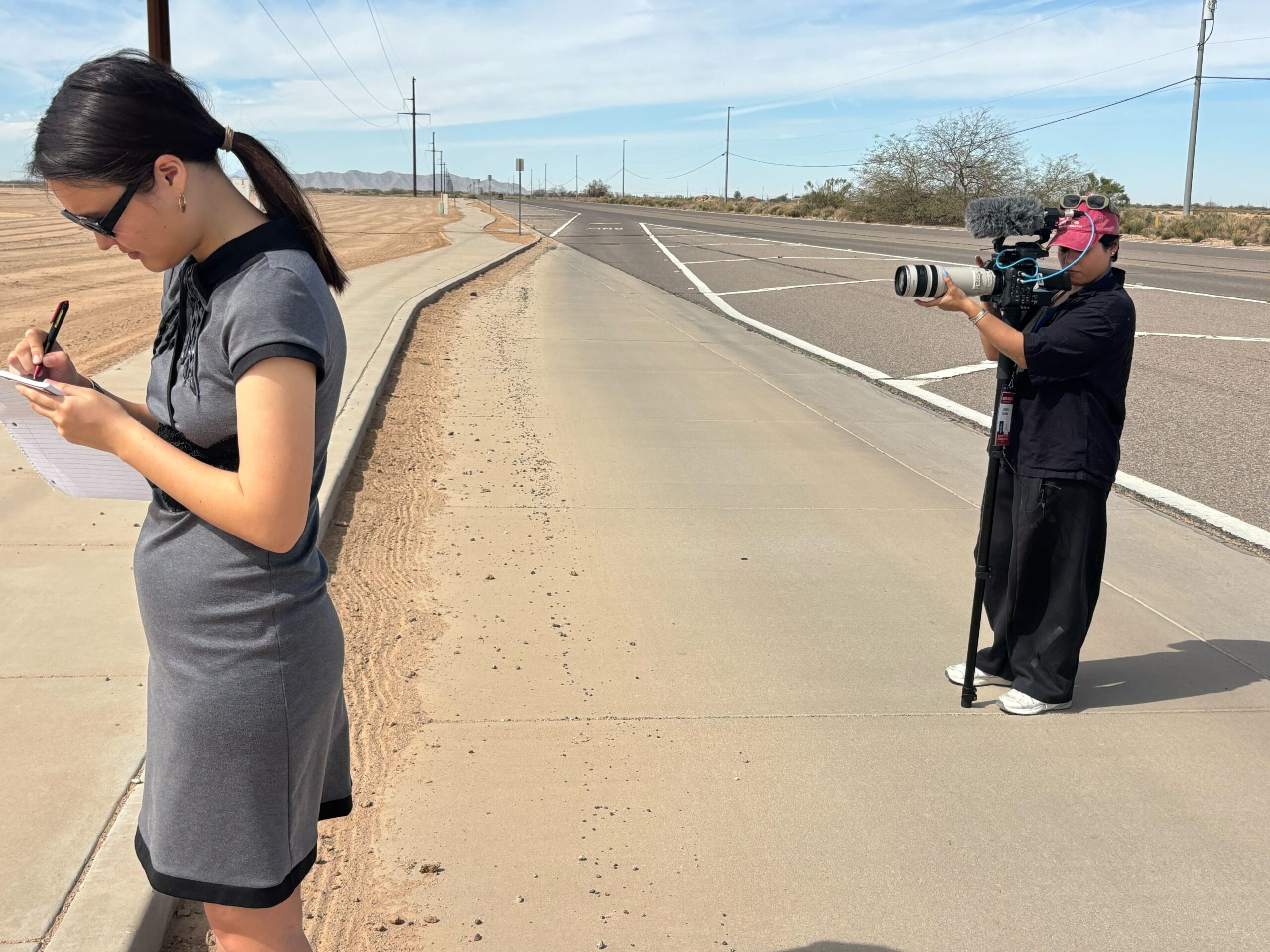
Photo by Lilly Roseburrough
Howard Center ASU reporters Mia Osmonbekov and Lavanya Paliwal report from outside Eloy Detention Center and immigration court in Eloy, Arizona on March 4, 2026.
Despite government directives to prioritize journalists over the public at court hearings, reporters have also faced restrictions. In support of AHR, 10 news organizations, including The New York Times, The Washington Post, ProPublica, The Guardian and Minnesota Public Radio, filed a friend-of-the-court brief April 29, 2026. In it, they argued that restricting access to immigration hearings threatens the press’s ability to serve as a public watchdog and monitor how the courts administer justice.
“In immigration courts throughout the country, press and other members of the public have faced similar barriers to access. Security guards at an immigration court in Sacramento ‘barred entry to the head of a legal organization, volunteers seeking to accompany immigrants to hearings, and reporters,’” the brief reads.
Reporters Without Borders, known as RSF, a nongovernmental organization promoting press freedom, filed its own friend-of-the-court brief April 13, 2026. In the brief, RSF argued that restricted access deprives the public of the opportunity to understand life-altering decisions made in these courts and whether the decisions are carried out fairly.
“For over a century, the American legal tradition has recognized that openness is essential to the legitimacy of judicial proceedings. Shutting out the press not only violates that tradition, it also erodes confidence in a system that must be transparent to be trusted. We call on the court to protect citizens’ right to information and grant the requested preliminary injunction,” said Clayton Weimers, RSF executive director for North America, in a press release.
In a statement released in late April 2026, the Reporters Committee for Freedom of the Press, a nonprofit that promotes press freedom, said, “The issues raised in AHR’s lawsuit are not limited to one immigration court in Minnesota, nor to one organization’s court observation project.” The Committee indicated that journalists across the country have contacted the organization to raise similar concerns.
In October 2025, Freedom of the Press Foundation, a nonprofit organization, sent a letter to Claudia Cubas, the assistant chief immigration judge at Hyattsville Immigration Court in Maryland, after journalists were told they could not attend hearings without permission from the Justice Department.
“By requiring journalists to identify themselves and obtain advance permission, the Hyattsville Immigration Court has also converted EOIR’s voluntary coordination policy into a mandatory licensing scheme—a prior restraint on newsgathering that violates the First Amendment,” the letter states.
Advocates are concerned that EOIR’s most recent February 2026 fact sheet expands restrictions on public access beyond what formal regulations allow. They dispute its provisions allowing access rules to vary by court location and management, limiting remote hearings to parties only and restricting administrative offices and judges’ chambers to authorized individuals.
Katie Fleming, director of public education and engagement at the Acacia Center for Justice, a nonprofit that advocates for immigrants at risk of detention or deportation, said that although the fact sheet has no legal backing, it is influencing courtroom practice. Given the document’s wide use and judges’ reliance upon it, she said it should be challenged.
“The regulations are the law. If I were to go into court and say, ‘I would like to observe,’ I would point to the regulations over the fact sheet,” said Fleming, who indicated that restricted public access is a widespread problem across the country. The fact sheet also is a subject of The Advocates for Human Rights’ lawsuit, which argues it is not backed by law.
Acacia runs a nationwide court monitoring project called Witness for Justice. Fleming said that its participants have observed greater limitations on access to immigration courts and that their reports are being compiled into data. She has also witnessed such restrictions firsthand at the Sacramento Immigration Court in California, she said.
Hiedy Marcus, an immigration attorney in Arizona, feels differently about these new constraints.
“The judges have to run a courtroom,” Marcus said. “As an attorney, it is such a distraction to have, let’s say, activists go in there and do protests when that doesn’t protect the clients from their case.”
Marcus stressed that when there is no potential threat, the courts should be willing to provide public access to promote transparency. Still, there must be a proper balance that allows judges to run courts without disruptions, she said, as this is also in the interest of justice.
The Georgia Asylum and Immigration Network, an Atlanta-based nonprofit, also said its court observers have been denied access to virtual immigration court hearings. In a March 25, 2026, statement, the organization said its volunteers have observed more than 900 online bond hearings for people detained at the Stewart and Folkston detention centers since 2024, before they were blocked in March 2026.
“The public cannot meaningfully access a hearing taking place in Lumpkin, Georgia—over two hours from Atlanta—if we are blocked from attending virtual hearings.”
In addition, the American Civil Liberties Union Foundation of Northern California has raised concerns about restrictions at the Concord Immigration Court. A June 2025 letter to Assistant Chief Immigration Judge Julie Nelson argued that “Even when the government does purport to have a compelling interest in closure, that interest must be weighed against ‘conflicting constitutional claims’ with a ‘presumption in favor of openness.’”
EOIR did not respond to an emailed request for comment from the Howard Center.
The lawsuits filed in New York and Washington, D.C., now place the future of immigration court transparency before federal judges. In the New York case, the government has filed a motion opposing the application, but a hearing has not been set, according to court records. In Washington, D.C., the government is expected to file a motion opposing plaintiffs’ applications by July 17, 2026.
At stake in these cases is the extent to which public access to immigration courts can be narrowed by local courthouse practice, judicial discretion or agency guidance. The answer could determine how effectively advocates, watchdogs, journalists and the public are able to see inside a court system that carries life-changing consequences for the millions of immigrants and asylum seekers across the country.
Note: This story was produced by the Howard Center for Investigative Journalism, based at Arizona State University’s Walter Cronkite School of Journalism and Mass Communication. The Howard Center is an initiative of the Scripps Howard Fund in honor of the late news industry executive and pioneer Roy W. Howard.
Contact us at howardcenter@asu.edu and follow us on X and Instagram @HowardCenterASU.
An investigative journalist from Malawi spending 2025-26 as a Humphrey Fellow at the Walter Cronkite School at ASU.